
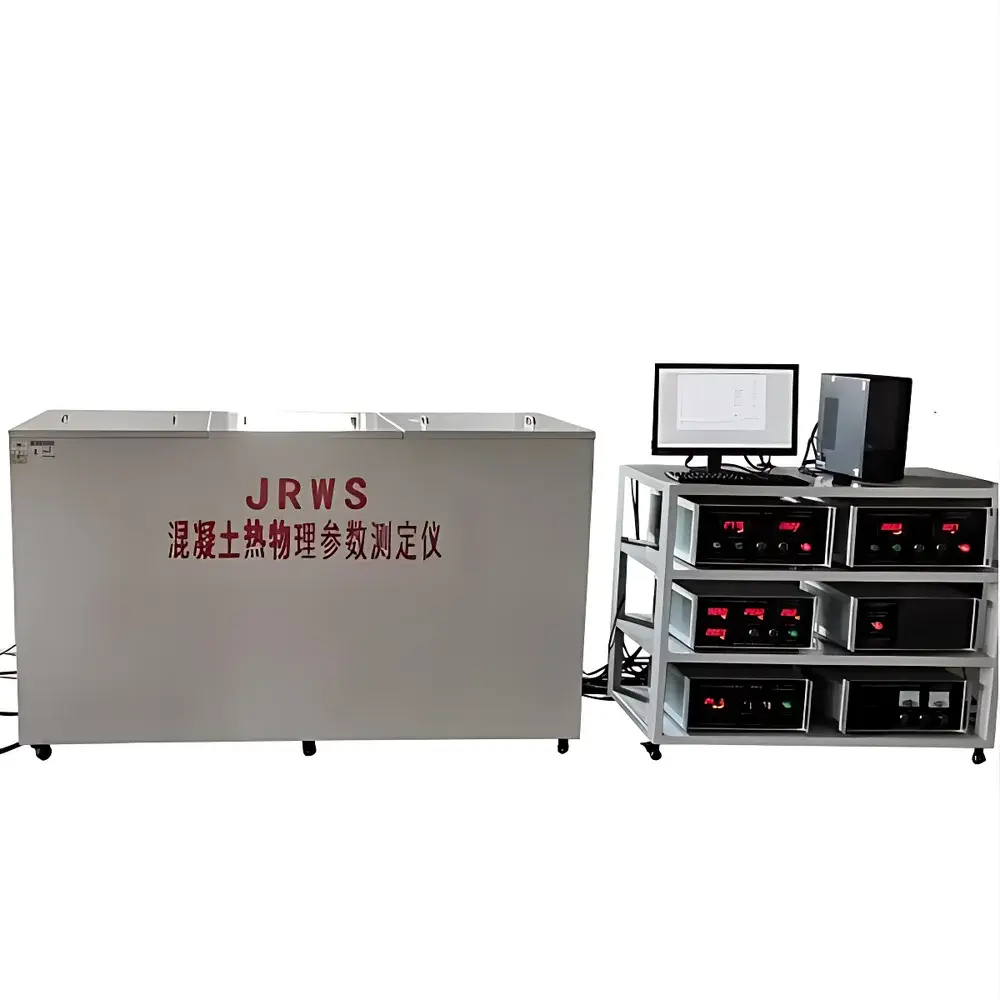
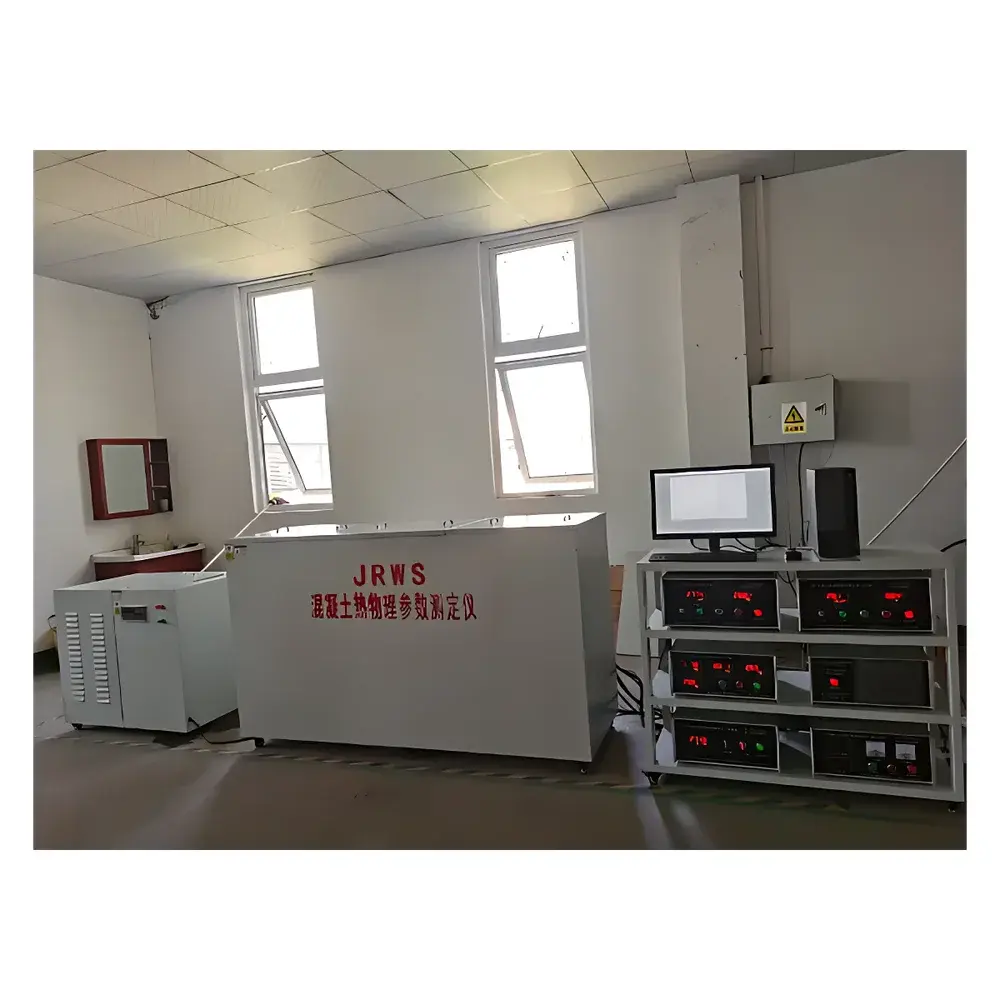
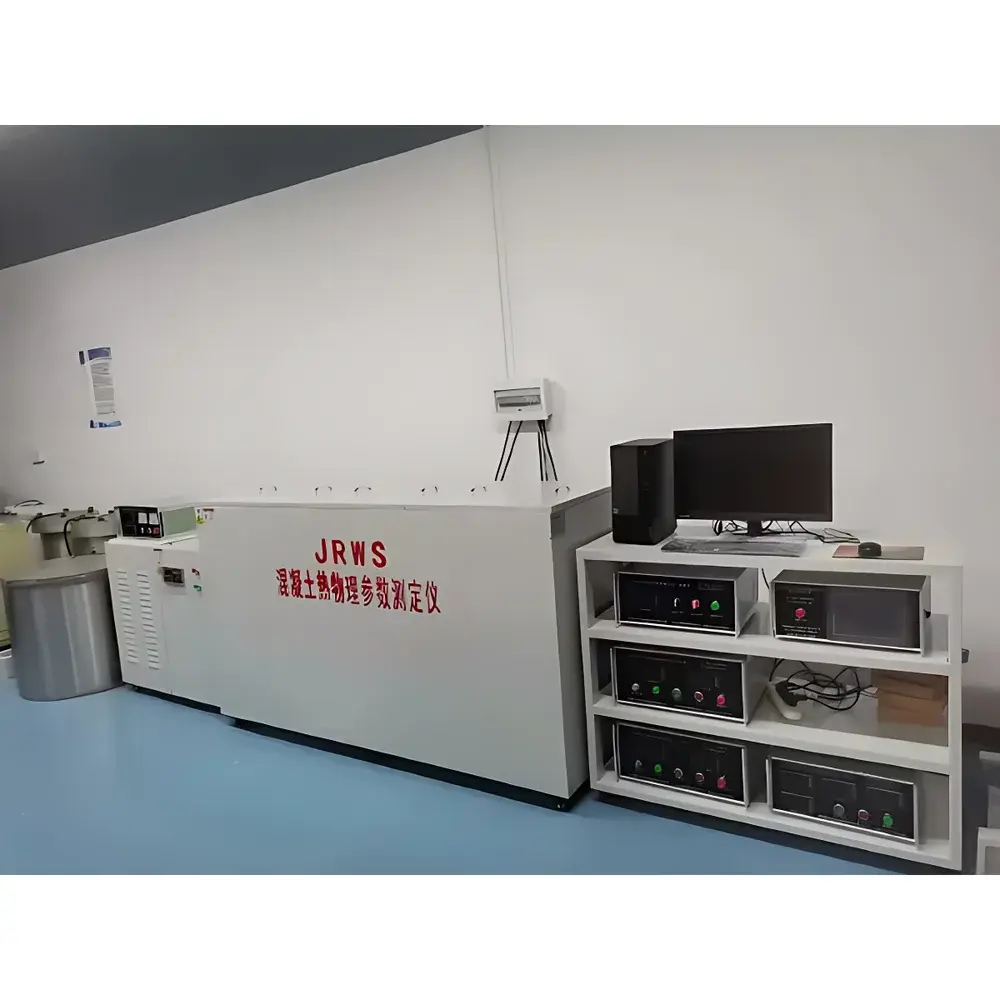
ZHENHUAFENXI JRWS Concrete Thermophysical Properties Analyzer
| Brand | ZHENHUAFENXI |
|---|---|
| Origin | Hunan, China |
| Model | JRWS |
| Temperature Range | 0–100 °C |
| Temp. Measurement Accuracy | ≤ ±0.1 °C |
| Resolution | 0.01 °C |
| Tracking Precision | 0.05 °C |
| Deformation Measurement | Resistive Strain Gauge (250 mm gauge length, 0.1 με accuracy) |
| Specimen Container Volume | 50 L |
| Thermal Conductivity Range | 0.01–10 W/(m·K) |
| Specific Heat Capacity Range | 0.5–5.0 kJ/(kg·K) |
| Specimen Geometry for λ & cp | Ø200 mm × 400 mm cylinder with Ø40 mm central bore |
| Water Bath Temp. Range | 10–80 °C |
| Water Bath Ramp Rate | 0.5–1.0 °C/min |
| Power Consumption | < 8 kW |
| Compliance | GB/T 50081–2019, JG/T 329–2011, DL/T 5150–2017, SL 352–2006 |
Overview
The ZHENHUAFENXI JRWS Concrete Thermophysical Properties Analyzer is a fully integrated, multi-module laboratory instrument engineered for the precise and standardized determination of key thermal and dimensional response parameters in hardened and fresh concrete. Based on established principles of calorimetry, transient plane source (TPS) methodology, linear thermal expansion measurement via high-resolution strain gauging, and controlled-rate water-bath thermal stimulation, the system delivers traceable, reproducible data essential for thermal stress modeling, mass concrete hydration analysis, and long-term structural integrity assessment. Its design adheres to the physical foundations of Fourier’s law of heat conduction, the definition of specific heat capacity (cp = dQ/dT per unit mass), and the relationship between thermal diffusivity (α), conductivity (λ), and volumetric heat capacity (ρcp). The analyzer operates under strictly regulated thermal boundary conditions—particularly during adiabatic temperature rise testing—ensuring minimal heat loss and enabling accurate quantification of exothermic hydration kinetics over extended durations (up to 90 days).
Key Features
- Modular architecture supporting six independent yet interoperable test protocols: (1) Adiabatic temperature rise, (2) Specific heat capacity (cp), (3) Thermal conductivity (λ), (4) Thermal diffusivity (α), (5) Coefficient of linear thermal expansion (CTE), and (6) Autogenous volumetric change rate.
- High-stability water bath with programmable ramp rates (0.5–1.0 °C/min) and uniform temperature field control (±0.05 °C spatial deviation) across Ø200 mm × 400 mm cylindrical specimens containing a central Ø40 mm calibration bore.
- Dual-sensor thermal monitoring: Pt100 Class A RTDs (0.01 °C resolution, ≤±0.1 °C absolute error) combined with micro-strain measurement using bonded foil strain gauges (250 mm gauge length, 0.1 με sensitivity) for simultaneous thermal and mechanical response capture.
- 50 L insulated specimen chamber with active thermal shielding, enabling stable operation across 0–100 °C ambient and internal ranges while maintaining adiabatic fidelity via real-time feedback-controlled jacket temperature compensation.
- Industrial-grade three-phase (A/B/C/N) power interface rated for continuous duty at < 8 kW, compatible with standard laboratory electrical infrastructure in civil engineering research facilities.
Sample Compatibility & Compliance
The JRWS analyzer accommodates standard cylindrical concrete specimens per GB/T 50081–2019 and JG/T 329–2011—including Ø150 mm × 300 mm, Ø200 mm × 400 mm, and custom-molded prisms up to 50 L volume. It supports both normal-weight and low-permeability high-performance concretes, fiber-reinforced composites, and supplementary cementitious material (SCM)-blended mixes. All test procedures are aligned with internationally referenced methodologies: thermal conductivity and diffusivity measurements conform to ISO 22007-2 (transient plane source), specific heat evaluation follows ASTM E1269 (modulated DSC correlation), and linear expansion complies with ASTM E831 and ISO 11359-2. Full documentation traceability—including raw sensor logs, calibration certificates, and environmental chamber audit trails—supports GLP-compliant reporting and FDA 21 CFR Part 11–ready electronic records when paired with validated software configurations.
Software & Data Management
The embedded control and acquisition software provides a native Windows-based interface with dual operational modes: standalone module execution or synchronized multi-parameter acquisition. Real-time visualization includes overlay plots of temperature vs. time, strain vs. temperature, and derived λ/α/cp curves with configurable smoothing and derivative computation. All datasets are timestamped, auto-saved in HDF5 format (with metadata tagging per test type, operator ID, and specimen ID), and exportable to CSV, Excel, or XML for integration into finite element thermal modeling platforms (e.g., COMSOL Multiphysics, ANSYS Mechanical). Audit trails record user actions, parameter modifications, and calibration events; digital signatures and role-based access control align with ISO/IEC 17025 requirements for accredited testing laboratories.
Applications
- Prediction of thermal cracking risk in massive concrete structures (dams, nuclear containment, bridge piers) via adiabatic temperature rise profiling and hydration enthalpy modeling.
- Validation of thermal boundary conditions in computational fluid dynamics (CFD) and coupled thermo-mechanical simulations.
- Quality assurance of low-heat cements and SCM blends by quantifying reductions in peak hydration temperature and cumulative heat release.
- Development of thermal insulation specifications for precast elements through direct λ and α measurement under service-relevant moisture states.
- Long-term durability assessment via correlation of autogenous shrinkage rates with early-age CTE and pore solution chemistry evolution.
FAQ
What standards does the JRWS analyzer directly support?
It implements test protocols defined in GB/T 50081–2019, JG/T 329–2011, DL/T 5150–2017, and SL 352–2006, with methodological alignment to ASTM E1269, ISO 22007-2, and ASTM E831.
Can the system operate unattended for multi-day adiabatic tests?
Yes—the thermal jacket and feedback loop enable stable adiabatic conditions for up to 90 days; all sensors log continuously with battery-backed memory and network failover.
Is specimen preparation guidance included?
Comprehensive SOPs cover mold selection, casting procedure, moist curing protocol, surface conditioning, and sensor embedding techniques for optimal interfacial contact and signal fidelity.
Does the software support automated report generation compliant with ISO/IEC 17025?
Yes—templates include uncertainty budgets per parameter, equipment calibration status, environmental condition logs, and digital signature fields for authorized reviewer approval.
What maintenance is required for long-term accuracy?
Annual verification of RTD calibration against NIST-traceable references and strain gauge shunt calibration are recommended; no consumables or proprietary reagents are used.



