
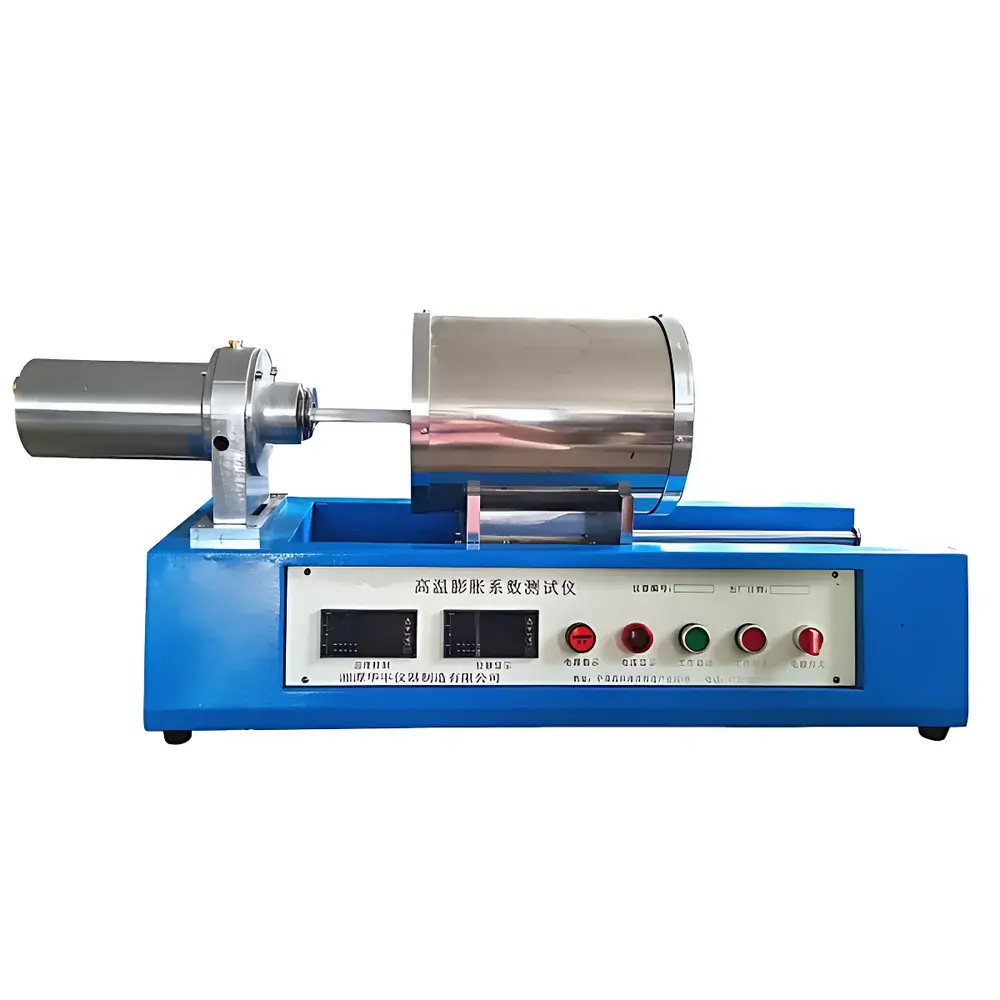
ZHENHUAFENXI XPY Linear Thermal Dilatometer for Ceramic Tiles
| Brand | ZHENHUAFENXI |
|---|---|
| Model | XPY |
| Temperature Range | RT to 1000 °C |
| Heating Rate | 0.1–20 °C/min |
| Temperature Accuracy | ±1 °C (at 1000 °C) |
| Sample Dimensions | Ø6–8 mm × up to 50 mm L |
| Measurement Range | ±5 mm |
| Resolution | 1 µm |
| Sample Holder Material | Fused Quartz |
| Compliance Standards | GB/T 4100–2015, GB/T 3810.9–2016 |
| Software Platform | Windows 10/7/XP |
Overview
The ZHENHUAFENXI XPY Linear Thermal Dilatometer is a precision instrument engineered for the quantitative determination of linear thermal expansion behavior in rigid solid materials—specifically optimized for ceramic tiles, natural stone, refractory ceramics, and other high-temperature structural ceramics. It operates on the principle of contact-based displacement measurement under controlled thermal ramping: a fused quartz pushrod transmits dimensional changes from a vertically mounted cylindrical sample to a high-resolution linear variable differential transformer (LVDT) sensor. Simultaneous temperature profiling is achieved via a calibrated Pt100 or K-type thermocouple embedded in the furnace zone, enabling synchronized acquisition of length change (ΔL) versus temperature (T). The resulting data yield the coefficient of linear expansion (αL) over defined temperature intervals, supporting both ASTM E228–22 and ISO 11359–1 compliance workflows when configured with traceable calibration standards.
Key Features
- High-stability vertical furnace architecture with dual-zone heating elements, enabling uniform thermal distribution across the 1000 °C operating range and minimizing axial temperature gradients during slow ramping (≤5 °C/min).
- Integrated PID-controlled temperature regulation system with user-configurable ramp/hold profiles; real-time parameter tuning and locking via front-panel intelligent controller or remote PC interface.
- Sub-micron displacement resolution: 1 µm per digital step, supported by LVDT linearity ≤±0.1% full scale and thermal drift compensation algorithms embedded in firmware.
- Fused quartz sample holder and pushrod assembly ensure minimal parasitic expansion contribution (<0.1 µm/°C above 200 °C), critical for accurate baseline subtraction in low-expansion ceramics.
- Modular mechanical design accommodating cylindrical specimens up to 50 mm in length and 6–8 mm in diameter—compatible with standard GB/T 3810.9–2016 test coupons and custom refractory geometry.
- Full-system calibration traceability: includes certified quartz reference standard rod (αL = 0.55 × 10⁻⁶ K−1 at 25–500 °C) and NIST-traceable temperature verification protocol.
Sample Compatibility & Compliance
The XPY accommodates only solid, non-volatile, dimensionally stable samples—including sintered ceramic tiles, porcelain stoneware, alumina and silicon carbide refractories, granite, basalt, and glass-ceramic composites. Samples must be free of surface contamination, cracks, or internal porosity exceeding 5% vol. to ensure mechanical coupling integrity with the quartz pushrod. The instrument satisfies mandatory testing requirements specified in GB/T 4100–2015 (ceramic tile classification) and GB/T 3810.9–2016 (determination of linear thermal expansion), with built-in reporting templates aligned to Chinese national standard formatting. Optional configuration supports ISO 11359–1 Annex A procedures for comparative expansion analysis and ASTM C372–19 for refractory materials, subject to user-defined calibration validation per GLP guidelines.
Software & Data Management
The XPY is operated via dedicated Windows-native software (v3.2+, compatible with Windows 10/7/XP), providing real-time graphical monitoring of ΔL vs. T, derivative dL/dT plots, and automatic αL calculation across user-selectable intervals (e.g., 50–300 °C, 300–800 °C). All raw sensor outputs—including LVDT voltage, thermocouple mV, and PID setpoint logs—are timestamped and stored in binary + CSV dual format. Audit trail functionality records operator ID, method version, calibration date, and parameter modification history—supporting 21 CFR Part 11 readiness when deployed in regulated QA/QC environments. Data export includes PDF reports with embedded metadata, digital signatures, and optional watermarking for laboratory accreditation submissions.
Applications
- Quality control of ceramic tile batches for dimensional stability during firing and service exposure.
- Development of low-expansion glaze-body systems to mitigate crazing and spalling in architectural ceramics.
- Thermal mismatch analysis between substrate and coating layers in multilayer refractory linings.
- Evaluation of phase-transition temperatures (e.g., quartz → cristobalite inversion at ~573 °C) via inflection point detection in expansion curves.
- Validation of thermal aging effects on engineered stone composites after cyclic heating-cooling protocols.
- Academic research into anisotropic expansion behavior in textured polycrystalline ceramics using oriented sample mounting.
FAQ
What is the maximum recommended heating rate for routine ceramic tile testing per GB/T 3810.9–2016?
Standard practice specifies 5 °C/min or lower for reproducible αL determination; higher rates (up to 20 °C/min) are permissible for screening but require explicit documentation in test reports.
Can the XPY measure samples with irregular cross-sections?
No—only cylindrical specimens with parallel, flat end faces are supported to ensure consistent mechanical contact and minimize bending moments during expansion.
Is furnace atmosphere control available as an option?
The base configuration operates in ambient air; inert gas purging (N2, Ar) can be integrated via optional quartz tube extension and mass flow controller (MFC) module.
How often must the LVDT sensor be recalibrated?
Annual verification against the supplied quartz reference rod is recommended; full recalibration by authorized service center every 24 months or after 500 operational cycles.
Does the software support automated pass/fail evaluation against GB/T 4100–2015 limits?
Yes—user-defined αL thresholds (e.g., ≤6.5 × 10⁻⁶ K−1 for Class BIa tiles) trigger color-coded status flags and summary statistics in exported reports.



