
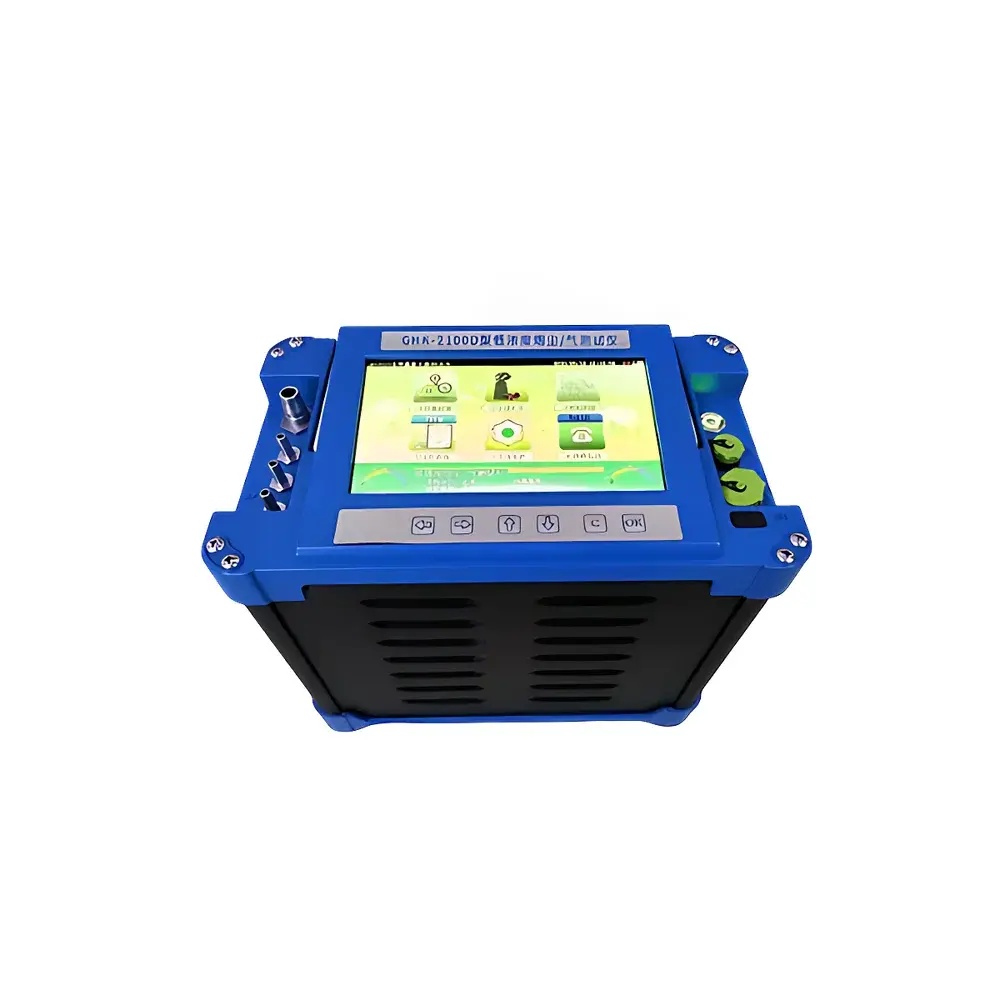
HUANKONG GHK-2100D Portable Low-Concentration Particulate and Flue Gas Analyzer
| Brand | HUANKONG |
|---|---|
| Model | GHK-2100D |
| Type | Portable Flue Gas & Particulate Analyzer |
| Origin | Shandong, China |
| Manufacturer | HUANKONG (Domestic Producer) |
| Compliance | GB/T 16157–1996, HJ/T 48–1999, HJ 57–2017, HJ 693–2014, HJ 836–2017, JJG 680–2007, JJG 968–2002 |
| Sampling Principle | Pitot Tube Parallel Isokinetic Sampling + Gravimetric Filtration (for PM) + Potentiostatic Electrolysis (for SO₂/NOₓ) |
| Display | High-brightness wide-temperature color touchscreen with dual touch/key input |
| Flow Range | 0–110 L/min (max), isokinetic tracking up to 40 L/min |
| Power Input | AC 80–260 V (with overvoltage/overcurrent protection) |
| Housing Material | Titanium alloy (high-temp resistant, corrosion-resistant, low adsorption, lightweight) |
| Data Storage | ≥100,000 records |
| Connectivity | Wired & wireless (sampling tube), Bluetooth printer support |
| Certifications | Compliant with Chinese national metrological verification regulations and environmental monitoring technical specifications |
Overview
The HUANKONG GHK-2100D Portable Low-Concentration Particulate and Flue Gas Analyzer is an integrated field-deployable instrument engineered for regulatory-grade emission monitoring at stationary sources. It combines isokinetic particulate sampling with real-time flue gas component analysis in a single ruggedized platform. The system operates on the principle of Pitot tube-based parallel isokinetic sampling—ensuring representative capture of particulate matter (PM) across varying stack velocities—while simultaneously performing quantitative gas-phase measurements via potentiostatic electrolysis (PE) for SO₂ and NOₓ. For low-concentration particulate mass determination, it implements gravimetric analysis per HJ 836–2017, using certified quartz or PTFE membrane filters. Optional analytical modules—including UV differential optical absorption spectroscopy (DOAS) and non-dispersive infrared (NDIR)—extend its gas speciation capability beyond standard PE sensors. Designed for compliance with China’s national environmental monitoring standards (e.g., GB/T 16157, HJ 57, HJ 693), the GHK-2100D supports full-stack characterization including temperature, velocity, humidity (via capacitive-resistive method), and dew point—all measured in situ by the intelligent multi-function probe.
Key Features
- Industrial-grade embedded control architecture with ESD-hardened circuitry and real-time self-diagnostic routines—including automatic leak detection, power-failure memory retention, and hardware fault alerts.
- Dual-mode human-machine interface: high-luminance wide-temperature TFT touchscreen complemented by tactile keypad to prevent misoperation in gloved or high-humidity conditions.
- Titanium-alloy multi-function sampling probe featuring integrated display, independent measurement of flue gas temperature (0–500 °C), velocity (1–30 m/s), and relative humidity (5–95% RH), with both wired RS485 and optional wireless data transmission.
- High-flow particulate sampling pump capable of 110 L/min maximum flow and precise 40 L/min isokinetic tracking; equipped with electronic mass flow controller, real-time temperature/pressure compensation, and active flow buffering for stability.
- Four-in-one modular cabling (smoke temperature line, communication bus, probe power, gas conduit) with quick-connect fittings—reducing setup time and minimizing field connection errors.
- Onboard cross-interference correction algorithms for SO₂/NOₓ sensors, compensating for common matrix effects from CO, H₂O, and NO₂ in complex flue streams.
- Integrated condensate management: transparent water trap with auto-drain pump, enabling continuous particulate and gas sampling without manual intervention.
- Anti-backflow valve and programmable post-sampling purge sequence to prevent re-entrainment of collected particulates into the duct during shutdown.
- Large-capacity internal storage (≥100,000 datasets) with USB export functionality and optional Bluetooth thermal printer for immediate field reporting.
Sample Compatibility & Compliance
The GHK-2100D accommodates multiple sampling configurations per regulatory requirements: standard glass-fiber filter cartridges (for total suspended particulate per GB/T 16157), low-concentration PTFE membrane filters (per HJ 836–2017), and solution-absorption impingers for soluble gases. Its β-ray direct-reading probe option enables real-time PM concentration estimation without lab gravimetry—ideal for preliminary screening or continuous compliance verification. All operational modes align with China’s statutory metrological verification protocols (JJG 680–2007, JJG 968–2002) and environmental monitoring technical criteria (HJ/T 48–1999). While not pre-certified to EU MCERTS or US EPA PS-11, its measurement principles and uncertainty controls are traceable to national primary standards; users may perform site-specific validation per ISO/IEC 17025 or ASTM D6784 where required.
Software & Data Management
The analyzer runs proprietary firmware with audit-trail-enabled data logging compliant with GLP-aligned recordkeeping practices. Each dataset includes timestamped metadata: probe ID, ambient pressure, stack temperature, isokinetic ratio deviation, filter ID, operator code, and calibration status. Exported CSV files contain raw sensor outputs, compensated concentrations, and QC flags (e.g., “flow out-of-spec”, “humidity saturation”). The built-in inventory management module supports equipment checkout/check-in tracking, calibration due-date alerts, and firmware version history—facilitating ISO 14001 or CNAS-accredited lab workflows. No cloud dependency: all processing occurs locally; data integrity is preserved via cyclic redundancy checksums and write-protected storage partitions.
Applications
- Regulatory stack testing for coal-fired boilers, waste incinerators, cement kilns, and chemical process heaters.
- Low-PM emission verification in ultra-low-emission retrofit projects (e.g., wet electrostatic precipitators, catalytic filters).
- Performance evaluation of flue gas desulfurization (FGD) and selective catalytic reduction (SCR) systems.
- Field QA/QC for continuous emission monitoring systems (CEMS) audits and relative accuracy test audits (RATA).
- Research-grade combustion diagnostics requiring synchronized particulate mass and gaseous pollutant profiles.
FAQ
Does the GHK-2100D meet international standards such as ISO 12141 or EN 13284?
It is designed and verified against Chinese national standards (HJ, GB/T, JJG series). While its isokinetic sampling methodology and gravimetric PM determination are technically aligned with ISO 12141–1 and EN 13284–1 principles, formal certification under those frameworks requires third-party testing per local accreditation bodies.
Can the instrument operate continuously for extended field campaigns?
Yes—its titanium housing, wide-input AC power supply (80–260 V), and thermal-stable electronics enable 8–12 hour unattended operation per charge cycle when paired with external battery packs; internal rechargeable backup maintains clock and memory during main power loss.
Is remote data telemetry supported?
Standard configuration includes Bluetooth and USB; optional 4G/LTE module integration is available for secure MQTT-based data forwarding to centralized EMS platforms.
What maintenance intervals are recommended for field use?
Sensor zero/span checks every 24 hours; filter replacement before each sampling run; annual calibration of flow meter, temperature sensors, and electrolytic cells per JJG 680–2007 and JJG 968–2002 procedures.
How is humidity interference mitigated during SO₂ and NOₓ measurement?
The instrument applies real-time compensation using co-located capacitive-resistive humidity readings and embedded cross-sensitivity coefficients derived from manufacturer characterization matrices—validated across 10–90% RH ranges.
Related Products







