
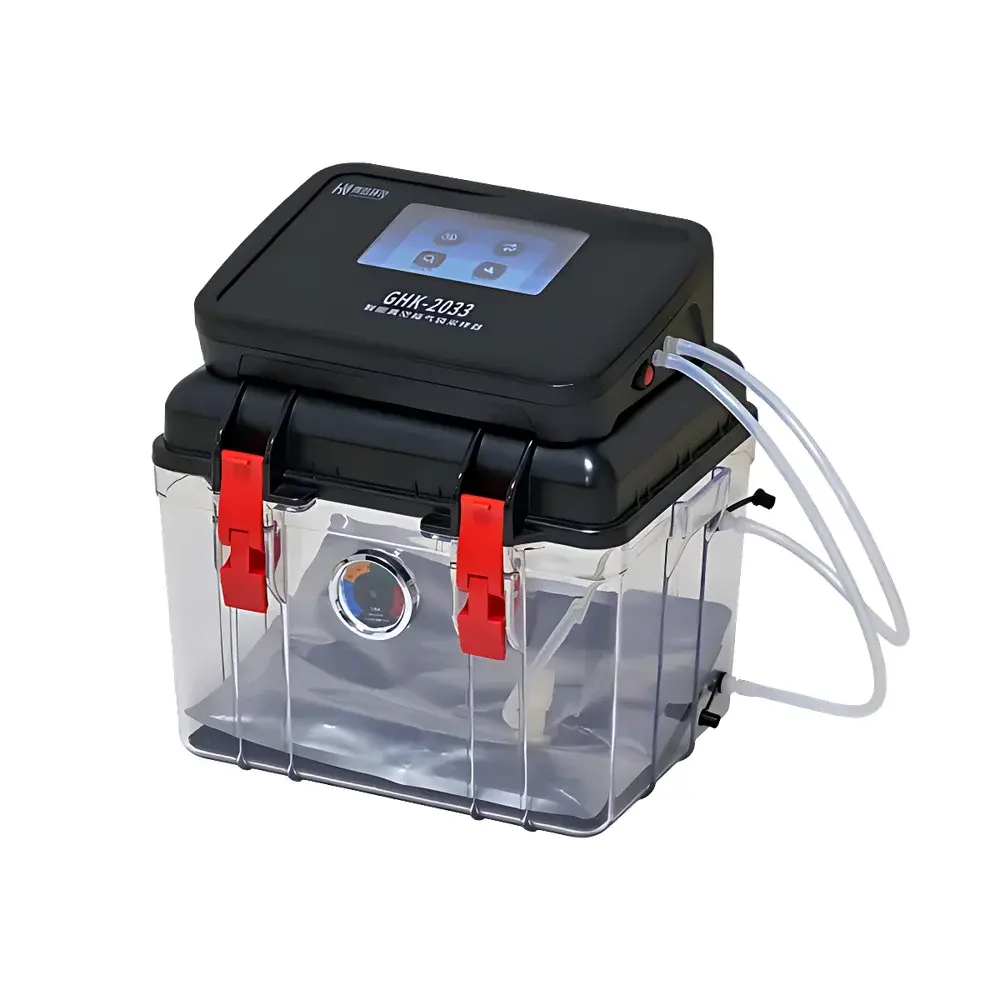
HUANKONG GHK-2033 Intelligent Vacuum Chamber Gas Sampler
| Brand | HUANKONG |
|---|---|
| Origin | Shandong, China |
| Manufacturer Type | Direct Manufacturer |
| Product Category | Domestic |
| Model | GHK-2033 |
| Instrument Type | 24-Hour Isothermal & Isokinetic Gas Sampler |
| Configuration | Single-Channel Gas Sampler |
| Flow Range | 10–100 mL/min |
| Maximum Vacuum Pressure | 50–110 kPa |
Overview
The HUANKONG GHK-2033 Intelligent Vacuum Chamber Gas Sampler is a field-deployable, battery-powered passive sampling system engineered for high-fidelity collection of ambient and stack-sourced gaseous analytes—particularly volatile organic compounds (VOCs)—using evacuated gas-tight sampling bags. It operates on the principle of controlled negative-pressure aspiration: a sealed vacuum chamber houses the sampling bag; upon valve actuation, atmospheric or ducted gas is drawn into the bag solely by differential pressure, eliminating active pump contact with the sample stream. This zero-contact sampling architecture ensures no adsorption, catalytic interference, or cross-contamination from internal wetted surfaces—a critical requirement for trace-level VOC analysis per EPA Method TO-15, ASTM D6196, and ISO 16017-1. Designed for compliance with Chinese environmental monitoring standards—including HJ/T 55–2000 (Monitoring Guidelines for Unorganized Emission Sources), HJ 732–2014 (Bag Sampling for VOCs from Fixed Sources), and HJ 194–2017 (Manual Ambient Air Monitoring Procedures)—the GHK-2033 delivers metrologically sound sample integrity under variable field conditions.
Key Features
- Vacuum chamber-based passive sampling: eliminates pump-induced artifacts and guarantees true representative capture of reactive and condensable VOCs.
- Optically transparent chamber walls enable real-time visual verification of bag inflation dynamics and seal integrity during acquisition.
- Upstream-mounted precision flowmeter directly measures volumetric flow *entering* the bag—providing traceable, NIST-traceable volume integration without post-hoc correction.
- Intelligent isokinetic flow control: automatically adjusts throttling valve position to maintain user-defined or algorithmically derived constant flow across pressure and temperature fluctuations.
- Adaptive flow calculation: inputs bag volume (1–10 L) and target sampling duration (e.g., 60 min); computes and executes optimal flow rate—reducing operator error and improving method reproducibility.
- Multi-mode scheduling: supports immediate start, programmable time-triggered sampling, and fixed-volume termination—enabling unattended operation over extended periods.
- Automated post-sampling isolation: seals both inlet and outlet pathways immediately after volume completion, preventing atmospheric ingress or analyte loss during transport.
- Controlled vacuum bleed: depressurizes chamber interior to ambient prior to lid opening—ensuring safe, leak-free bag removal without mechanical stress on bag welds.
- Integrated rechargeable Li-ion battery pack: supports ≥8 hours of continuous operation at 50 mL/min, eliminating dependency on AC mains in remote or mobile monitoring scenarios.
- Programmable bag purge cycle: configurable pre-sampling flush sequences (1–5 cycles) using certified zero air or nitrogen to remove residual contaminants from bag interior.
Sample Compatibility & Compliance
The GHK-2033 is validated for use with standard 1–10 L Tedlar® (polyvinyl fluoride), FlexFoil®, and aluminized Mylar® gas sampling bags meeting ASTM D5466 specifications. Its passive architecture avoids thermal degradation or surface reactivity associated with diaphragm or piston pumps—making it suitable for sulfur-containing compounds (e.g., H2S, mercaptans), oxygenates (e.g., formaldehyde, acetaldehyde), and halogenated VOCs (e.g., chloroform, perchloroethylene). The device conforms to data integrity requirements outlined in GLP and ISO/IEC 17025–accredited laboratories: all sampling events are timestamped, flow-corrected, and stored with audit trail metadata (operator ID, location tag, ambient T/P, bag serial number). Firmware supports optional 21 CFR Part 11–compliant electronic signatures when paired with validated laboratory information management systems (LIMS).
Software & Data Management
The 4.3-inch capacitive color touchscreen interface provides intuitive navigation through sampling setup, real-time parameter visualization (instantaneous flow, accumulated volume, elapsed time, battery status), and historical log review. Internal flash memory retains ≥10,000 complete sampling records—including date/time stamp, setpoint vs. actual flow deviation, final bag volume, and purge cycle count. Data export occurs via USB 2.0 port to FAT32-formatted U-disk in CSV format, compatible with Excel, R, and LIMS ingestion pipelines. No proprietary software installation is required; raw logs include ISO 8601 timestamps and SI-unit annotations for seamless regulatory reporting.
Applications
- Unorganized emission monitoring at petrochemical facilities, paint manufacturing sites, and pharmaceutical cleanrooms per HJ/T 55–2000.
- Fixed-source VOC characterization from smokestacks and exhaust ducts in accordance with HJ 732–2014.
- Background and hotspot ambient air profiling for odorant screening and community exposure assessment.
- Calibration gas preparation and reference standard generation in metrology labs.
- Mobile monitoring campaigns using vehicle-mounted or backpack-configured deployments.
FAQ
What gas bag volumes is the GHK-2033 rated for?
The standard configuration supports 1–10 L gas-tight bags; chamber variants are available for larger capacities upon request.
Does the instrument require external power during field deployment?
No—it operates exclusively on its internal rechargeable lithium-ion battery, rated for ≥8 hours at mid-range flow (50 mL/min).
How is flow accuracy verified and maintained?
Flow measurement is performed upstream of the bag using a calibrated laminar flow element; factory calibration certificates are supplied with each unit, and field verification can be conducted using a primary-standard bubble meter or electronic calibrator.
Can sampling data be integrated into an existing LIMS?
Yes—CSV exports contain structured, machine-readable fields (e.g., “Sample_ID”, “Start_Time_UTC”, “Final_Volume_mL”, “Avg_Flow_mL_min”) compatible with common LIMS import modules.
Is the vacuum chamber material chemically resistant to aggressive VOCs?
The chamber body is constructed from anodized aluminum and borosilicate viewing panels; all internal seals utilize FKM (Viton®) elastomers rated for hydrocarbon and chlorinated solvent exposure.







