
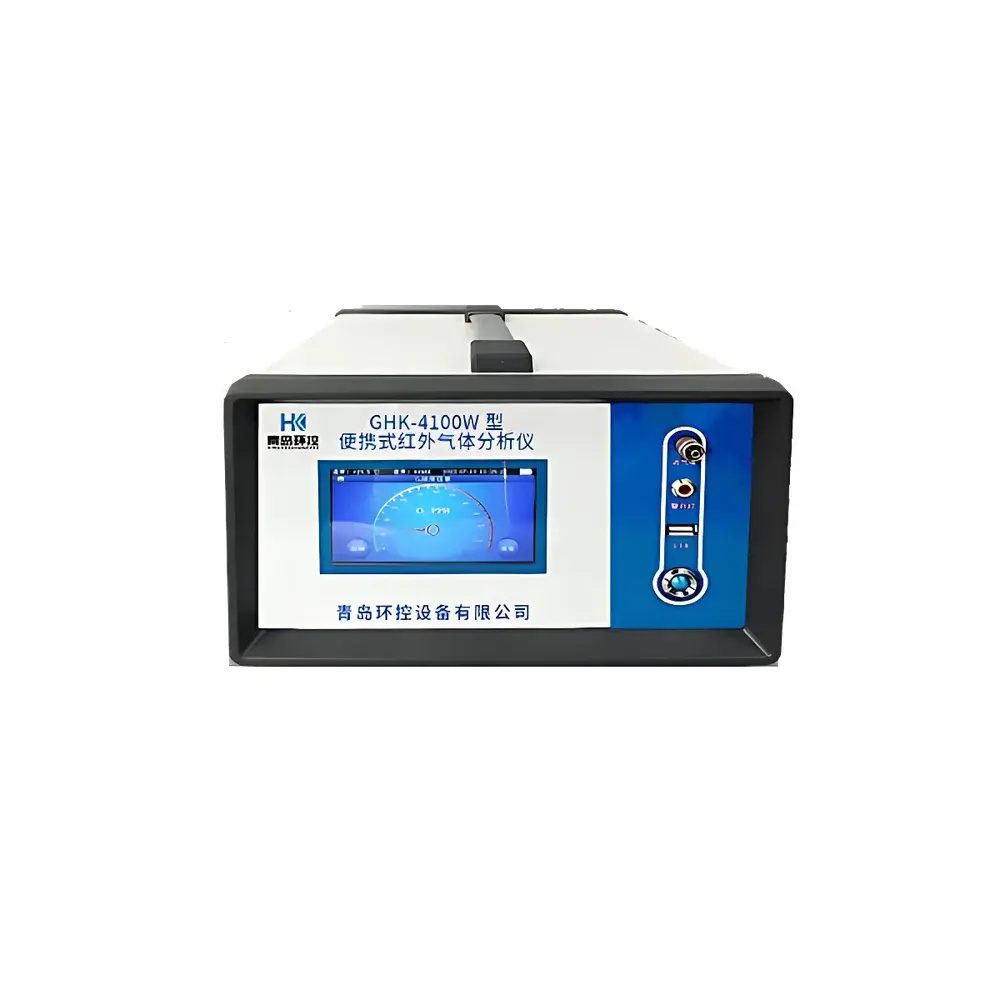
HUANKONG GHK-4100W Portable NDIR Multi-Gas Analyzer (CO/CO₂/O₂)
| Brand | HUANKONG |
|---|---|
| Model | GHK-4100W |
| Detection Principle | Non-Dispersive Infrared (NDIR) Absorption |
| Gas Targets | CO, CO₂, O₂ (simultaneous) |
| Portability | Handheld, Battery-Powered |
| Measurement Range (Configurable) | CO: 0–1000 ppm / 0–5000 ppm |
| CO₂ | 0–2000 ppm / 0–100 % vol |
| O₂ | 0–25 % vol |
| Accuracy | ±2 % FS (typical, per gas channel) |
| Response Time (T₉₀) | <30 s |
| Operating Temperature | −10 to +50 °C |
| Relative Humidity Range | 0–95 % RH (non-condensing) |
| Data Storage Capacity | ≥5000 measurement records |
| Sampling Flow Rate | 0.5–2.0 L/min (adjustable) |
| Power Supply | Rechargeable Li-ion battery (≥4 h continuous operation) |
| Communication Interfaces | USB, RS232, optional Bluetooth printing module |
| Alarm | Configurable audible & visual alarms with user-defined thresholds |
| Units | ppm, mg/m³, % vol (switchable) |
| Environmental Compensation | Integrated temperature & humidity sensors with real-time compensation algorithm |
| Compliance Standards | JJG635-2011, HJ870-2017, HJ/T44-1999, GBZ/T300.37-2017, GB/T18204.2-2014, GB/T18204.23-2000, GB/T18204.24-2000 |
Overview
The HUANKONG GHK-4100W Portable NDIR Multi-Gas Analyzer is an engineered field-deployable instrument designed for quantitative determination of carbon monoxide (CO), carbon dioxide (CO₂), and oxygen (O₂) in ambient air, indoor environments, occupational settings, and stack emissions. It employs dual-beam non-dispersive infrared (NDIR) absorption spectroscopy—optimized for high selectivity and minimal spectral interference—combined with electrochemical sensing for O₂. The optical path is thermally stabilized and sealed against contamination, ensuring long-term baseline stability and repeatability across variable environmental conditions. Unlike filter-wheel or single-beam systems, the GHK-4100W utilizes matched reference and measurement channels to dynamically correct for source drift, window fouling, and ambient thermal fluctuations. Its compact ergonomic housing meets IP54 ingress protection requirements, supporting reliable operation during mobile surveys, industrial hygiene assessments, and emergency response deployments.
Key Features
- True simultaneous multi-gas detection: CO, CO₂, and O₂ measured in parallel using dedicated NDIR cells (CO/CO₂) and a zirconia-based electrochemical O₂ sensor
- High-resolution 5-inch capacitive color touchscreen with dual display modes: numeric concentration readout and analog-style gauge visualization for rapid interpretation
- Integrated temperature and relative humidity sensors feeding real-time compensation algorithms—critical for maintaining accuracy across seasonal and geographic variations
- Automated zero calibration via dual-path selection: catalytic oxidation (for ambient air zeroing) or external nitrogen purge (for high-precision baseline reset)
- Onboard electromagnetic valve manifold enabling fully automated sequence control: auto-zero → sample draw → analysis → purge — reducing operator error and cycle time
- Configurable averaging functions: 1-hour, 8-hour, and 24-hour rolling mean calculations compliant with occupational exposure limit (OEL) assessment protocols (e.g., TLV-TWA, STEL)
- Adjustable sampling flow (0.5–2.0 L/min) driven by a maintenance-free imported diaphragm pump rated for >10,000 hours MTBF
- Rechargeable high-energy lithium-ion battery supporting ≥4 hours of continuous operation at full sampling load; hot-swappable with AC adapter for extended missions
- Comprehensive data management: timestamped storage of ≥5000 measurement records including gas concentrations, T/RH, flow rate, battery status, and calibration logs
- Flexible unit output: seamless switching between ppm, mg/m³, and % volume—automatically scaled using molecular weight and standard temperature/pressure (STP) corrections
Sample Compatibility & Compliance
The GHK-4100W is validated for direct analysis of unfiltered, non-corrosive gaseous samples across diverse matrices: indoor air (offices, schools, hospitals), workplace breathing zones (manufacturing, welding, boiler rooms), and diluted flue gas streams from combustion sources. It excludes particulate-laden or condensable hydrocarbon-rich exhaust without optional particulate filter or heated line accessories. Regulatory alignment includes full traceability to Chinese national metrological verification规程 JJG635-2011 and environmental monitoring standards HJ870-2017 (CO₂ in stationary sources) and HJ/T44-1999 (CO in stack gas). For occupational health applications, it satisfies GBZ/T300.37-2017 requirements for simultaneous CO/CO₂ quantification in workplace air. All firmware and calibration procedures adhere to GLP documentation principles—including audit trails for calibration events, alarm threshold changes, and data export actions.
Software & Data Management
Data acquisition and reporting are supported through embedded firmware with configurable logging intervals (1 s to 60 min) and automatic file segmentation. Raw measurement records include ISO 8601 timestamps, sensor-specific diagnostics (e.g., detector signal-to-noise ratio, cell temperature deviation), and environmental metadata. Export occurs via USB mass storage mode (FAT32-formatted U-disk) or RS232 serial protocol compatible with third-party SCADA and LIMS platforms. Optional Bluetooth-enabled thermal printer provides on-site hardcopy reports with header fields for operator ID, location tag, and sampling duration. No proprietary software installation is required: exported CSV files open natively in Excel, MATLAB, or Python pandas environments for statistical validation, trend analysis, or regulatory submission.
Applications
- Indoor Air Quality (IAQ) audits in commercial buildings, schools, and healthcare facilities per GB/T18204.2-2014
- Occupational exposure monitoring for compliance with national permissible exposure limits (PELs) and time-weighted averages (TWAs)
- Leak detection and combustion efficiency evaluation in HVAC systems, boilers, and industrial furnaces
- Post-remediation verification following carbon monoxide incident investigations
- Field screening of landfill gas migration, biogas composition, and fermentation off-gas profiles
- Educational laboratory use for teaching gas law principles, stoichiometric combustion analysis, and sensor physics
FAQ
What calibration gases are required for routine verification?
Certified zero air (N₂ ≥99.999%) and span gases traceable to NIM (National Institute of Metrology, China) or NIST-equivalent standards: CO (e.g., 500 ppm in air), CO₂ (e.g., 2000 ppm in air), and O₂ (e.g., 20.9% in N₂).
Does the instrument support remote data transmission?
Not natively via cellular/WiFi; however, RS232 output can be interfaced with external telemetry modules (e.g., LTE gateways) using Modbus RTU or ASCII protocol.
How often must the NDIR optical cell be cleaned or serviced?
Under typical indoor or filtered-stack use, no routine optical cleaning is needed within 24 months; visual inspection recommended every 6 months per preventive maintenance schedule.
Is the device suitable for Class I, Division 1 hazardous locations?
No—it lacks intrinsic safety (IS) certification (e.g., ATEX, IECEx); intended for general-purpose use only.
Can measurement data be synchronized with cloud-based EHS platforms?
Yes—via USB-exported CSV files ingested into enterprise EHS software (e.g., Intelex, Sphera, ETQ Reliance) using standard import templates.
Related Products







