
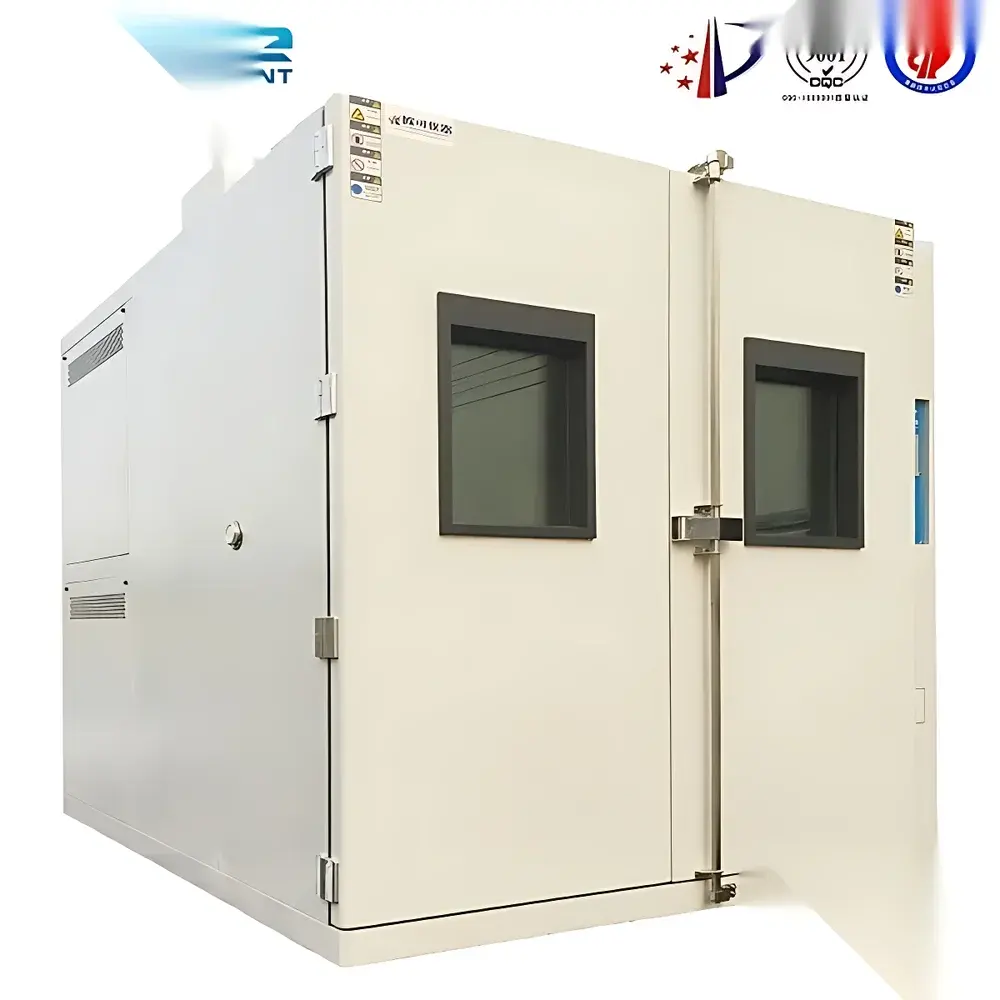
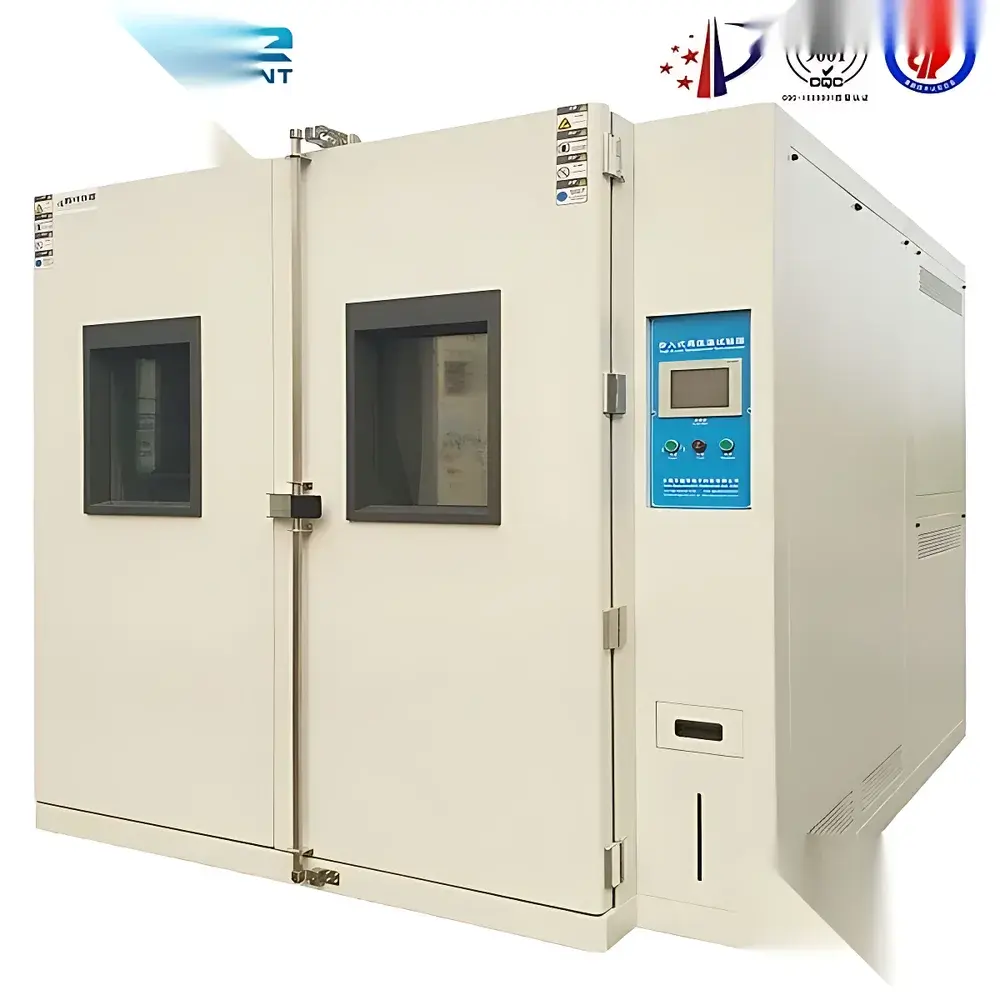
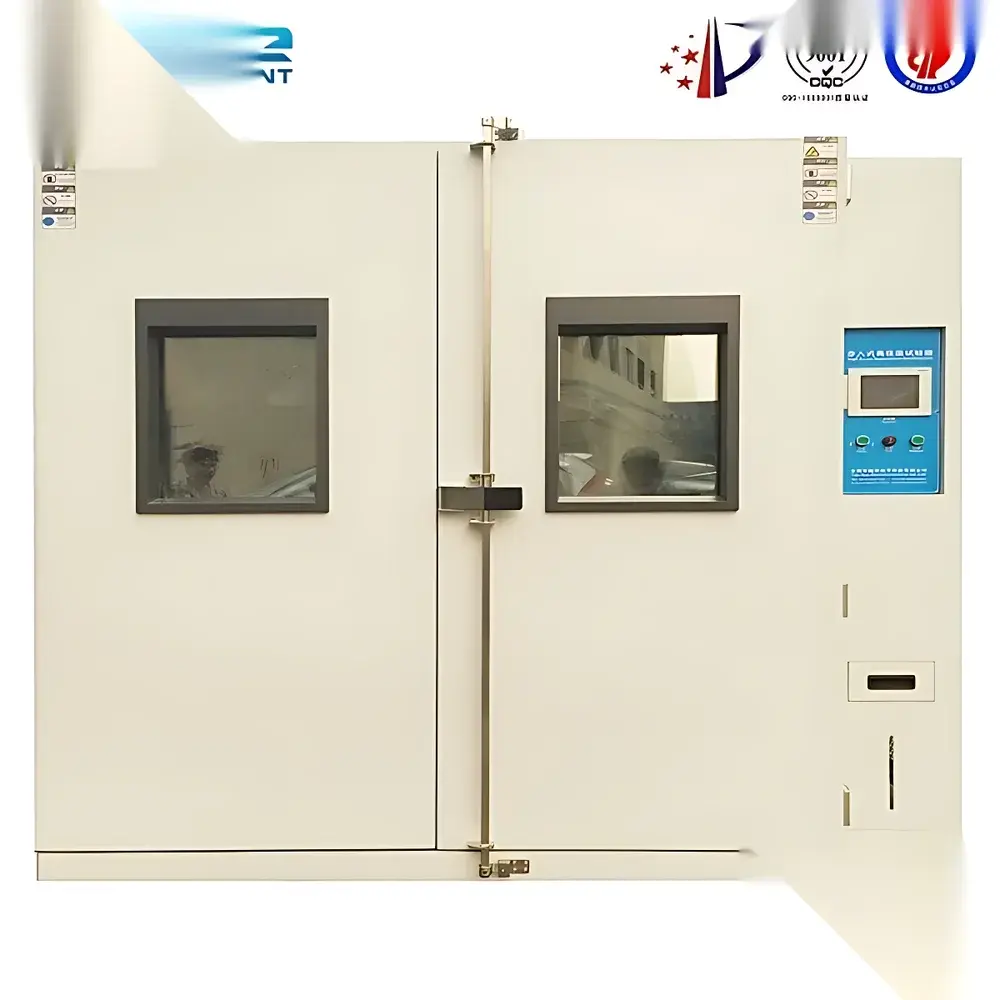
Walk-in Environmental Chamber – OK-STH Series by Other Brands
| Key | Temperature Range: -60°C to 100°C (selectable variants: -35°C/–20°C to 100°C) |
|---|---|
| Humidity Range | 15–95% RH |
| Temperature Stability | ±0.5°C |
| Humidity Stability | ±2% RH |
| Temperature Uniformity | ±2°C |
| Humidity Uniformity | ±3% RH |
| Temperature/Humidity Deviation | ≤±2°C / ≤±3% RH |
| Refrigerant | HFC-404A & HFC-23 (zero ozone depletion potential) |
| Construction | Modular PU-insulated panels |
| Inner Chamber | SUS304 stainless steel |
| Outer Shell | Color-coated steel |
| Heating | Stainless finned-tube electric heaters |
| Humidification | Stainless-steel sheathed steam generator |
| Airflow Design | Ceiling-mounted low-velocity discharge for high uniformity and minimal sample disturbance |
| Safety | Overload protection, compressor overheat/overcurrent/overpressure protection, dry-run and low-water alarms, power failure memory |
| Controller | Large LED-based multi-function programmable controller |
| Standard Port | One φ50 mm test port |
| Lighting | Explosion-proof interior lamp |
| Power Supply | AC 3-phase 5-wire 380 V / 50 Hz |
| Compliance | GB/T 5170.2–1996, GB/T 10592–1993, GB/T 2423.2–2008 (IEC 60068-2-2), GJB 150.3–2009, GJB 150.4–2009, GJB 360B–2009 |
Overview
The OK-STH Series Walk-in Environmental Chamber is an industrial-grade, modular climate simulation system engineered for large-scale reliability testing of components, subassemblies, and finished products under precisely controlled temperature and humidity conditions. Designed around the principles of thermodynamic equilibrium and vapor pressure control, the chamber employs a dual-refrigerant cascade system (HFC-404A for primary cooling and HFC-23 for deep sub-zero operation) to achieve stable thermal profiles from –60°C to +100°C, coupled with humidity control across 15–95% RH. Its ceiling-mounted, low-velocity air distribution architecture minimizes convective stress on test specimens while maintaining spatial uniformity—critical for validating thermal expansion, material hygroscopicity, seal integrity, and long-term aging behavior in accordance with international environmental test standards.
Key Features
- Modular panel construction using polyurethane (PU) insulated sandwich panels—enables field-assembled, scalable chamber volumes tailored to user-defined footprint and height requirements.
- Corrosion-resistant inner chamber fabricated from 304 stainless steel; outer shell constructed from pre-painted galvanized steel for durability and cleanroom compatibility.
- Dual-stage refrigeration system with hermetic or semi-hermetic compressors and finned-tube evaporators serving as both cooling and dehumidification elements—eliminating separate mechanical dehumidifiers and reducing maintenance points.
- Steam-based humidification via stainless-steel sheathed electric generators ensures rapid RH response and contamination-free moisture delivery, avoiding mineral deposits common with ultrasonic or pan-type systems.
- Programmable LED controller supports multi-step ramp-soak profiles, real-time monitoring, data logging (via optional RS485/Ethernet interface), and alarm-triggered event recording with time-stamped timestamps.
- Integrated safety suite includes compressor overtemperature cut-off, phase-loss detection, heater dry-run protection, water-level sensing, and non-fuse overload circuit breakers—all compliant with IEC 61000-4 electromagnetic immunity requirements.
Sample Compatibility & Compliance
The OK-STH chamber accommodates oversized test articles—including automotive ECUs, aerospace avionics enclosures, medical device sterilization trays, and battery module stacks—without requiring disassembly or reconfiguration. Its structural modularity supports custom internal dimensions (e.g., 2 m × 2 m × 2.5 m up to 6 m × 4 m × 3 m), with reinforced floor framing (Q235 angle iron and channel steel) rated for static loads up to 1,500 kg/m². The system conforms to multiple national and military environmental test standards, including GB/T 5170.2–1996 (temperature test equipment verification), GB/T 10592–1993 (high/low-temperature chamber specifications), IEC 60068-2-2 (Test B: Dry Heat), MIL-STD-810G Method 502.6 (Low Temperature) and Method 501.6 (High Temperature), and GJB 360B–2009 (Environmental Test Methods for Electronic and Electrical Components). All calibration procedures follow traceable NIST-equivalent metrology protocols.
Software & Data Management
While the standard controller provides local operation via intuitive LED interface, optional Ethernet or RS485 connectivity enables integration into centralized laboratory information management systems (LIMS) or MES platforms. Logged parameters—including chamber setpoints, actual temperature/humidity values, alarm status, and compressor runtime—are exportable in CSV format for audit-ready reporting. The controller’s built-in power-failure memory retains active test profiles and elapsed cycle time, ensuring continuity after unexpected outages—a requirement under GLP-compliant validation environments. For regulated industries, optional 21 CFR Part 11-compliant software packages provide electronic signatures, role-based access control, and full audit trails for all configuration changes and data exports.
Applications
This chamber serves critical roles in product development and quality assurance workflows across sectors where environmental robustness is mission-critical. In automotive electronics, it validates ECU performance under extreme desert heat (+85°C/10% RH) and arctic cold (–40°C/95% RH) per ISO 16750-4. In photovoltaic manufacturing, it executes damp heat cycling (85°C/85% RH, 1,000 h) per IEC 61215 to assess encapsulant delamination. For lithium-ion battery modules, it supports thermal runaway propagation studies under controlled humidity gradients. Aerospace suppliers use it for DO-160 Section 4.5 (temperature variation) and Section 4.6 (humidity) qualification. Additionally, pharmaceutical packaging stability chambers leverage its uniformity and repeatability for ICH Q1A(R2)-aligned accelerated stability protocols.
FAQ
What is the typical lead time for a custom-sized OK-STH chamber?
Lead time ranges from 12–16 weeks following final dimensional approval and deposit confirmation—subject to refrigerant certification and panel fabrication schedules.
Can the chamber be validated for IQ/OQ/PQ protocols?
Yes. Factory-installed calibrated sensors (NIST-traceable PT100 and capacitive RH probes) support full qualification documentation, including mapping reports, uncertainty budgets, and deviation logs.
Is remote monitoring supported without third-party SCADA?
Standard Modbus RTU over RS485 allows direct integration with most PLCs and building management systems; optional web server module enables browser-based status viewing and email alerting.
Does the system meet UL or CE safety certification requirements?
The base configuration complies with GB 4793.1 (equivalent to IEC 61010-1) for electrical safety; CE marking requires site-specific EMC testing per EN 61326-1 and mechanical risk assessment per EN ISO 12100.
How is humidity accuracy maintained at low temperatures (e.g., –40°C)?
At sub-zero conditions, the chamber operates in dew-point control mode using chilled-mirror hygrometry feedback—bypassing conventional RH sensor drift limitations and enabling reliable 15% RH capability down to –60°C.



