
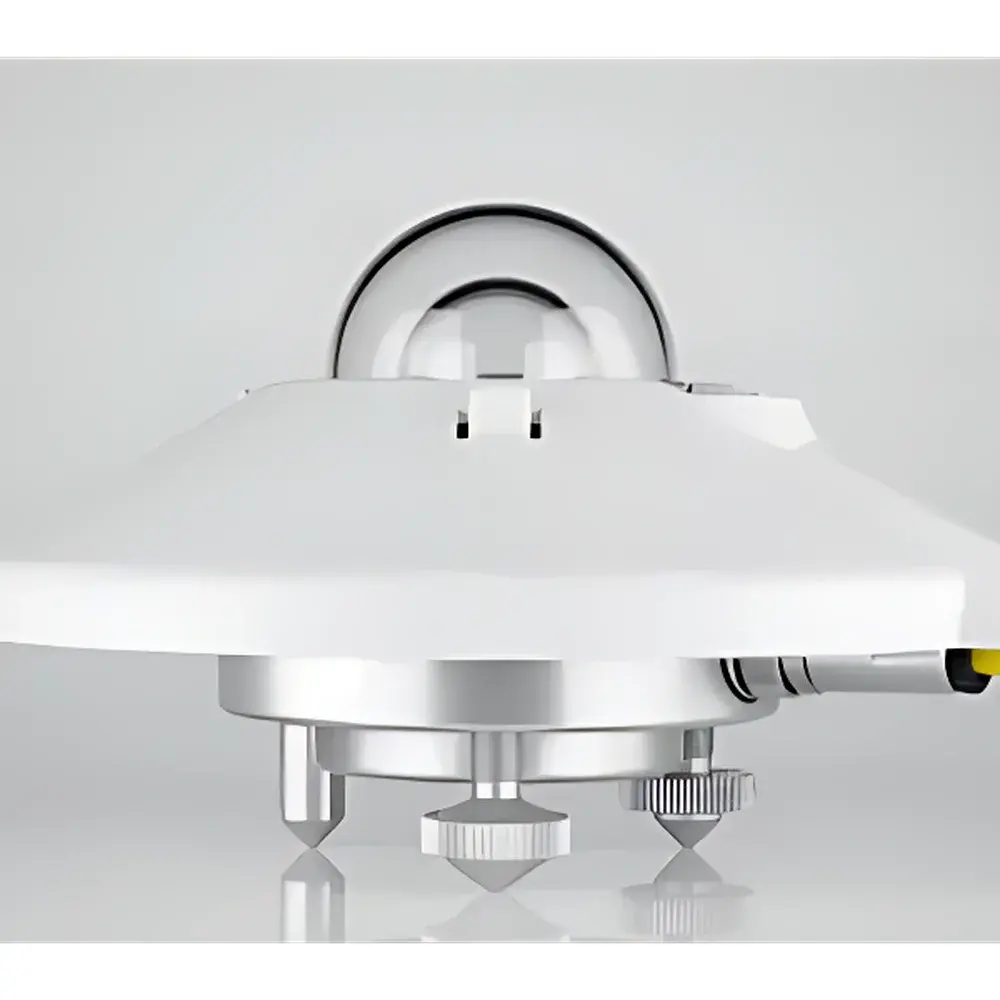
Kipp & Zonen SMP6 Secondary Standard Pyranometer
| Brand | Kipp & Zonen |
|---|---|
| Origin | Netherlands |
| Model | SMP6 |
| Spectral Range | 300–2800 nm |
| Response Time (63%) | < 1.5 s |
| Response Time (95%) | < 12 s |
| Zero Offset A | < 10 W/m² |
| Zero Offset B | < 4 W/m² |
| Directional Error (up to 80°, 1000 W/m² beam) | ±15 W/m² |
| Temperature Dependence of Sensitivity (−10 °C to +40 °C) | < 2 % |
| Analog Output (-V version) | 0–1 V |
| Analog Output (-A version) | 4–20 mA |
| Digital Output | 2-wire RS-485 Modbus® RTU |
| Operating Voltage | 5–30 VDC |
| Integrated Desiccant Lifetime | ≥10 years |
| Compliance | ISO 9060:2018 Secondary Standard (Class A) |
Overview
The Kipp & Zonen SMP6 is a secondary standard pyranometer engineered for high-accuracy, long-term solar irradiance measurement in meteorological networks, solar resource assessment, photovoltaic (PV) performance monitoring, and climate research applications. It integrates the proven thermopile-based sensing architecture of the CMP6 series into a compact, fully sealed housing with dual analog and digital output capabilities. The instrument operates on the principle of thermal detection: incident solar radiation (300–2800 nm) heats a blackened thermopile sensor mounted beneath a precision-ground, hemispherical quartz dome; the resulting thermoelectric voltage is linearly proportional to irradiance (W/m²). Unlike silicon-cell sensors, the SMP6 delivers spectrally flat response across the full solar spectrum—including near-infrared—ensuring traceable, calibration-stable measurements compliant with ISO 9060:2018 Class A specifications for secondary standard instruments.
Key Features
- Thermopile-based detection with ISO 9060:2018 secondary standard (Class A) classification, enabling use in reference stations and bankable solar yield studies.
- Dual-output interface: galvanically isolated 2-wire RS-485 Modbus® RTU (addressable, noise-immune, up to 1200 m cable length) and factory-configurable analog output (0–1 V or 4–20 mA), supporting seamless integration with SCADA, PLCs, and legacy dataloggers.
- Integrated desiccant cartridge with ≥10-year service life, eliminating routine desiccant replacement and minimizing long-term maintenance overhead.
- Optimized thermal design with low zero-offset characteristics: <10 W/m² (Zero Offset A, 5 K/h temperature change) and <4 W/m² (Zero Offset B, night-time cooling), critical for accurate net radiation and low-irradiance conditions.
- Wide operating voltage range (5–30 VDC) and ultra-low power consumption (<15 mW at 12 VDC), facilitating deployment in remote, battery-powered solar monitoring systems.
- Enhanced environmental robustness: stainless steel housing, IP67-rated enclosure, and quartz dome with anti-reflective coating ensure stability under UV exposure, wind loading, and thermal cycling.
Sample Compatibility & Compliance
The SMP6 is designed for outdoor, unshaded horizontal or tilted-plane installation on fixed mounts, solar trackers, or meteorological masts. Its directional response error remains within ±15 W/m² up to 80° zenith angle under 1000 W/m² beam irradiance—meeting stringent requirements for global horizontal irradiance (GHI) and plane-of-array (POA) measurements. The instrument conforms to ISO 9060:2018 (Secondary Standard, Class A), IEC 61724-1:2021 (Photovoltaic system performance monitoring), and WMO Guide to Meteorological Instruments and Methods of Observation (CIMO Guide, Chapter 7). Calibration is traceable to the World Radiometric Reference (WRR) via Kipp & Zonen’s accredited calibration laboratory (ISO/IEC 17025). Optional CVF4 ventilation unit reduces dome soiling rate by >70%, extends cleaning intervals, and suppresses dew/frost formation—critical for high-accuracy operation in humid or dusty environments.
Software & Data Management
Kipp & Zonen provides SmartExplorer Windows™ software as standard, enabling local configuration, real-time data visualization, firmware updates, and Modbus® register mapping. The SMP6 supports full audit-trail functionality when integrated with compliant data acquisition platforms adhering to FDA 21 CFR Part 11 and ISO/IEC 17025 requirements—including electronic signatures, change logging, and secure user access control. Raw sensor output undergoes on-board temperature compensation using an embedded Pt1000 RTD, ensuring linearity and stability across −40 °C to +80 °C ambient operating range. All digital registers include status flags for heater activation (if CVF4 is connected), desiccant saturation warning, and sensor health diagnostics.
Applications
- Solar resource assessment for utility-scale PV plant feasibility and energy yield modeling (P50/P90 analysis).
- Performance ratio (PR) and specific yield validation in operational solar farms per IEC 61724-1.
- Long-term climate monitoring networks requiring WMO-compliant GHI records.
- Calibration transfer and field reference instrumentation for lower-tier pyranometers and pyrheliometers.
- Building-integrated photovoltaics (BIPV) and agrivoltaic system irradiance profiling.
- Atmospheric science campaigns measuring surface albedo, cloud radiative forcing, and aerosol optical depth.
FAQ
Is the SMP6 suitable for use in harsh desert or coastal environments?
Yes—the IP67-rated stainless steel housing, corrosion-resistant hardware, and quartz dome with hydrophobic coating provide resilience against sand abrasion, salt spray, and high UV flux. When paired with the CVF4 ventilator, it maintains optical clarity under extreme soiling conditions.
Does the SMP6 require annual recalibration?
Per ISO/IEC 17025 and WMO recommendations, secondary standard pyranometers should be recalibrated every two years under typical field conditions. Kipp & Zonen offers accredited on-site or lab-based recalibration with WRR traceability and uncertainty reporting.
Can the SMP6 be used with third-party Modbus® master devices?
Yes—the RS-485 interface implements standard Modbus® RTU protocol (function codes 03h/04h for holding/input registers) with configurable slave ID, baud rate (up to 115.2 kbps), and parity. Register maps are publicly documented in the SMP6 Communication Protocol Manual.
What is the impact of temperature gradients on measurement accuracy?
The SMP6 incorporates active temperature compensation via its internal Pt1000 sensor, limiting sensitivity drift to <2 % over −10 °C to +40 °C ambient range—significantly improving diurnal stability compared to uncompensated thermopile designs.
How does the integrated desiccant system differ from traditional replaceable cartridges?
The SMP6 uses a diffusion-barrier encapsulated desiccant module with controlled release kinetics, rated for ≥10 years of continuous operation without maintenance—eliminating field servicing while maintaining internal relative humidity below 15 % RH throughout its service life.
Related Products







