
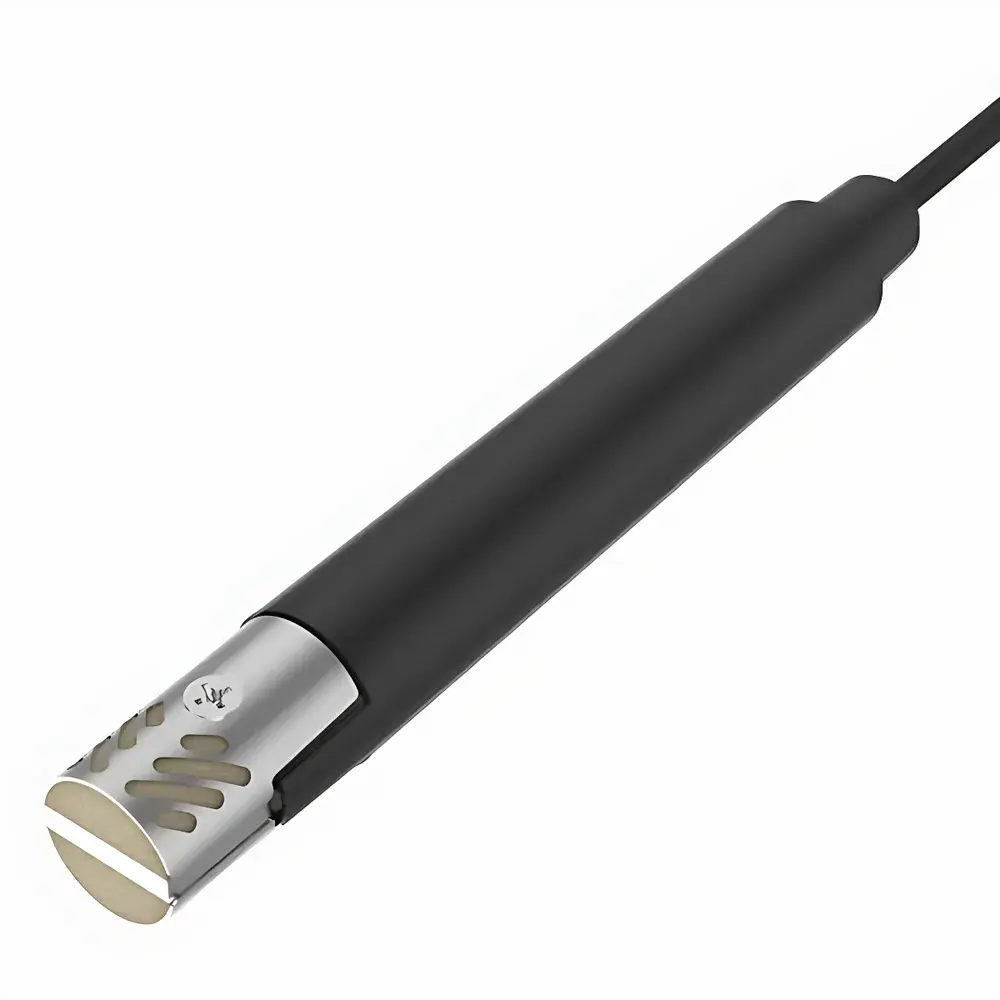
METER TEROS 22 Soil Water Potential and Temperature Sensor
| Brand | METER |
|---|---|
| Origin | USA |
| Model | TEROS 22 |
| Resolution | 0.1 kPa |
| Operating Temperature Range | -40 to 60 °C |
Overview
The METER TEROS 22 is a high-precision, field-deployable soil water potential and temperature sensor engineered for continuous, long-term monitoring in ecological, agronomic, and hydrological research. It operates on the fundamental principle of thermodynamic equilibrium between a calibrated porous ceramic matrix and the surrounding soil matrix. When equilibrated, the sensor’s integrated relative humidity (RH) sensor measures the vapor pressure inside the ceramic block, which—via a pre-characterized soil–water retention curve (SWRC)—is converted into matric water potential (kPa). This method enables direct, physics-based quantification of soil water energy status across the full biologically relevant range—from saturated conditions (0 kPa) to extreme drought (-100,000 kPa, equivalent to pF 6.0). Unlike tensiometric or thermal dissipation approaches, the TEROS 22 requires no water refilling, exhibits negligible hysteresis, and maintains stability under freeze–thaw cycles and high-salinity conditions—making it uniquely suited for unattended deployment in diverse pedoclimatic environments.
Key Features
- Full-range measurement capability: 0 to –100,000 kPa (pF 1.7–6.0), covering all physiological thresholds critical for plant water stress assessment and root zone modeling.
- Integrated high-accuracy temperature sensing: ±1 °C accuracy over –40 to +60 °C, enabling simultaneous monitoring of two key drivers of soil–plant–atmosphere continuum dynamics.
- Minimalist installation protocol: Requires only a 1.6 cm diameter pilot hole; no grouting, backfilling, or site-specific calibration needed.
- Silica-based ceramic matrix: Chemically inert, non-hygroscopic, and resistant to degradation—eliminates drift due to aging or organic fouling, ensuring long-term calibration stability.
- Salinity resilience: Performance unaffected by variable or elevated electrolyte concentrations, validated across saline, sodic, and coastal soils.
- Robust mechanical construction: Dual-layer epoxy overmolding provides IP68-rated environmental sealing and mechanical durability for multi-year field exposure.
- Plug-and-play interoperability: Native SDI-12 and DDI serial output protocols ensure compatibility with METER ZL6, EM60 series loggers, and third-party data acquisition systems supporting 4.0–15.0 VDC power and standard SDI-12 timing.
- Ultra-low power consumption: Typical 5 mA during measurement; <0.03 mA in quiescent state—enabling solar-powered deployments with extended battery life.
Sample Compatibility & Compliance
The TEROS 22 is validated for use in mineral soils, volcanic ash, peat, and engineered growing media—including substrates with high clay or organic matter content. Its ceramic matrix is compatible with USDA texture classes from sand to heavy clay and has been tested per ASTM D4318 (liquid limit) and ISO 11277 (soil particle-size analysis) reference frameworks. The sensor complies with EN 55011:2016/A1:2017 for electromagnetic compatibility (EMC) and bears CE and RCM markings per ISO/IEC 17050:2010. While not intrinsically certified for hazardous locations, its low-voltage operation (4.0–15.0 VDC) and galvanic isolation meet general-purpose field instrumentation safety requirements under IEC 61000-6-2 and IEC 61000-6-4.
Software & Data Management
TEROS 22 data are natively supported in METER’s ZENTRA Cloud platform, enabling secure remote access, automated QA/QC flagging, time-series visualization, and export to CSV, NetCDF, or JSON formats. When paired with ZL6 loggers, the system supports audit-trail logging compliant with GLP principles, including timestamped metadata (sensor ID, firmware version, battery voltage, measurement interval). SDI-12 output is fully compatible with Campbell Scientific LoggerNet, Onset HOBOware, and other industry-standard DAQ software packages. All calibration coefficients are embedded in firmware and traceable to NIST-traceable RH and temperature standards; no user recalibration is required over the sensor’s operational lifetime.
Applications
- Root-zone water stress phenotyping in controlled-environment and field trials.
- Calibration and validation of vadose zone models (e.g., HYDRUS, STOMP, PFLOTRAN).
- Long-term edaphic monitoring in LTER (Long Term Ecological Research) networks and NEON (National Ecological Observatory Network) sites.
- Irrigation scheduling and deficit irrigation optimization in precision agriculture systems.
- Soil hydraulic property estimation via inverse modeling of transient water potential profiles.
- Climate change impact studies on soil desiccation thresholds and ecohydrological tipping points.
FAQ
Does the TEROS 22 require periodic recalibration?
No. The silica-ceramic matrix exhibits no measurable chemical or structural degradation under field conditions; factory calibration remains stable for the sensor’s service life.
Can it be used in frozen soils?
Yes. The ceramic matrix remains functional below 0 °C; ice formation does not impair equilibration or measurement integrity.
What is the maximum cable length supported?
Standard cable is 5 m; custom lengths up to 75 m are available with appropriate voltage drop compensation and shielding.
Is the sensor compatible with non-METER data loggers?
Yes—any SDI-12–compliant logger operating within 4.0–15.0 VDC and meeting SDI-12 v1.3 timing specifications will interface successfully.
How does it differ from the TEROS 21?
The TEROS 22 features a reduced form factor (1.7 cm diameter), enhanced thermal coupling for improved temperature accuracy, and optimized electronics for lower power draw and faster startup times.
Related Products



