
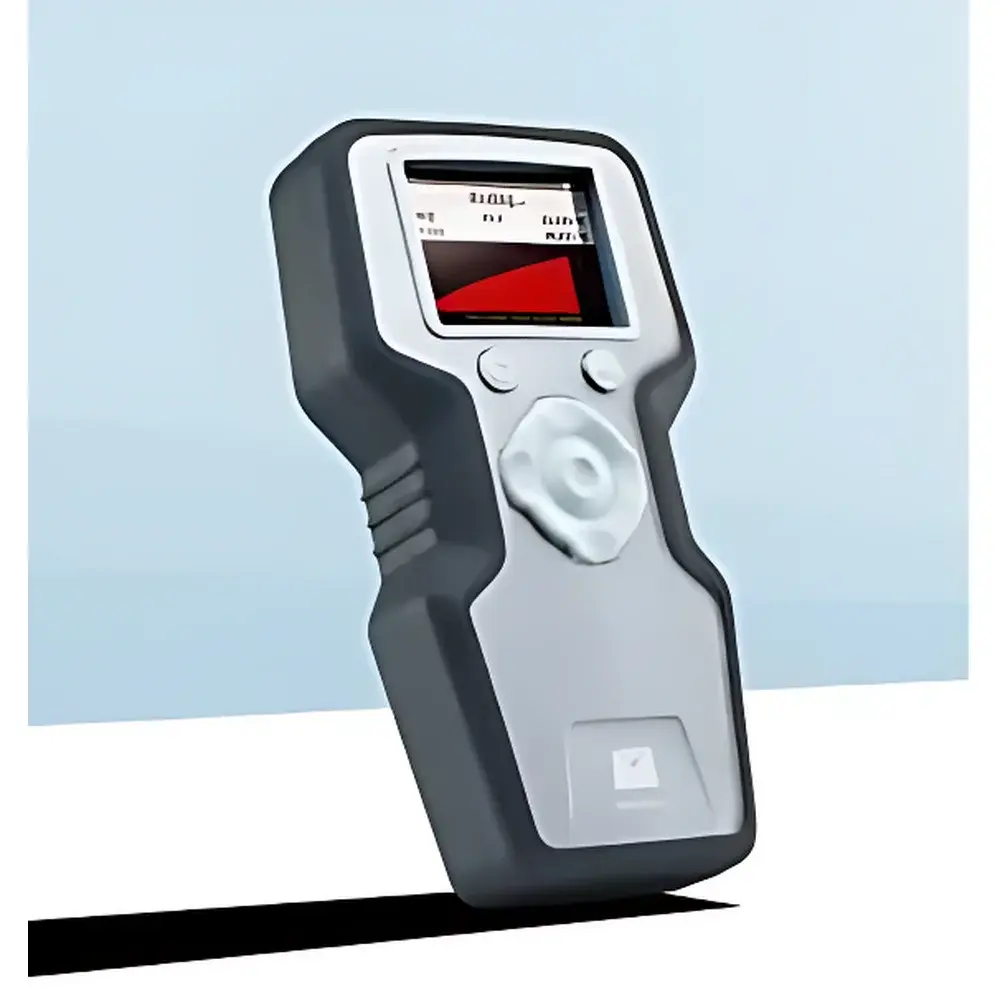
METER TEMPOS Thermal Properties Analyzer
| Brand | METER |
|---|---|
| Origin | USA |
| Model | TEMPOS |
| Type | Multiparameter Soil Thermal Property Analyzer |
| Compliance | ASTM D5334, IEEE Std 442, ISO 9001:2015, EN 61326-1:2013, CISPR 22 |
| Operating Temperature (Controller) | 0–50 °C |
| Sensor Operating Range | −50–150 °C |
| Power Supply | 5 × AA batteries (alkaline or rechargeable) |
| Battery Life | >250 high-power measurements |
| Data Storage | Flash memory, 2,048 full measurement records (raw + processed) |
| Display | Color LCD, 5.5 cm × 4.0 cm |
| Controller Dimensions | 18.5 × 10 × 3.5 cm |
| Carry Case | Ergonomic molded polymer, 37 × 30 × 10.5 cm |
| Interface | DB-15 sensor port |
| Connectivity | Mini-USB for data export |
| Temperature Resolution | ±0.001 °C |
| Measurement Cycle | Equilibration → Heating → Cooling, completed in ≤60 s |
Overview
The METER TEMPOS Thermal Properties Analyzer is a field-deployable, high-precision instrument engineered for the rapid and reliable determination of thermal conductivity (K), thermal diffusivity (D), and volumetric heat capacity (C) in heterogeneous, moisture-variable, and temperature-extreme media—including soils, sediments, snow, ice, and construction materials. It implements the transient line-source (TLS) method, a standardized technique defined in ASTM D5334 and IEEE Std 442. In this approach, a calibrated linear heater—integrated into a probe—is inserted into the sample. A constant current is applied to induce controlled resistive heating, while high-resolution thermistors continuously monitor temperature rise and decay over time. The resulting thermal response curve is fitted using a nonlinear least-squares algorithm to an analytical solution of the radial heat conduction equation in infinite medium geometry. Linear drift correction is applied to measured temperature profiles prior to fitting, compensating for ambient thermal drift and ensuring traceable accuracy across wide environmental gradients.
Key Features
- Sub-minute measurement cycles: Full K, D, and C derivation completed in ≤60 seconds per reading, minimizing thermal disturbance and eliminating convective water movement in moist samples.
- Multi-sensor compatibility: Supports four interchangeable probes—KS-3 (single-needle, 36 mm), TR-3 (single-needle, 100 mm), SH-3 (dual-needle, 30 mm), and RK-3 (robust single-needle, 60 mm)—each optimized for specific material classes, density ranges, and thermal regimes.
- High-fidelity thermal resolution: Temperature sensing with ±0.001 °C resolution enables detection of subtle thermal transients critical for low-conductivity materials (e.g., dry sand, peat, snow) and frozen soils.
- Intelligent power management: Adaptive heating control maintains constant thermal energy input regardless of probe resistance or ambient temperature, ensuring reproducible boundary conditions across battery discharge cycles.
- Integrated drift compensation: Real-time linear baseline correction during both heating and cooling phases eliminates systematic error from thermal inertia or sensor self-heating.
- Ergonomic field operation: Ruggedized controller with intuitive color touchscreen interface, graphical heating progress visualization, and context-sensitive menu navigation simplifies protocol selection and reduces operator training burden.
- Robust mechanical design: Stainless-steel probe bodies (1.3–3.9 mm diameter), precision-machined spacing (e.g., 6 mm inter-needle distance in SH-3), and IP-rated electronics ensure longevity under repeated field deployment and freeze-thaw cycling.
Sample Compatibility & Compliance
The TEMPOS system accommodates natural and engineered materials spanning six orders of magnitude in thermal conductivity—from aerated organic soils (K ≈ 0.02 W/(m·K)) to saturated clays and metallic composites (K up to 6.0 W/(m·K)). Its TLS methodology inherently accounts for variable moisture content and phase transitions (e.g., ice–water), making it uniquely suited for cryopedology, post-fire soil recovery studies, and geothermal borehole grouting verification. All sensors are validated against NIST-traceable reference standards and conform to international metrological requirements. The instrument complies with ASTM D5334 (Standard Test Method for Determining Thermal Conductivity of Soils and Soft Rock by Thermal Needle Probe Procedure), IEEE Std 442 (Guide for Soil Thermal Resistivity Measurements), ISO 9001:2015 (quality management), and electromagnetic compatibility directives EN 61326-1:2013 and CISPR 22 (Class B emissions). No calibration drift is observed over extended use; factory recalibration is recommended every 24 months for GLP-compliant applications.
Software & Data Management
Data acquisition, real-time visualization, and post-processing are managed via the onboard firmware and optional PC-based software (EM50 Logger Suite, compatible with Windows 10/11). Raw voltage–time and temperature–time series, along with fitted parameters (K, D, C), confidence intervals, and residual plots, are stored in non-volatile flash memory (2,048 record capacity). Export is supported via Mini-USB to CSV or proprietary .TEM format, preserving metadata including GPS timestamp, probe ID, ambient temperature, and operator notes. Audit trails—including parameter edits, measurement start/stop events, and firmware version—are maintained internally to support FDA 21 CFR Part 11–aligned workflows where electronic records require integrity assurance. No cloud dependency: all computation occurs locally on the device, ensuring data sovereignty and operational continuity in remote or offline environments.
Applications
- Soil physics research: Quantifying thermal fluxes in energy balance models, evaluating land–atmosphere coupling, and validating coupled heat–moisture transport simulations (e.g., HYDRUS, TOUGH2).
- Geotechnical engineering: Assessing thermal backfill performance around buried power cables, optimizing ground-source heat pump (GSHP) loop design, and monitoring permafrost degradation.
- Wildfire ecology: Measuring post-burn soil thermal resistance to inform erosion risk modeling and seedbed thermal dynamics.
- Cryosphere science: Characterizing thermal diffusivity and latent heat effects in seasonal snowpacks, glacier firn, and icy regolith analogs.
- Construction materials testing: Rapid screening of insulation efficacy, concrete curing thermal profiles, and composite thermal homogeneity.
- Planetary analog studies: Supporting NASA and ESA missions through laboratory characterization of Mars regolith simulants and lunar dust thermal behavior under vacuum and low-temperature conditions.
FAQ
What measurement principle does the TEMPOS employ?
It uses the transient line-source (TLS) method, as standardized in ASTM D5334 and IEEE Std 442, based on radial heat conduction theory and nonlinear least-squares curve fitting.
Can TEMPOS measure frozen or saturated soils accurately?
Yes—its TLS approach is insensitive to phase change hysteresis and remains valid across the full −50 °C to +150 °C sensor operating range, provided probe insertion integrity is maintained.
Is the instrument suitable for regulatory reporting?
Yes—its compliance with ASTM, ISO, and EMC standards, combined with internal audit logging and traceable calibration, supports use in GLP, GMP, and environmental monitoring programs requiring defensible data.
How often does the system require recalibration?
Factory recalibration is recommended every 24 months; field verification using reference glycerol or standard sand is advised before critical campaigns.
Does TEMPOS support automated long-term unattended operation?
Yes—it offers programmable timed measurement sequences (e.g., hourly readings over weeks), with data logged internally and retrievable via USB without external power or network infrastructure.
Related Products







