
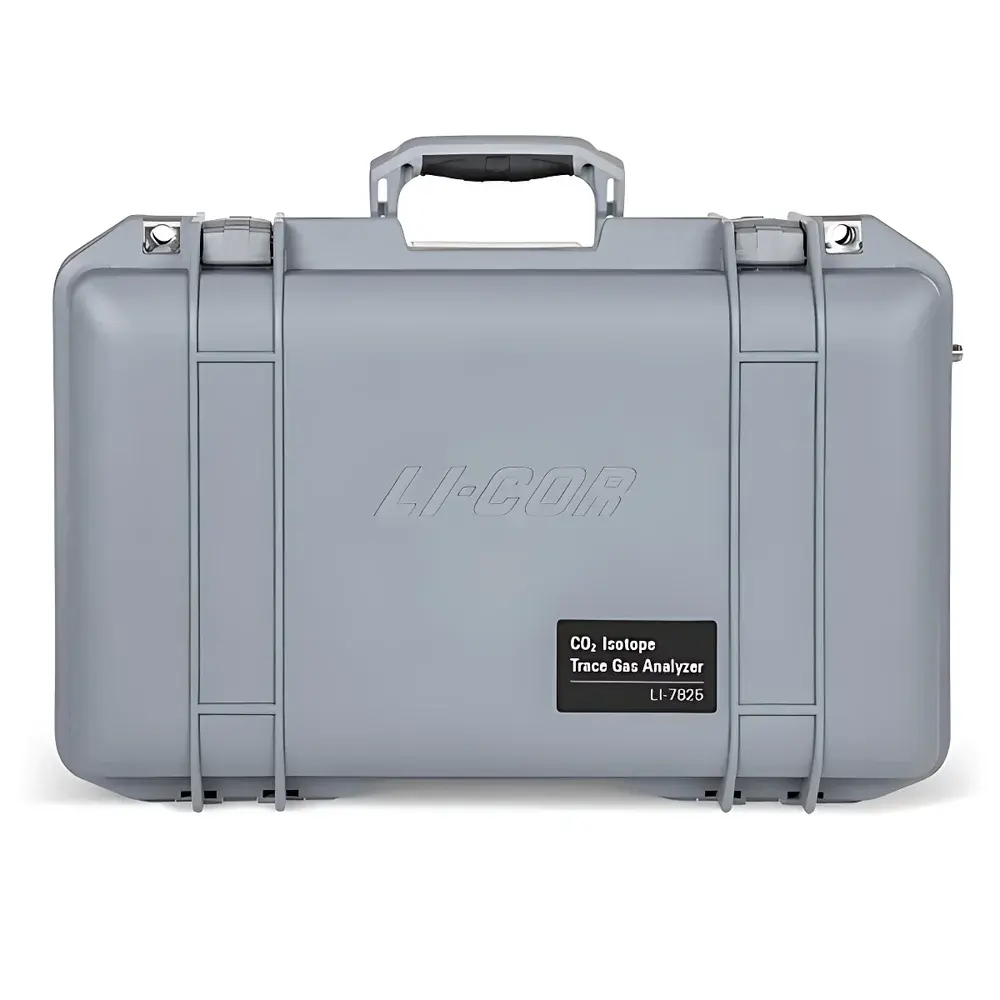
LI-COR LI-7825 High-Precision CO₂ Isotope and NH₃ Analyzer
| Brand | LI-COR |
|---|---|
| Origin | USA |
| Model | LI-7825 |
| Instrument Type | Stable Gas Isotope Ratio Analyzer |
| CO₂ Measurement Range | 50–2000 ppm |
| CO₂ δ¹³C Precision | <0.5 ‰ (1-s avg), <0.04 ‰ (5-min avg) @ 400 ppm |
| CO₂ δ¹⁸O Precision | <0.1 ‰ (5-min avg) @ 400 ppm |
| CO₂ δ¹⁷O Precision | <0.4 ‰ (5-min avg) @ 400 ppm |
| NH₃ Measurement Range | 0–30,000 ppm |
| NH₃ Precision | 2 ppb (1-s avg) @ 300 ppb |
| H₂O Range | 0–60,000 ppm |
| Measurement Technique | Optical Feedback–Cavity Enhanced Absorption Spectroscopy (OF-CEAS) |
| Measurement Frequency | 1 Hz |
| Cavity Volume | 6.41 cm³ |
| Sample Flow Rate | 250 sccm (70 sccm with low-flow accessory) |
| Operating Temperature | −25 °C to +45 °C |
| Operating Humidity | 0–85 % RH (non-condensing, no direct sunlight) |
| Power Consumption | 22 W @ 25 °C |
| Weight | 10.5 kg (with battery) |
| Dimensions (L×H×W) | 51 × 33 × 18 cm |
| Connectivity | Ethernet & Wi-Fi (2.4 GHz, 802.11 a/b/g/n/ac) |
Overview
The LI-COR LI-7825 High-Precision CO₂ Isotope and NH₃ Analyzer is an advanced, field-deployable optical isotope ratio analyzer engineered for quantitative, real-time measurement of stable carbon and oxygen isotopic ratios (δ¹³C, δ¹⁷O, δ¹⁸O) in atmospheric CO₂, alongside high-dynamic-range NH₃ concentration monitoring. Unlike traditional isotope ratio mass spectrometers (IRMS), the LI-7825 employs Optical Feedback–Cavity Enhanced Absorption Spectroscopy (OF-CEAS), a laser-based absorption technique offering exceptional sensitivity, long-term stability, and minimal calibration drift—without requiring vacuum systems, ion sources, or cryogenic cooling. Its compact cavity volume (6.41 cm³) and high-finesse optical resonator enable sub-part-per-trillion detection limits and rapid response times (<2 s for CO₂, ~5 min for NH₃). Designed for rigorous environmental and agricultural research, the LI-7825 delivers metrologically traceable isotope data compliant with best practices for isotopic source partitioning, ecosystem flux attribution, and biogeochemical process validation.
Key Features
- Simultaneous, continuous measurement of CO₂ concentration and its three major stable isotopologues (¹²C¹⁶O₂, ¹³C¹⁶O₂, ¹²C¹⁶O¹⁸O, ¹²C¹⁷O¹⁶O) enabling calculation of δ¹³C, δ¹⁸O, and δ¹⁷O with high reproducibility.
- Dual-gas capability: Integrated NH₃ sensor with 0–30,000 ppm dynamic range and sub-ppb precision at low concentrations—optimized for concentrated emission environments including livestock barns, manure application sites, and industrial leak detection.
- Robust OF-CEAS architecture eliminates moving parts and consumables, ensuring low maintenance and high uptime in remote or mobile deployments.
- Field-ready design: 10.5 kg total weight (including internal Li-ion battery), IP-rated enclosure, and operation across −25 °C to +45 °C ambient temperatures with humidity tolerance up to 85 % RH (non-condensing).
- Seamless integration via Ethernet and dual-band Wi-Fi (802.11 a/b/g/n/ac), supporting remote configuration, real-time data streaming, and synchronization with existing eddy covariance or sensor network infrastructure.
- Onboard data logging with timestamped, calibrated outputs in standard netCDF or CSV formats—fully compatible with post-processing workflows in MATLAB, Python, or R.
Sample Compatibility & Compliance
The LI-7825 is validated for use with dry or humidified gas streams containing CO₂ (50–2000 ppm), NH₃ (0–30,000 ppm), and H₂O (0–60,000 ppm). Its OF-CEAS optical path tolerates water vapor interference through real-time spectral correction algorithms, eliminating need for Nafion dryers in most applications. The instrument meets key regulatory and scientific reporting requirements: CO₂ isotope measurements adhere to IUPAC-recommended delta notation conventions and support compliance with ISO 13833 (environmental isotope analysis), ASTM D8201 (isotopic characterization of greenhouse gases), and US EPA Method TO-15A (for isotopic source apportionment studies). Data integrity is reinforced by built-in audit trails, time-stamped calibration logs, and configurable user access levels—facilitating alignment with GLP and GMP documentation frameworks where required.
Software & Data Management
The LI-7825 operates under LI-COR’s proprietary EddyPro®-compatible firmware and is fully supported by the LI-7825 Control Software Suite (v3.2+), providing intuitive GUI-based setup, real-time spectral visualization, automated zero/span validation, and customizable alarm thresholds. All raw absorbance spectra and processed isotope ratios are stored with full metadata (pressure, temperature, flow rate, laser current, cavity alignment status). Export options include CF-compliant netCDF files with embedded units, uncertainty propagation fields, and SI-traceable calibration coefficients. For enterprise deployment, the analyzer supports MQTT and RESTful API endpoints, enabling ingestion into centralized data lakes or LIMS platforms. Audit trail records—including operator ID, parameter changes, and calibration events—are retained for ≥12 months and exportable for FDA 21 CFR Part 11–compliant review.
Applications
- Atmospheric Carbon Cycle Research: Quantifying δ¹³C and δ¹⁸O signatures to distinguish fossil fuel vs. biogenic CO₂ sources, constrain net ecosystem exchange (NEE), and validate terrestrial carbon sink models.
- Agricultural Emission Monitoring: High-resolution NH₃ mapping near feedlots, poultry houses, and fertilizer application zones—supporting ammonia mitigation strategy evaluation and regulatory reporting under national air quality frameworks.
- Urban and Mobile Source Studies: Integration into vehicle-mounted or drone-based platforms for spatially resolved CO₂ isotope mapping across cities, ports, and industrial corridors.
- Soil–Plant–Atmosphere Continuum Studies: Coupled with soil chambers or leaf cuvettes to resolve isotopic fractionation during photosynthesis, respiration, and transpiration—enabling mechanistic interpretation of plant water-use efficiency and carbon assimilation pathways.
- Carbon Capture & Storage (CCS) Verification: Detection of CO₂ leakage from geological sequestration sites via isotopic fingerprinting (e.g., distinguishing injected CO₂ from background biogenic signals).
FAQ
Does the LI-7825 require external calibration gases for routine operation?
No—its OF-CEAS platform enables self-referencing via continuous cavity-length monitoring and internal reference spectra. Certified span gases are recommended quarterly for verification; zero gas (N₂ or synthetic air) is used daily for baseline validation.
Can the LI-7825 measure δ¹⁵N in NH₃?
No—the LI-7825 does not perform nitrogen isotope analysis. It quantifies NH₃ concentration only, using mid-infrared absorption at 10.3 µm. Isotopic analysis of NH₃ requires dedicated IRMS or CRDS instrumentation.
Is the LI-7825 suitable for eddy covariance flux measurements?
Yes—its 1 Hz sampling rate, fast CO₂ response (<2 s), and integrated pressure/temperature compensation make it compatible with high-frequency flux calculations when paired with a 3D sonic anemometer and appropriate coordinate rotation software.
What is the expected lifetime of the laser and photodetector modules?
The distributed feedback (DFB) lasers and InGaAs photodetectors are rated for >20,000 hours of continuous operation under nominal conditions. No scheduled replacement is required within the first five years of typical field use.
How is data security handled during remote Wi-Fi transmission?
All wireless communication uses WPA2-Enterprise encryption with TLS 1.2+ for API and control traffic. Firmware updates are cryptographically signed and verified prior to installation, preventing unauthorized code injection.




