
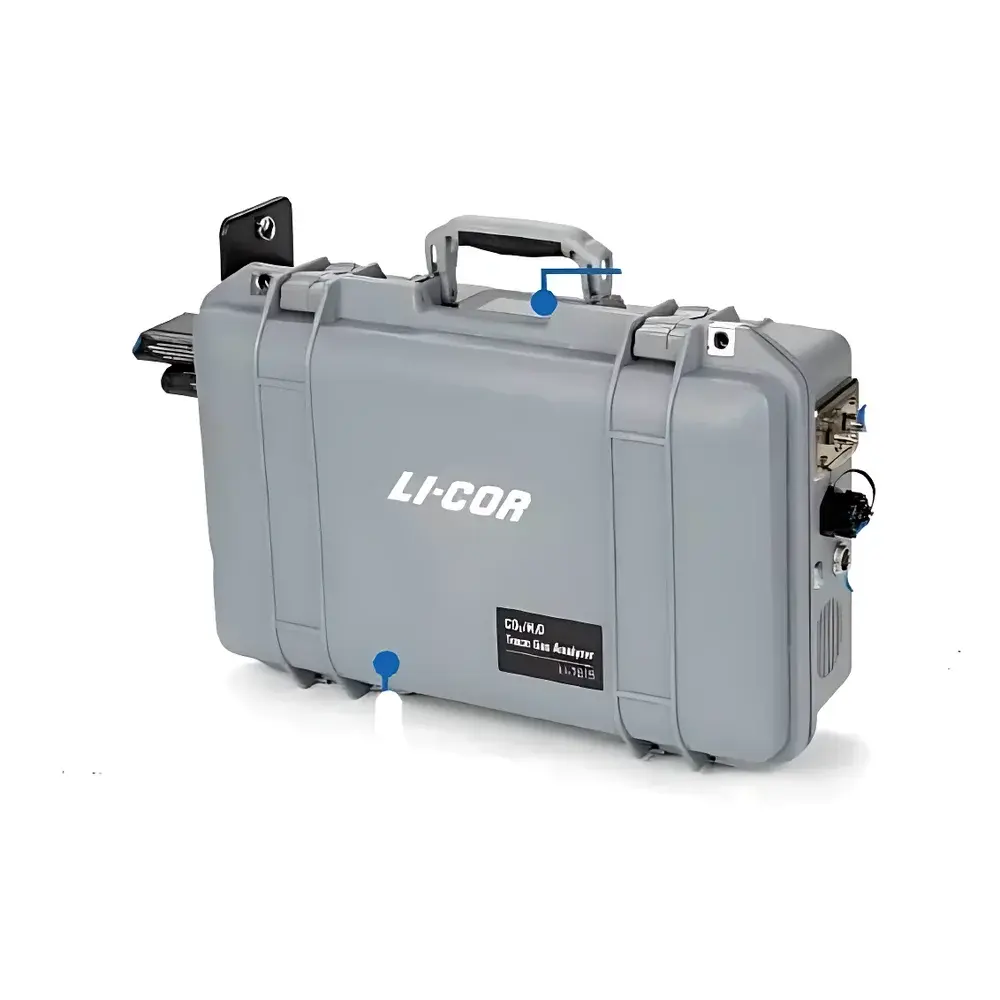
LI-COR LI-7815 High-Precision CO₂/H₂O Gas Analyzer
| Brand | LI-COR |
|---|---|
| Origin | USA |
| Model | LI-7815 |
| Measurement Principle | Optical Feedback–Cavity Enhanced Absorption Spectroscopy (OF-CEAS) |
| Measurement Frequency | 1 Hz |
| Cavity Volume | 6.41 cm³ |
| Sample Flow Rate | 250 sccm (standard mL/min) |
| CO₂ Range | 0–10,000 µmol/mol |
| CO₂ Precision (1σ) | 0.04 µmol/mol @ 400 µmol/mol (5-s average), 0.10 µmol/mol @ 400 µmol/mol (1-s average) |
| CO₂ Drift | < 0.2 µmol/mol per 24 h |
| H₂O Range | 0–60,000 µmol/mol |
| H₂O Precision (1σ) | 20 µmol/mol @ 10,000 µmol/mol (5-s average), 45 µmol/mol @ 10,000 µmol/mol (1-s average) |
| Response Time (T₁₀–T₉₀) | ≤2 s for CO₂ (0 → 400 µmol/mol) |
| Operating Temperature | −25 °C to +45 °C (non-direct-sunlight ambient) |
| Operating Humidity | 0–85 % RH (non-condensing, ambient) |
| sample line | 0–99.9 % RH (non-condensing) |
| Pressure Range | 70–110 kPa (high-altitude mode: 50–110 kPa) |
| Power Consumption | 22 W @ 25 °C (steady state) |
| AC Input | 100–240 VAC, 50–60 Hz |
| Battery Runtime | ~8 h with two standard batteries |
| Weight | 10.5 kg (including battery) |
| Dimensions (L×H×W) | 51 × 33 × 18 cm |
| Connectivity | Ethernet and Wi-Fi (2.4 GHz, IEEE 802.11 a/b/g/n/ac) |
| Onboard Data Storage | Up to 3 months of 1-Hz data |
| Internal Web Server | Yes (accessible via browser over wired or wireless network) |
Overview
The LI-COR LI-7815 High-Precision CO₂/H₂O Gas Analyzer is an engineered solution for continuous, field-deployable trace gas quantification in environmental and ecological research. Based on Optical Feedback–Cavity Enhanced Absorption Spectroscopy (OF-CEAS), the instrument delivers laboratory-grade precision in a portable platform—eliminating the need for routine calibration while maintaining long-term measurement stability. OF-CEAS combines high-finesse optical cavities with real-time laser frequency stabilization to achieve sub-part-per-trillion effective pathlengths (>20 km), enabling detection limits and signal-to-noise performance unattainable with conventional non-dispersive infrared (NDIR) or tunable diode laser absorption spectroscopy (TDLAS) systems. Designed for unattended operation in remote or infrastructure-limited settings, the LI-7815 supports autonomous monitoring across diverse deployment modes—including eddy covariance towers, soil flux chambers (e.g., paired with the LI-8200-01 Smart Chamber), mobile platforms, and controlled-environment respiration assays.
Key Features
- Calibration-free operation enabled by intrinsic spectral stability of OF-CEAS architecture and embedded reference channel monitoring.
- Ultra-low 24-hour CO₂ drift (< 0.2 µmol/mol), verified under field-representative thermal and pressure conditions per ASTM D6348-16 guidelines for trace gas analyzer validation.
- Integrated dual-gas measurement: simultaneous, independent quantification of CO₂ and H₂O vapor at 1 Hz, with cross-sensitivity correction validated per ISO 17025-compliant protocols.
- Robust mechanical design: IP54-rated enclosure with UV-stabilized polycarbonate housing, rated for continuous outdoor exposure in temperate and arid climates.
- Low-power architecture optimized for solar-powered deployments—22 W nominal draw enables >7-day operation with standard 100 Ah LiFePO₄ battery banks.
- Embedded web server with TLS-secured HTTP interface: real-time access to live data streams, diagnostic logs, firmware updates, and configuration management via any standards-compliant browser.
Sample Compatibility & Compliance
The LI-7815 accepts sample gas across a broad humidity range (0–99.9 % RH in the inlet line, non-condensing), making it compatible with untreated ambient air, chamber headspace, and biological respiration effluents without external drying or conditioning. Its pressure-compensated algorithm ensures accuracy across altitudes from sea level to 5,500 m (enabled via high-altitude mode). The analyzer meets electromagnetic compatibility requirements per FCC Part 15 Class B and CE EN 61326-1:2013. Data integrity complies with ALCOA+ principles (Attributable, Legible, Contemporaneous, Original, Accurate, Complete, Consistent, Enduring, Available) for GLP/GMP-aligned environmental studies. While not FDA 21 CFR Part 11 certified out-of-the-box, audit trails, user-access controls, and electronic signature support can be implemented via third-party data acquisition software meeting Part 11 requirements.
Software & Data Management
Data are timestamped using internal GPS-synchronized NTP (when connected to external GNSS) or high-stability TCXO (±0.5 ppm). Raw spectra, calibrated concentrations, diagnostics (cavity alignment status, laser lock quality, pressure/temperature readings), and system health metrics are stored onboard in binary format (LI-COR .dat v3.1), supporting post-processing with LI-COR’s EddyPro® or open-source tools (e.g., Python-based li7815io library). Ethernet and Wi-Fi interfaces support both static IP and DHCP configurations; data export options include CSV streaming over HTTP GET, FTP push, or direct integration with Campbell Scientific CR-series dataloggers via Modbus TCP. Firmware updates preserve user-defined configurations and historical calibration metadata.
Applications
- Soil carbon flux quantification using automated closed- or open-path chamber systems (e.g., LI-8200-01), with automatic temperature/pressure compensation aligned with AmeriFlux and ICOS protocols.
- Urban atmospheric monitoring networks—deployed on rooftops or mobile platforms to characterize spatial gradients in CO₂ concentration linked to traffic emissions, building energy use, or green infrastructure efficacy.
- In situ plant and ecosystem respiration studies, including fruit ripening kinetics, small-mammal metabolic rate assessment, and mycorrhizal CO₂ dynamics in rhizosphere microcosms.
- Validation of satellite-based column CO₂ retrievals (e.g., OCO-2/3, GOSAT) through ground-truth time series at TCCON or NOAA Global Greenhouse Gas Reference Network sites.
- Short-term emission source identification via mobile mapping (‘sniffer’ mode), synchronized with GNSS position and inertial navigation data for plume attribution modeling.
FAQ
Does the LI-7815 require periodic calibration with certified gas standards?
No. The OF-CEAS optical architecture provides inherent long-term stability. Field verification against primary standards is recommended annually for QA/QC, but operational calibration is not required between verifications.
Can the LI-7815 operate unattended for extended periods in extreme temperatures?
Yes. It is rated for −25 °C to +45 °C ambient operation. For sustained sub-zero deployments, optional heated inlet lines and cavity thermal stabilization kits are available to maintain dew point control and optical alignment.
Is raw spectral data accessible for custom processing?
Yes. Binary-format spectral dumps (wavelength-resolved absorbance) are logged alongside concentration outputs and can be extracted via USB or network interface for advanced spectral fitting or interference analysis.
How is data security handled during wireless transmission?
Wi-Fi communication uses WPA2-PSK encryption. The embedded web server supports HTTPS with user-configurable TLS certificates. All remote configuration changes require authenticated session tokens with role-based access control.
What maintenance is required for long-term field deployment?
None beyond periodic inlet filter replacement (every 3–6 months depending on particulate load) and visual inspection of optical windows for dust accumulation. No consumables, lasers, or detectors require scheduled replacement within the 10-year design lifetime.
Related Products







