
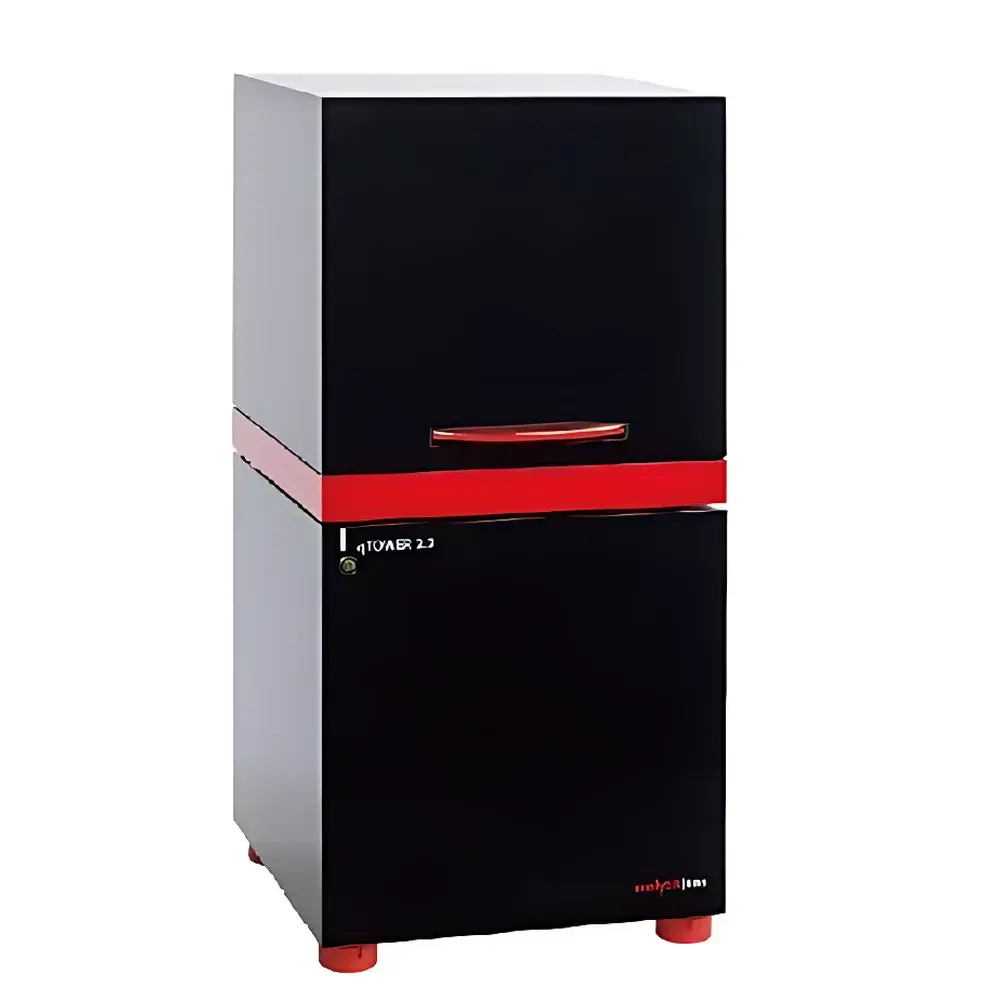
analytikjena qTOWER3G Real-Time Fluorescence Quantitative Gradient PCR System
| Brand | analytikjena |
|---|---|
| Origin | Germany |
| Model | qTOWER3G |
| Instrument Type | Real-Time Fluorescence Quantitative PCR System |
| Sample Capacity | 96-well format |
| Max Heating Rate | 8 °C/s |
| Temperature Accuracy | ±0.1 °C |
| Temperature Uniformity | ±0.15 °C |
| Linear Gradient Range | 12-column independent gradient |
| Detection Sensitivity | Single-copy DNA detection |
| Dynamic Range | 10 orders of magnitude |
| Optical Channels | Up to 6 channels (configurable 1–6) |
| Excitation/Detection Filter Sets | 12 interchangeable combinations including FRET and protein melting-optimized configurations |
| Light Source | RGBW high-intensity LEDs (blue, green, red, white) |
| Detector | Channel-type Photomultiplier Tube (CPMT) |
| Scanning Method | 8-channel fiber-optic simultaneous detection |
| Scan Time | 6 s for full 96-well plate (6-channel mode) |
| Cycle Time | ≤45 min for 40 cycles |
| Thermal Block | Gold-plated pure silver Peltier module |
| Heat Lid | 110 °C max, auto-pressure adjustment up to 10 kg/plate |
| Reaction Volume | 10–80 µL |
| Noise Level | ≤45 dB(A) |
| Connectivity | USB, RS232, Ethernet |
| Dimensions (W×H×D) | 275 × 585 × 275 mm |
| Weight | ~30 kg |
Overview
The analytikjena qTOWER3G is a purpose-built real-time fluorescence quantitative PCR system engineered for precision, reproducibility, and experimental flexibility in molecular diagnostics, gene expression profiling, pathogen quantification, and SNP genotyping. Unlike retrofitted conventional thermal cyclers, the qTOWER3G integrates a dedicated optical architecture, high-fidelity thermal control, and MIQE-compliant software from the ground up. Its core measurement principle relies on sequence-specific fluorescent probe or intercalating dye signal accumulation during exponential amplification, with real-time acquisition synchronized to each temperature transition. The system employs a robust Peltier-based thermal module with gold-plated pure silver reaction block—ensuring rapid heat transfer, exceptional corrosion resistance, and long-term calibration stability. Combined with a 12-column linear temperature gradient function, it enables empirical optimization of annealing conditions across a single run—critical for assay development, multiplex primer validation, and melt-curve-based discrimination of closely related alleles.
Key Features
- Modular 6-channel optical system: Configurable from 1 to 6 detection channels; field-upgradable without hardware replacement.
- 12 programmable excitation/emission filter sets: Includes FRET-optimized mismatched pairs and specialized filters for high-resolution protein thermal shift assays (e.g., DSF).
- RGBW LED light source: Four solid-state, non-thermal, long-lifetime emitters covering 450–650 nm; eliminates lamp drift and warm-up delays while delivering uniform spectral intensity.
- Channel-type photomultiplier tube (CPMT) detection: Provides low-noise, high-gain signal acquisition with superior signal-to-background ratio compared to CCD or PMT array alternatives.
- 8-channel fiber-optic scanning: Simultaneous readout of 8 wells per scan cycle; full 96-well plate completed in 6 seconds under 6-channel mode—no ROX normalization required, though ROX reference channel remains optional.
- Thermal performance: ±0.1 °C absolute accuracy and ±0.15 °C well-to-well uniformity over full 96-well block; maximum heating/cooling rates of 8 °C/s and 6 °C/s respectively.
- Intelligent heat lid: Programmable up to 110 °C with dynamic pressure compensation (up to 10 kg/plate), minimizing evaporation in low-volume reactions (10–80 µL).
Sample Compatibility & Compliance
The qTOWER3G accommodates standard 96-well plates, 0.2 mL 8-tube strips, and individual PCR tubes—compatible with all major commercial master mixes and probe chemistries (TaqMan®, SYBR® Green I, EvaGreen®, Molecular Beacons). Its thermal design supports high-fidelity amplification of GC-rich templates, long amplicons (>5 kb), and AT-rich sequences without bias. From a regulatory standpoint, the system supports audit-ready workflows compliant with ISO/IEC 17025, CLIA, and CAP requirements. Data integrity is reinforced via built-in electronic logs, user-access controls, and optional 21 CFR Part 11–compliant software modules (available upon request). All instrument calibrations adhere to manufacturer-defined traceable protocols aligned with DIN EN 61010-1 safety standards.
Software & Data Management
The qPCRsoft suite is provided free of charge, with unlimited installation rights and lifetime version updates. It delivers full analytical functionality—including absolute quantification, dual-standard curve relative quantification, ΔΔCt with amplification efficiency correction (LinRegPCR integration), high-resolution melt (HRM) analysis, allelic discrimination, endpoint genotyping, and PCR efficiency modeling. Reports conform to Minimum Information for Publication of Quantitative Real-Time PCR Experiments (MIQE) guidelines, generating structured metadata-rich PDFs with embedded raw fluorescence traces, amplification plots, melt curves, and statistical summaries. Data export supports CSV, Excel, and XML formats for LIMS integration. Audit trails record all user actions, parameter changes, and result modifications with timestamps and operator IDs—enabling full GLP/GMP traceability.
Applications
The qTOWER3G serves as a primary platform for clinical molecular laboratories performing viral load monitoring (e.g., HIV, HBV, SARS-CoV-2), oncology biomarker testing (e.g., BCR-ABL1, EGFR mutations), food safety pathogen screening (Salmonella, Listeria), agricultural GMO detection, and academic research in functional genomics. Its gradient capability accelerates assay optimization for novel primer sets, while its single-copy sensitivity and 10-log dynamic range support both rare transcript detection and highly abundant target quantification within the same run. The integrated protein melting analysis option extends utility into biophysical characterization of recombinant proteins and ligand-binding studies.
FAQ
Is the qTOWER3G compatible with third-party reagents and consumables?
Yes—it accepts all commercially available 96-well PCR plates, tubes, and master mixes without proprietary lock-in.
Does the system require routine optical recalibration?
No—RGBW LEDs and CPMT detector are factory-calibrated with no scheduled maintenance or user-performed optical alignment.
Can gradient PCR data be analyzed alongside standard qPCR runs in the same software session?
Yes—gradient profiles are stored as discrete experimental conditions and can be cross-compared using side-by-side amplification/melt overlays.
What network security protocols does the instrument support?
It operates on standard TCP/IP networks with configurable firewall ports; authentication is managed via local OS-level user accounts or LDAP integration.
Is remote monitoring or unattended operation supported?
Yes—scheduled runs, email notifications upon completion, and live status dashboards are enabled through the qPCRsoft Remote Manager extension.



