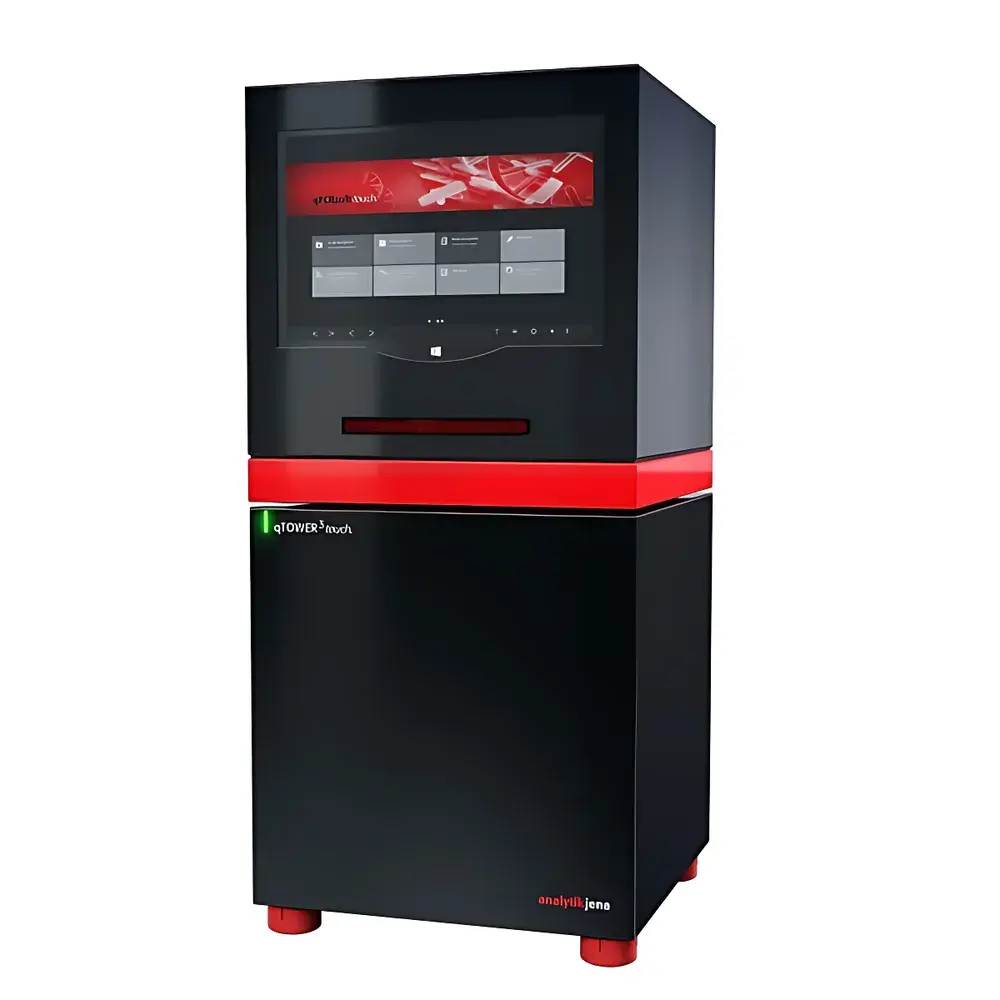
Analytik Jena qTOWER3G touch Real-Time Fluorescence Quantitative PCR System
| Brand | Analytik Jena |
|---|---|
| Origin | Shanghai, China |
| Model | qTOWER3G touch |
| Instrument Type | Real-Time Fluorescence Quantitative PCR System |
| Sample Capacity | 96-well |
| Maximum Heating Rate | 8 °C/s |
| Temperature Accuracy | ±0.1 °C |
| Well-to-Well Temperature Uniformity | ±0.10 °C |
| Excitation Source | Four Solid-State RGBW LEDs (Blue, Green, Red, White) |
| Detection System | 8-Channel Fiber-Optic Scanning with Channel-Type PMT Detectors |
| Temperature Gradient | 12-Column Linear Gradient |
| Thermal Lid | Motorized Auto-Lid with Pressure & Height Adjustment |
| Compatible Consumables | Standard 96-Well Plates, 8-Tube Strips, Single Tubes |
| Optical Channels | Configurable 1–6 Channels with 12 Optional Filter Sets (including FRET and Protein Melting Analysis Configurations) |
| Software | qPCRsoft v5.x (MIQE-Compliant Reporting, Audit Trail, CFR Part 11 Ready) |
Overview
The Analytik Jena qTOWER3G touch is a benchtop real-time fluorescence quantitative PCR system engineered for precision, reproducibility, and operational flexibility in molecular diagnostics, academic research, and quality control laboratories. It operates on the principle of sequence-specific nucleic acid amplification monitored in real time via fluorescent reporter chemistries—including intercalating dyes (e.g., SYBR Green I), hydrolysis probes (TaqMan), hybridization probes, and FRET-based assays. Its core thermal architecture features a gold-plated pure silver heating block, delivering exceptional thermal conductivity, corrosion resistance, and long-term stability—critical for high-fidelity amplification across all 96 wells. The system achieves ±0.1 °C temperature accuracy and ±0.10 °C well-to-well uniformity over the full 96-well format, meeting stringent requirements for quantitative assay validation under ISO/IEC 17025 and CLIA frameworks.
Key Features
- High-Performance Thermal Module: Gold-plated pure silver sample block enables rapid thermal ramping up to 8 °C/s and maintains tight temperature control across the entire 96-well plate—ensuring consistent denaturation, annealing, and extension kinetics.
- Multi-LED Excitation Architecture: Four independently controlled solid-state RGBW LEDs (blue, green, red, white) provide broad-spectrum, high-intensity excitation without thermal load or lamp degradation—eliminating routine source replacement and enabling lifetime optical stability.
- 8-Channel Fiber-Optic Scanning Detection: A fixed-path, scanning-based optical system acquires fluorescence signals simultaneously from all 96 wells using eight parallel fiber-optic channels coupled to channel-type photomultiplier tube (PMT) detectors—delivering superior signal-to-noise ratio and eliminating well-position bias.
- True 6-Channel Flexibility: No dedicated calibration channel is required due to path-length consistency across all wells; users configure 1–6 detection channels using any combination of 12 available filter sets—including specialized configurations for FRET pair detection and protein melting curve analysis.
- 12-Column Linear Temperature Gradient: Enables precise, independent temperature profiling across 12 columns (not rows), facilitating rapid empirical optimization of annealing conditions for primer pairs with divergent Tm values.
- Motorized Auto-Thermal Lid: Dynamically adjusts lid height and contact pressure to accommodate varying tube heights and cap types—maintaining consistent vapor-tight sealing and minimizing evaporation during extended cycling protocols.
Sample Compatibility & Compliance
The qTOWER3G touch accepts standard ANSI/SBS-compliant 96-well plates, 8-tube strips, and individual PCR tubes—requiring no proprietary consumables. This open-platform design supports method transfer across laboratories and simplifies reagent sourcing. The instrument complies with IEC 61010-1 (Safety Requirements for Electrical Equipment for Measurement, Control, and Laboratory Use) and meets electromagnetic compatibility (EMC) standards per EN 61326-1. When operated with qPCRsoft v5.x configured for audit trail logging, electronic signatures, and user access controls, the system supports compliance with FDA 21 CFR Part 11, EU Annex 11, and GLP/GMP documentation requirements for regulated environments.
Software & Data Management
qPCRsoft v5.x is a validated, standalone Windows application designed for end-to-end qPCR data acquisition, analysis, and reporting. It implements MIQE (Minimum Information for Publication of Quantitative Real-Time PCR Experiments) guidelines by default—automatically capturing instrument metadata, protocol parameters, and raw fluorescence traces. Supported analysis modes include absolute quantification (standard curve), relative quantification (ΔΔCt with amplification efficiency correction), melt curve analysis (with derivative peak calling), allelic discrimination (SNP genotyping), endpoint fluorescence evaluation, and PCR efficiency calculation (LinRegPCR integration). All reports are exportable in PDF, Excel, and XML formats; audit trails record user actions, parameter changes, and result modifications with timestamps and operator IDs—enabling full traceability for regulatory submissions.
Applications
The qTOWER3G touch serves as a foundational platform for applications demanding high sensitivity, multiplex capability, and analytical rigor. These include: gene expression profiling in translational research; pathogen load quantification in clinical virology and bacteriology; SNP genotyping and pharmacogenomic screening; GMO and food authenticity testing; viral load monitoring in antiviral therapy; and quality control of biologics and cell therapies. Its robust thermal performance and flexible optical configuration also support emerging applications such as digital PCR pre-amplification, methylation-specific PCR, and protein thermal shift assays when combined with appropriate dye chemistries.
FAQ
Is the qTOWER3G touch compatible with third-party qPCR reagents and master mixes?
Yes—the system is fully open-platform and validated with major commercial SYBR Green and probe-based chemistries from Thermo Fisher Scientific, Bio-Rad, Takara Bio, and Qiagen.
Can the optical configuration be upgraded after purchase?
Yes—channel count and filter sets can be added or modified in the field via software license activation and hardware module installation, without requiring instrument return to service.
Does the system support remote monitoring or networked operation?
qPCRsoft supports local area network (LAN) deployment with centralized data archiving; remote desktop access is permitted under IT-administered security policies, but cloud connectivity is not implemented to preserve data sovereignty.
What maintenance is required for the LED excitation sources?
None—the RGBW LED array is rated for >50,000 hours of continuous operation and requires no alignment, recalibration, or replacement during the instrument’s service life.
How is temperature gradient functionality implemented?
The 12-column gradient applies discrete, user-defined temperatures across columns 1–12—ideal for optimizing multi-primer assays or evaluating primer-dimer formation across a range of annealing temperatures in a single run.
Related Products