
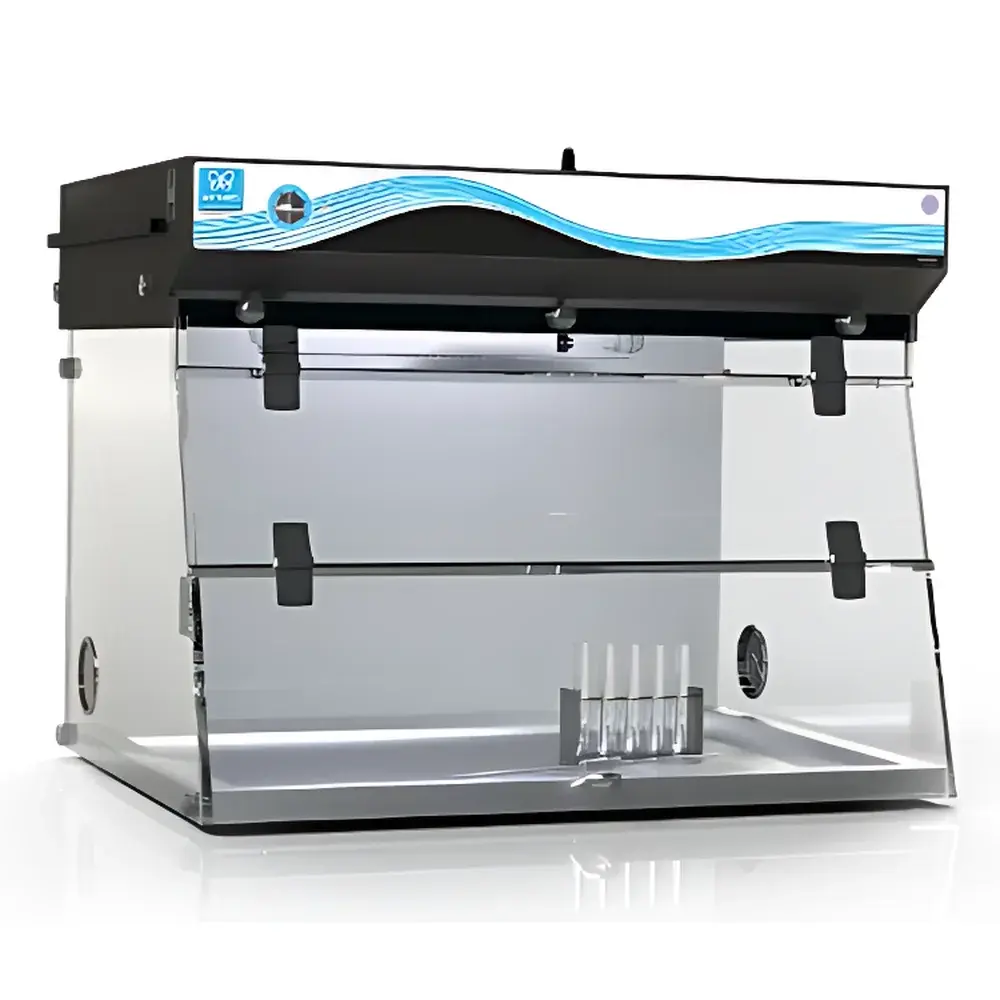
Erlab Captair Bio 320 Vertical Flow Clean Bench
| Brand | Erlab |
|---|---|
| Origin | France |
| Model | Captair Bio 320 |
| Flow Type | Vertical Laminar Flow |
| Dimensions (W×D×H) | 825 × 630 × 647 mm |
| Category | Class II Biological Safety Cabinet Alternative (Non-Containment, Personnel/Environmental Protection Not Provided) |
| Regulatory Designation | ISO 14644-1 Class 5 (ISO Class 5 / Fed Std 209E Class 100) Compliant Work Surface |
Overview
The Erlab Captair Bio 320 is a certified vertical laminar flow clean bench engineered for contamination-sensitive applications in molecular biology, cell culture preparation, PCR setup, and sterile media handling. Unlike biological safety cabinets, the Captair Bio 320 is designed exclusively for product protection—not personnel or environmental protection—making it ideal for non-hazardous, low-risk procedures where ultra-clean airflow over the work surface is paramount. Its core principle relies on ISO 14644-1 compliant vertical laminar airflow: HEPA-filtered air (≥99.995% @ 0.3 µm) is delivered uniformly downward at a controlled velocity (0.3–0.5 m/s) across the entire work area, minimizing turbulent eddies and particle resuspension. The unit meets ISO Class 5 (formerly Fed Std 209E Class 100) cleanroom performance standards when operated under validated conditions and maintained per manufacturer-specified filter replacement intervals and airflow calibration protocols.
Key Features
- Vertically oriented, unidirectional HEPA-filtered airflow ensuring consistent particle-free environment across the full 825 mm wide work surface
- Integrated pre-filter and H14-class HEPA filter (EN 1822-1:2019 certified), with filter life monitoring and visual status indicator
- Ergonomically optimized height (647 mm total; work surface ~750 mm AGL) and depth (630 mm) to support seated and standing operation while maintaining optimal arm clearance and workflow efficiency
- Corrosion-resistant 304 stainless steel work surface and front grille, compatible with common laboratory disinfectants including 70% ethanol and diluted sodium hypochlorite
- Low-noise DC motor-driven blower system (<62 dB[A] at 1 m), enabling extended use in shared lab environments without acoustic interference
- Touch-free LED lighting (500–600 lux at work surface) with uniform illumination distribution and UV-free spectrum to prevent DNA/RNA photodamage during PCR prep
- Optional integrated UV-C germicidal lamp (254 nm, timer-controlled) for pre-use surface decontamination—compliant with IEC 62471 photobiological safety classification
Sample Compatibility & Compliance
The Captair Bio 320 accommodates standard PCR tube racks (0.2 mL, 0.5 mL), 96-well plates, microcentrifuge tubes, pipette tip boxes, and small-scale tissue culture vessels (e.g., T25 flasks). Its open-front design permits unrestricted access for manual manipulation while maintaining laminar integrity. The unit complies with ISO 14644-1:2015 (Cleanrooms and associated controlled environments) for airborne particulate cleanliness and EN 61326-1:2013 (EMC requirements for laboratory equipment). It is CE-marked under the EU Machinery Directive 2006/42/EC and Low Voltage Directive 2014/35/EU. While not classified as a biological safety cabinet per NSF/ANSI 49, its validation protocol aligns with GLP-relevant documentation practices—including airflow mapping, filter integrity testing (DOP/PAO scan), and operational qualification reports suitable for internal audit trails.
Software & Data Management
The Captair Bio 320 operates via a dedicated embedded control panel with real-time display of airflow velocity, filter differential pressure, and UV lamp operational hours. No proprietary software installation is required; however, optional data logging modules (via RS-485 or Modbus RTU interface) enable integration into centralized laboratory infrastructure management systems (LIMS or BMS). Audit-ready event logs—including filter change timestamps, UV cycle history, and airflow deviation alerts—are stored locally for ≥12 months and exportable in CSV format. All firmware updates adhere to IEC 62304 medical device software lifecycle standards, ensuring traceability and version control for regulated environments.
Applications
- Preparation of PCR master mixes, primer dilutions, and template DNA handling prior to thermal cycling
- Assembly of next-generation sequencing (NGS) libraries under low-particulate conditions
- Plating of transformed bacterial colonies and yeast cultures onto selective agar media
- Handling of sterile reagents, growth factors, and serum-free media formulations
- Quality control steps in diagnostic kit manufacturing where ISO Class 5 background is mandated
- Supporting ISO/IEC 17025-accredited testing laboratories requiring documented clean environment controls for method validation
FAQ
Does the Captair Bio 320 provide protection against biohazards or chemical vapors?
No. It is a product-protection-only clean bench and does not offer personnel or environmental protection. It must not be used with volatile toxic, radioactive, or pathogenic agents.
What is the recommended HEPA filter replacement interval?
Under typical usage (6–8 hrs/day, ISO Class 5 ambient), replacement is advised every 18–24 months—or sooner if differential pressure exceeds 250 Pa—per EN 1822 maintenance guidelines.
Can the unit be installed in a non-ISO-certified lab space?
Yes, but upstream ambient air quality directly affects performance. For reliable ISO Class 5 operation, the surrounding room should meet ISO 14644-1 Class 8 (100,000) or better, with controlled temperature (18–25°C) and humidity (30–60% RH).
Is the Captair Bio 320 compatible with electrical safety standards for clinical laboratories?
Yes. It conforms to IEC 61010-1:2010 for safety requirements of electrical equipment for measurement, control, and laboratory use, including leakage current limits and dielectric strength testing.
How is airflow uniformity validated during commissioning?
Per ISO 14644-3:2019 Annex B, validation requires anemometer-based point measurements at 100 mm intervals across a 3×3 grid over the work surface, confirming ±20% velocity variation and no turbulence-inducing recirculation zones.
Related Products



