
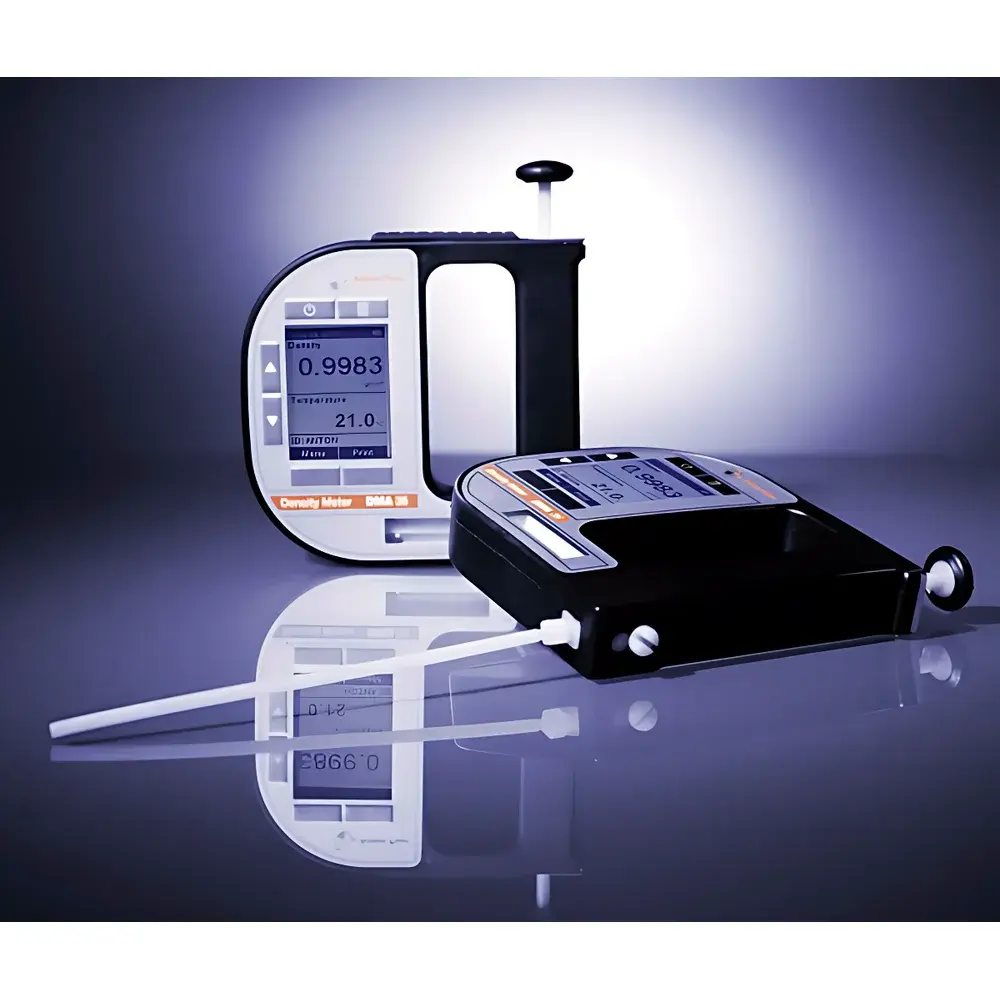
Anton Paar DMA35 Portable Oscillating U-Tube Densimeter
| Brand | Anton Paar |
|---|---|
| Origin | Austria |
| Model | DMA35 |
| Instrument Type | Portable Oscillating Tube Densimeter |
| Sample Type | Liquid |
| Density Range | 0–3 g/cm³ |
| Density Accuracy | ±0.001 g/cm³ |
| Density Resolution | 0.0001 g/cm³ |
| Temperature Range | 0–40 °C (operational range: −10 to +50 °C) |
| Temperature Accuracy | ±0.2 °C |
| Temperature Resolution | 0.1 °C |
| Density Repeatability | ±0.0005 g/cm³ |
| Minimum Sample Volume | 1–2 mL |
| Viscosity Limit | ≤100 mPa·s (for samples <2 g/cm³) |
| Data Storage Capacity | 1024 measurements |
| Communication Interfaces | IrDA infrared, RFID (Tag&Log version only) |
| Ingress Protection Rating | IP54 |
| Power Supply | 2 × AA alkaline batteries (1.5 V) |
| Dimensions | 140 × 138 × 27 mm |
| Weight | 368 g |
Overview
The Anton Paar DMA35 is a handheld, battery-powered oscillating U-tube densimeter engineered for high-precision density and related concentration measurements of liquid samples in field, production, and laboratory environments. Based on the fundamental principle of oscillating tube metrology—where the resonant frequency of a precisely manufactured U-shaped glass tube filled with sample correlates directly to its density—the DMA35 delivers traceable, SI-referenced density values compliant with ISO 12089, ASTM D4052, and DIN 51757 standards. Its compact architecture integrates a temperature-controlled measurement cell, piezoelectric excitation, and high-resolution frequency detection to ensure stability and reproducibility under variable ambient conditions. Designed for operational flexibility, the instrument operates across a broad temperature range (−10 °C to +50 °C), with active thermal equilibration enabling accurate density determination at user-defined setpoints from 0 °C to 40 °C.
Key Features
- Portable, single-hand operation with ergonomic design and integrated sample aspiration pump for rapid, contamination-minimized loading
- High-resolution density measurement up to 0.0001 g/cm³, with accuracy of ±0.001 g/cm³ and repeatability of ±0.0005 g/cm³
- Large backlit LCD display supporting multi-parameter readouts—including density, temperature, and derived units (e.g., % ethanol, Brix, API gravity, sulfuric acid concentration)—with customizable screen layout
- Onboard storage for 1024 complete measurement records, each timestamped and tagged with temperature, density, and user-defined metadata
- IP54-rated enclosure ensuring resistance to dust ingress and water splashes, suitable for industrial floor, refinery, or outdoor deployment
- Dual communication interfaces: IrDA for wireless data transfer to PCs or printers; optional RFID Tag&Log functionality for automated sample identification and audit-trail logging
- Preloaded calibration and conversion tables per international standards (USP, ISO, OIML), plus five user-definable concentration functions
Sample Compatibility & Compliance
The DMA35 is validated for Newtonian and mildly non-Newtonian liquids with kinematic viscosity below 100 mPa·s (at densities <2 g/cm³) and vapor pressure compatible with ambient-pressure measurement. It supports aqueous solutions, hydrocarbons, alcohols, organic solvents, coolants, and electrolytes—provided samples remain fully liquid within the operating temperature window and do not induce chemical attack on borosilicate glass or PTFE wetted components. Regulatory compliance includes full alignment with GLP data integrity requirements: all stored results include immutable timestamps, operator ID (via RFID tag), and system-generated calibration logs. The instrument meets FDA 21 CFR Part 11 readiness when paired with Anton Paar’s certified PC software (e.g., LabX Lite), supporting electronic signatures, audit trails, and secure user access control.
Software & Data Management
Data export is supported via IrDA to Windows-based systems running Anton Paar’s LabX Lite or third-party spreadsheet applications. Each measurement record contains raw oscillation period, temperature-corrected density, standard deviation over three internal oscillations, and optional concentration output. The embedded firmware enables CSV-formatted batch export, configurable auto-zero routines, and periodic self-diagnostic checks (e.g., tube cleanliness verification, battery voltage monitoring). For regulated environments, optional LabX Connect licenses extend functionality to full 21 CFR Part 11 compliance—including role-based permissions, electronic signature workflows, and encrypted database archiving with SHA-256 hashing.
Applications
- Quality control of fuels and lubricants (API gravity, distillation cut verification)
- In-process monitoring of fermentation broths and alcoholic beverages (% alcohol by volume)
- Concentration verification of battery electrolytes, antifreeze mixtures, and cleaning agents
- Field testing of geological fluid samples (brines, drilling mud filtrates)
- Educational laboratories requiring portable, standards-compliant density instrumentation
- Pharmaceutical excipient qualification per USP and EP 2.2.39
FAQ
What is the minimum sample volume required for reliable measurement?
A volume of 1–2 mL is sufficient; the integrated micro-pump ensures complete tube filling with minimal manual handling.
Can the DMA35 measure viscous or suspended samples?
It is optimized for low-to-moderate viscosity liquids (<100 mPa·s); particulates or high-viscosity fluids may impair oscillation stability and require filtration or dilution.
How is temperature control achieved without external cooling/heating?
The instrument uses Peltier-assisted thermal stabilization of the measuring cell, maintaining setpoint accuracy within ±0.2 °C across ambient conditions from −10 °C to +50 °C.
Is calibration traceable to national standards?
Yes—factory calibration is performed using NIST-traceable water and air standards; users may perform two-point calibration with certified reference materials (e.g., dry air and pure water at 20 °C).
Does the device support GMP-compliant documentation?
When used with LabX Lite or LabX Connect software, it generates ALCOA+ compliant records—including audit trails, electronic signatures, and version-controlled method files—fully auditable during regulatory inspections.



