
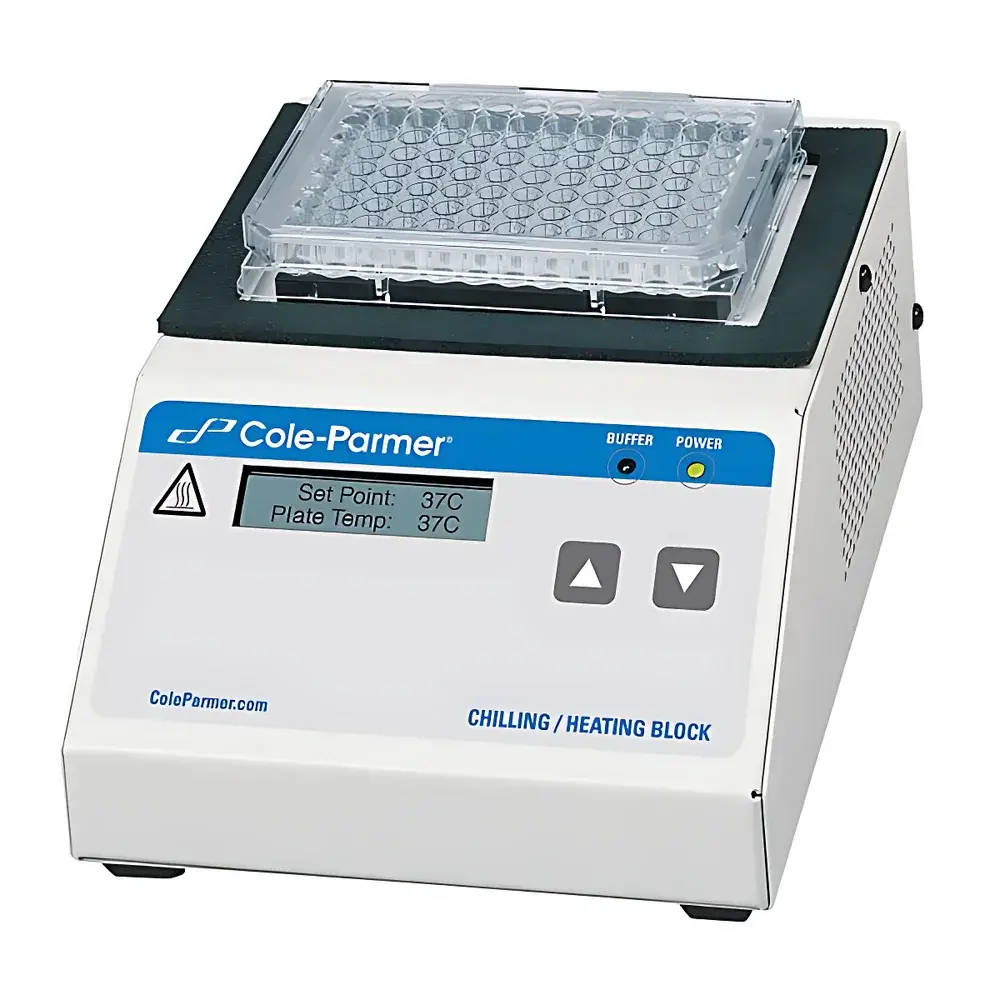
Cole-Parmer 44175-xx Programmable Thermo-Controlled Heating/Cooling Block System
| Brand | Cole-Parmer |
|---|---|
| Origin | USA |
| Model | 44175-xx |
| Temperature Range | −10 °C to 100 °C (1 °C increment) |
| Temperature Accuracy | ±1 °C |
| Mixing Speed | 200–1000 rpm |
| Heating Rate | 4 °C/min |
| Cooling Rate | 2 °C/min (from ambient to 100 °C), 1 °C/min (from ambient to −10 °C) |
| Timer Range | 1 min to 30 days with audible alarm and auto-shutdown |
| Programmable Protocols | 5 stored programs, up to 10 steps per program (temperature, time, speed) |
| Auto-repeat | 1–99 cycles |
| Communication Interface | RS-232 |
| Power Input | 100–240 V AC |
Overview
The Cole-Parmer 44175-xx Programmable Thermo-Controlled Heating/Cooling Block System is an engineered solution for precise thermal management of biological and chemical samples in research, clinical, and quality control laboratories. Unlike conventional water baths or dry-block heaters, this system integrates thermoelectric (Peltier) heating and cooling technology—enabling bidirectional temperature control without external chillers or cryogens. Its core architecture supports stable setpoint maintenance across the full operational range of −10 °C to 100 °C, with resolution to 1 °C and accuracy of ±1 °C under standard laboratory conditions (23 °C ambient, still air). The system’s modular block design accommodates a wide variety of sample formats—including microcentrifuge tubes, PCR strips, microplates, and test tubes—while maintaining uniform thermal distribution across all wells within a given block. This eliminates gradient-related variability common in immersion-based systems and ensures reproducibility critical for enzyme kinetics, nucleic acid hybridization, immunoassay incubation, and controlled denaturation studies.
Key Features
- Thermoelectric (Peltier) temperature control enables rapid, reversible heating and cooling without consumables or external refrigeration units
- Dual-line LCD display simultaneously shows real-time temperature and user-defined setpoint
- Programmable timer with 1-minute to 30-day range, audible alarm, and automatic power-down upon completion
- Integrated data logging capability with RS-232 serial interface for bidirectional communication—supports remote parameter adjustment, real-time monitoring, and timestamped temperature/mixing event export
- Five user-storable protocols, each configurable with up to ten sequential steps combining temperature, dwell time, and mixing speed (200–1000 rpm)
- Auto-repeat function allows execution of selected protocols 1–99 times without manual intervention
- Voltage-flexible power supply (100–240 V AC, 50/60 Hz) ensures global compatibility and stable operation under variable line conditions
Sample Compatibility & Compliance
The 44175-xx platform accepts interchangeable aluminum heating/cooling blocks designed for standardized laboratory consumables. Compatible configurations include: 40×0.5 mL tubes, 30×1.5 mL tubes, 40×0.5 mL + 15×1.5 mL dual-format blocks; 96-well and 384-well flat-bottom microplates; 96×0.2 mL PCR plates; and tube holders for 12×15/16 mm or 20×12/13 mm formats. All blocks are precision-machined to ensure consistent well geometry and thermal coupling. While the device itself does not carry CE IVD or FDA 510(k) clearance, its operational parameters align with routine use requirements under ISO/IEC 17025-accredited testing environments. When deployed in GLP or GMP workflows, the RS-232 interface supports integration into validated data acquisition systems compliant with FDA 21 CFR Part 11 when paired with appropriate audit-trail-enabled software.
Software & Data Management
Data exchange occurs via ASCII-based RS-232 protocol at default settings (9600 baud, 8N1). The system transmits live temperature readings, current RPM, elapsed time, and active step number. Logged data includes timestamps (YYYY-MM-DD HH:MM:SS), temperature (°C), and speed (rpm) at user-configurable intervals (default: 10-second sampling). No proprietary drivers or cloud services are required—raw output can be parsed by LabVIEW, Python (pySerial), MATLAB, or Excel with serial port add-ins. For regulated environments, laboratories may implement third-party electronic lab notebook (ELN) or LIMS interfaces that enforce user authentication, change tracking, and electronic signature capture prior to data archival.
Applications
- Enzyme activity assays requiring strict thermal staging (e.g., restriction digests, ligations, phosphatase treatments)
- Controlled DNA denaturation and annealing in PCR setup and post-amplification handling
- Antibody-antigen binding optimization in ELISA development
- Cell lysis and protein extraction protocols with temperature-dependent detergent activation
- Long-duration incubations for microbial growth inhibition or metabolic profiling
- Calibration verification of thermocouples and digital thermometers against NIST-traceable references
FAQ
Does the 44175-xx require calibration certification?
No factory-issued calibration certificate is included, but the unit features a user-accessible offset adjustment function (±5 °C range) to align displayed temperature with a reference thermometer traceable to national standards.
Can multiple blocks operate at different temperatures simultaneously?
Only the 44175-06 dual-position variant supports independent temperature control of two blocks. The 44175-04 and other single-block models regulate one thermal zone only.
Is condensation management addressed in sub-zero operation?
Yes—blocks are anodized and sealed to minimize moisture ingress; however, users should avoid rapid transitions from humid ambient conditions to −10 °C to prevent surface dew formation on samples or caps.
What is the expected service life of the Peltier modules?
Rated for ≥100,000 thermal cycles (defined as one full ramp from −10 °C to 100 °C and back), assuming continuous operation within specified ambient temperature (15–30 °C) and relative humidity (<80% non-condensing).
Are replacement blocks available with custom well configurations?
Cole-Parmer offers a limited catalog of certified blocks; non-standard configurations require OEM engineering review and are subject to minimum order quantities and lead time.
Related Products



