
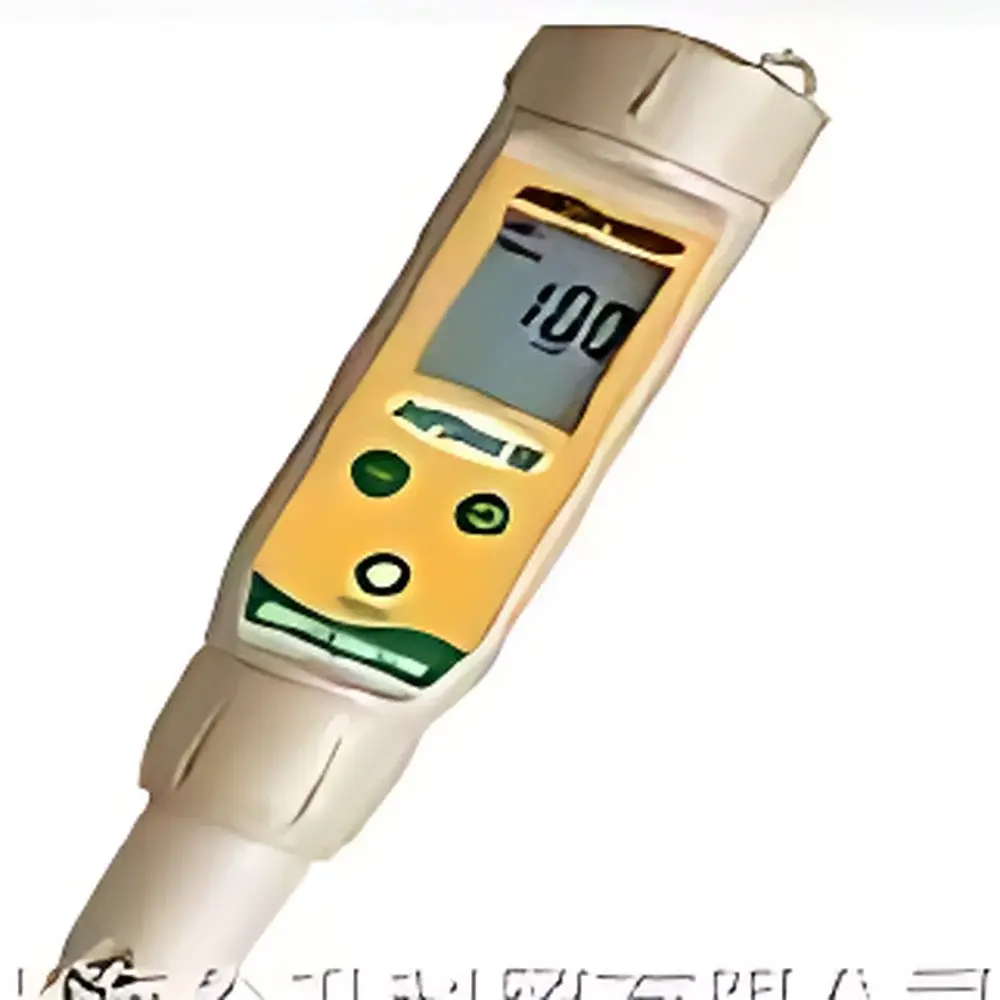
Thermo Fisher ORPTestr 10 Portable ORP Meter
| Brand | Thermo Fisher |
|---|---|
| Origin | USA |
| Model | ORPTestr 10 |
| Electrode Type | Double-Junction |
| Interface | BNC (ORPTestr 10 BNC variant) |
| Measurement Range | −999 to +1000 mV |
| Resolution | 1 mV |
| Accuracy | ±2 mV |
| Calibration | Single-point manual |
| Temperature Compensation | None |
| Operating Temperature | 0–50 °C |
| Display | Dual-line LCD (2.1 × 2.7 cm) |
| Power | 4 × 1.5 V button cells |
| Battery Life | >500 hours |
| Dimensions (Instrument Only) | 16.5 × 3.8 cm |
| Weight (Instrument Only) | 90 g |
| Packaging Dimensions | 18.5 × 6.5 × 5 cm |
| Package Weight | 200 g |
Overview
The Thermo Fisher ORPTestr 10 is a compact, handheld redox potential meter engineered for field-deployable and routine laboratory measurement of oxidation-reduction potential (ORP) in aqueous solutions. Based on potentiometric principle, the instrument measures the voltage difference between a noble-metal sensing electrode (typically platinum or gold) and a stable reference electrode—expressed in millivolts (mV) relative to the Standard Hydrogen Electrode (SHE). Unlike pH meters that require two-point calibration and temperature compensation, ORP measurement reflects the thermodynamic tendency of a solution to gain or lose electrons, making it critical for monitoring disinfection efficacy, wastewater treatment redox conditions, electroplating bath stability, and corrosion inhibition systems. The ORPTestr 10 employs a microprocessor-controlled analog-to-digital conversion architecture to ensure signal stability and low-noise acquisition, delivering repeatable results under variable environmental conditions.
Key Features
- High-precision measurement with ±2 mV accuracy across the full −999 to +1000 mV range—suitable for compliance-critical applications such as EPA Method 9080A (redox potential in contaminated sediments) and ASTM D1129 (standard terminology relating to water).
- Interchangeable double-junction electrode module minimizes liquid junction potential drift and contamination risk when measuring samples with high sulfide, protein, or heavy metal content.
- BNC-compatible interface (on ORPTestr 10 BNC model) enables direct integration with third-party ORP electrodes—including ruggedized industrial probes, flow-through sensors, or sterilizable laboratory-grade units—extending operational flexibility without requiring hardware modification.
- Dual-line LCD display (2.1 × 2.7 cm active area) provides simultaneous readout of measured mV value and battery status indicator, optimized for gloved-hand operation in production or field environments.
- Low-power design powered by four standard 1.5 V button cells supports over 500 hours of continuous use—equivalent to >20 days of 24/7 intermittent monitoring—reducing maintenance frequency and total cost of ownership.
- Compact ergonomic form factor (16.5 × 3.8 cm, 90 g) ensures portability for on-site audits, process line checks, or mobile QC labs; unit meets IP65-rated ingress protection against dust and low-pressure water jets when housed in its supplied carrying case.
Sample Compatibility & Compliance
The ORPTestr 10 is validated for use with aqueous matrices including drinking water, swimming pool chlorination systems, activated sludge effluents, cooling tower recirculation water, and pharmaceutical rinse solutions. Its double-junction electrode configuration prevents clogging and reference electrolyte contamination in samples containing suspended solids, colloids, or organic fouling agents. While the instrument itself does not perform automatic temperature compensation (ATC), users are advised to record ambient temperature alongside ORP values per ISO 5814:2012 (Water quality — Determination of oxidation-reduction potential), particularly when interpreting redox trends across thermal gradients. The device complies with IEC 61010-1:2010 safety standards for electrical equipment used in measurement, control, and laboratory applications. It supports GLP-aligned documentation when paired with external logging software via optional RS232 or Bluetooth adapters (sold separately).
Software & Data Management
Standalone operation requires no proprietary software—measurements are displayed and retained in real time on the integrated LCD. For traceable data capture, the ORPTestr 10 BNC model can be connected to PC-based data acquisition platforms using standard BNC-to-RS232 or BNC-to-USB interface modules. When integrated into regulated environments (e.g., pharmaceutical water systems compliant with USP or EU GMP Annex 1), the instrument supports manual entry into electronic lab notebooks (ELNs) or LIMS with full audit trail documentation. Although the base unit lacks FDA 21 CFR Part 11-compliant electronic signatures or automated calibration logging, its consistent ±2 mV accuracy and single-point manual calibration protocol align with routine monitoring requirements defined in ISO/IEC 17025:2017 Clause 7.7 (Ensuring validity of results).
Applications
- Verification of free chlorine and ozone residual activity in municipal and recreational water treatment.
- Monitoring anaerobic digestion redox thresholds (−200 to −400 mV) during biogas production.
- Quality control of electroplating baths where ORP correlates with metal ion valence state (e.g., Cr⁶⁺/Cr³⁺ ratio in chromic acid solutions).
- Validation of sanitization cycles in food processing CIP (Clean-in-Place) systems.
- Field assessment of sediment redox potential in environmental site assessments per ASTM D5744.
- Teaching laboratories for electrochemistry fundamentals—including Nernst equation verification and half-cell potential comparison.
FAQ
What is the recommended calibration standard for the ORPTestr 10?
Standard ORP calibration solutions include Zobell’s solution (225 ± 5 mV at 25 °C) and Light’s solution (+470 ± 5 mV at 25 °C); both are traceable to NIST SRM 1960. Calibration is performed manually at a single point prior to each measurement session.
Can the ORPTestr 10 measure pH?
No—the instrument is dedicated exclusively to ORP (mV) measurement and lacks pH-specific circuitry, buffer recognition algorithms, or glass electrode input capability.
Is the double-junction electrode replaceable in the field?
Yes—the electrode module is tool-free and designed for user replacement without recalibration; Thermo Fisher part number 9701BNMD is the certified replacement cartridge.
Does the device meet CE or UKCA marking requirements?
Yes—the ORPTestr 10 carries CE marking per Directive 2014/30/EU (EMC) and 2014/35/EU (LVD), and UKCA marking for post-Brexit Great Britain market access.
How often should the electrode be cleaned and stored?
Rinse with deionized water after each use; store immersed in 3 M KCl solution. Clean platinum tips weekly with 0.1 M HNO₃ followed by DI water rinse if exposed to sulfide-rich or organic-laden samples.




