
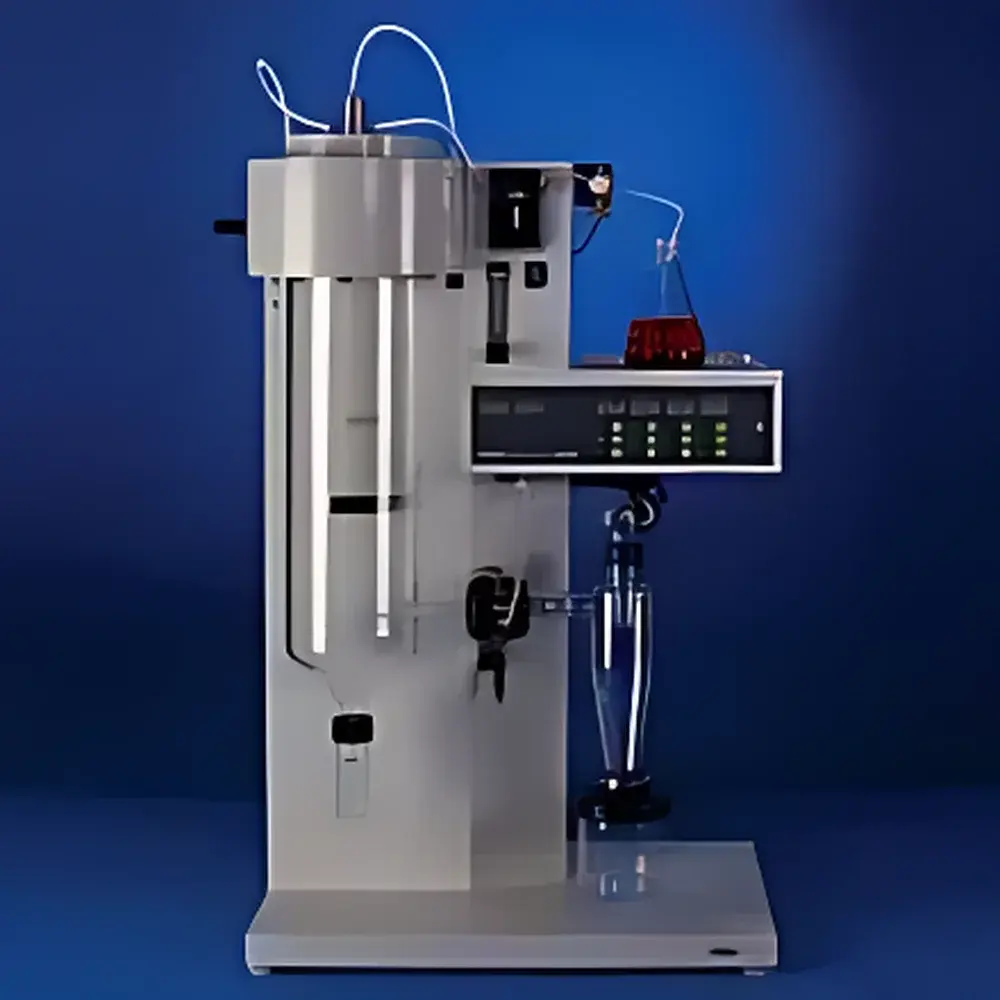
BUCHI B-290 Mini Spray Dryer
| Brand | BUCHI |
|---|---|
| Origin | Switzerland |
| Model | B-290 |
| Max. Water Evaporation Rate | 1.0 L/h |
| Inlet Air Temperature Range | Up to 220 °C |
| Air Flow Rate | 35 m³/h |
| Compressed Air Flow (std.) | 800 L/h |
| Minimum Sample Volume | 20 mL |
| Nozzle Orifice | 0.7 mm (standard, ruby material) |
Overview
The BUCHI B-290 Mini Spray Dryer is a benchtop, continuous-feed spray drying system engineered for precision, reproducibility, and gentle thermal processing of heat-sensitive materials. Operating on the principle of rapid solvent evaporation via atomization—where liquid feed is dispersed into fine droplets using compressed air or inert gas, then exposed to a controlled stream of heated drying air—the B-290 achieves particle formation within 1.0–1.5 seconds. This ultra-short residence time minimizes thermal degradation, making it ideal for biopharmaceuticals, enzymes, probiotics, natural extracts, and other labile compounds. Designed and manufactured in Switzerland, the system complies with international laboratory safety and performance benchmarks, including ISO 9001-certified production and CE marking for electromagnetic compatibility and mechanical safety.
Key Features
- Glass drying chamber with proprietary anti-static internal coating—reduces powder adhesion and enables real-time visual monitoring of atomization, drying trajectory, and wall deposition behavior.
- Ruby nozzle (standard 0.7 mm orifice) offering exceptional wear resistance, dimensional stability, and consistent droplet size distribution across extended operation cycles.
- Integrated automatic needle cleaner (‘通针’ function) that periodically actuates to clear nozzle blockages without interrupting drying—critical for viscous, particulate-laden, or proteinaceous feeds.
- Full digital parameter control and monitoring via high-resolution LCD display: inlet/outlet air temperature, drying air flow rate, peristaltic pump speed, and fan speed—all independently adjustable and logged in real time.
- High-temperature pre-sterilization mode (up to 220 °C inlet air) combined with HEPA-filtered air intake—supports aseptic processing validation for pharmaceutical R&D and GLP-compliant formulation development.
- Compact footprint (< 0.5 m²), modular design, and tool-free disassembly enable rapid cleaning, maintenance, and method transfer between users or labs.
Sample Compatibility & Compliance
The B-290 accommodates aqueous solutions, colloidal suspensions, emulsions, and (with optional solvent kit) organic solvent-based feeds—including ethanol, acetone, and ethyl acetate—under nitrogen inerting for explosion-safe operation. It supports regulatory workflows aligned with USP , FDA 21 CFR Part 11 (when paired with BUCHI’s LabX software), and ISO 22000/ISO 13485 quality management frameworks. The glass contact surfaces meet USP Class VI biocompatibility standards; all wetted parts are autoclavable or chemically compatible with standard CIP/SIP agents. Particle size distribution (PSD) reproducibility—typically >90% of dried powder falling within ±15% of median diameter—is validated per ISO 9276-2 for dry powder characterization.
Software & Data Management
When connected to BUCHI LabX™ software (optional), the B-290 enables full audit trail functionality—including user authentication, electronic signatures, parameter change logging, and raw data export in CSV or PDF formats—meeting ALCOA+ principles for data integrity. Method templates can be saved, recalled, and version-controlled; process deviations trigger automatic alerts and timestamped event logs. All displayed parameters are continuously recorded at 1 Hz resolution, supporting post-run analysis of thermal history, drying kinetics, and mass balance correlation.
Applications
- Pharmaceutical formulation: Production of inhalable powders, amorphous solid dispersions, and nanoparticle carriers for controlled release.
- Biotechnology: Stabilization of monoclonal antibodies, vaccines, plasmid DNA, and CRISPR ribonucleoprotein complexes without aggregation or activity loss.
- Food & nutraceuticals: Encapsulation of probiotics, omega-3 oils, anthocyanins, and thermolabile vitamins (e.g., vitamin C, folate).
- Agricultural science: Preparation of biopesticide microcapsules, pheromone carriers, and microbial inoculant powders with high viability retention.
- Materials science: Synthesis of metal oxide nanoparticles, battery cathode precursors, and functionalized silica microparticles.
FAQ
What is the minimum sample volume required for a valid drying run?
The system supports reliable operation down to 20 mL of feed solution, provided viscosity remains below 500 mPa·s and solids content does not exceed 20% w/w.
Can the B-290 handle organic solvents safely?
Yes—when equipped with the optional solvent kit, nitrogen inerting, and explosion-proof components, it complies with ATEX Directive 2014/34/EU for Class II 2G/D zones.
How is particle size controlled during operation?
Primary control variables include nozzle orifice diameter, feed concentration, inlet temperature, and atomizing air pressure—each influencing droplet size and drying kinetics per the D²-law of evaporation.
Is the system compliant with FDA 21 CFR Part 11 requirements?
Full compliance is achieved only when used with LabX software configured for electronic records and signatures, including role-based access control and immutable audit trails.
What maintenance intervals are recommended for routine operation?
Daily: Visual inspection of nozzle, cleaning of cyclone and collection vessel. Weekly: Verification of anti-static coating integrity and calibration of temperature sensors per ISO/IEC 17025 guidelines.



