
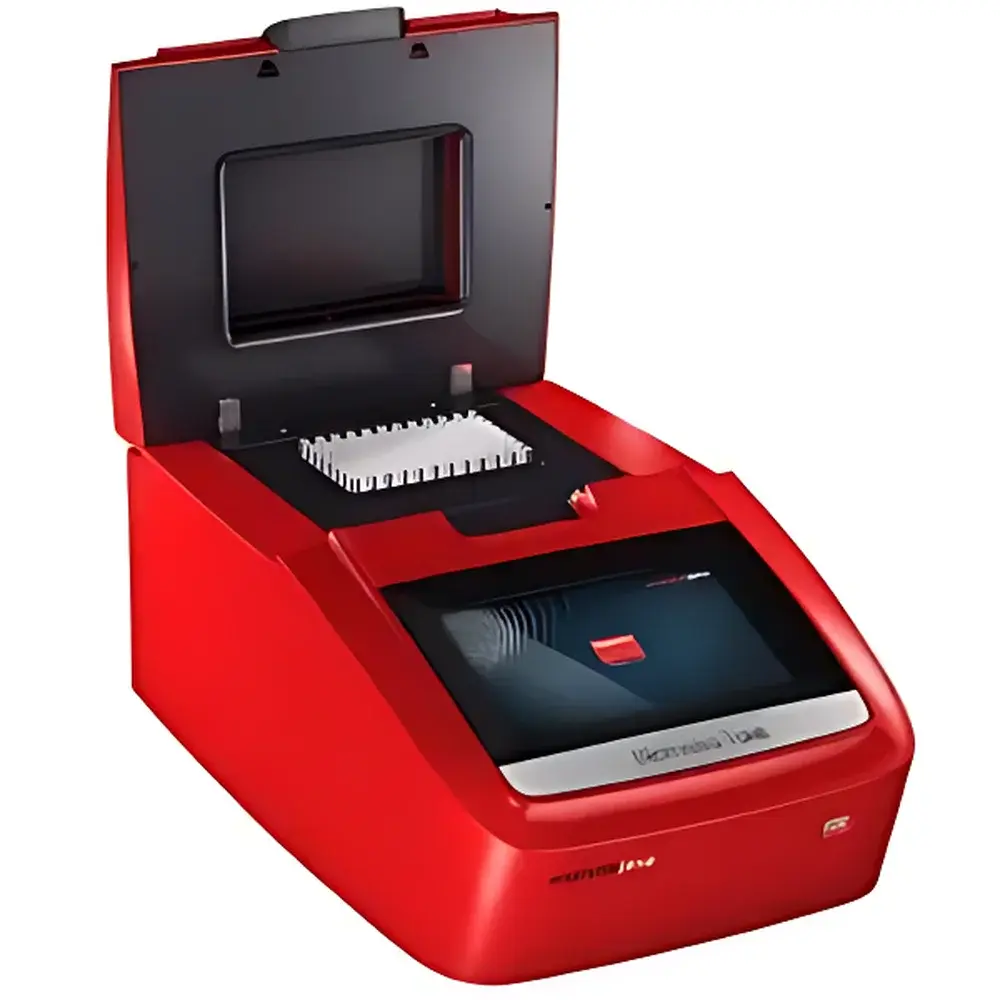
Analytik Jena Biometra TOne 96G Gradient PCR Thermal Cycler
| Brand | Analytik Jena |
|---|---|
| Origin | Germany |
| Model | Biometra TOne 96G |
| Instrument Type | Gradient PCR Thermal Cycler |
| Sample Capacity | 96-well format |
| Max Heating Rate | 4.0 °C/s |
| Temperature Accuracy | ±0.1 °C |
| Well-to-Well Temperature Uniformity | ±0.15 °C at 55 °C |
Overview
The Analytik Jena Biometra TOne 96G is a high-performance gradient thermal cycler engineered for precision, reliability, and ease of use in molecular biology laboratories. Built upon over three decades of expertise in PCR instrument design and manufacturing, the TOne 96G implements Peltier-based thermoelectric control with advanced thermal calibration algorithms to deliver rapid, reproducible, and spatially uniform temperature transitions across all 96 wells. Its core architecture adheres to fundamental PCR thermocycling requirements—precise denaturation (95 °C), stringent annealing (programmable gradient range), and efficient extension (72 °C)—while maintaining strict compliance with ISO 13485–certified production standards. Designed for routine and optimization workflows alike, the system supports both standard two-step and three-step cycling protocols, with real-time thermal monitoring at each well position to ensure protocol fidelity and inter-run comparability.
Key Features
- High-Fidelity Thermal Control: Achieves ±0.1 °C temperature accuracy and ±0.15 °C well-to-well uniformity at 55 °C—validated per ASTM E2777 guidelines for thermal performance assessment in nucleic acid amplification devices.
- Linear Gradient Functionality: Enables user-defined linear temperature gradients across the 96-well block (spanning up to 30 °C), facilitating empirical determination of optimal annealing temperatures without sequential manual re-runs.
- Optimized Thermal Block Design: Features an anodized aluminum heating block with proprietary alloy coating—enhancing thermal conductivity, minimizing oxidation, and ensuring long-term mechanical stability under repeated thermal cycling stress.
- Intuitive Human-Machine Interface: Integrated 7-inch full-color capacitive touchscreen with responsive GUI, supporting multi-language display (English, German, French, Chinese), touch-gesture navigation, and on-device protocol editing—including pause/resume, step duplication, and ramp rate adjustment.
- Acoustically Damped Enclosure: Engineered with vibration-dampening mounts and low-noise fan architecture, operating below 35 dB(A) during thermal ramping—ideal for shared lab spaces and noise-sensitive environments.
- Space-Efficient Airflow Management: Asymmetric ventilation layout (bottom intake / rear exhaust) allows side-to-side placement within standard laboratory benches without compromising cooling efficiency or adjacent equipment operation.
Sample Compatibility & Compliance
The Biometra TOne 96G accepts standard ANSI/SLAS-compliant 96-well plates (full-skirted, semi-skirted, unskirted), 0.2 mL PCR tubes (single or 8-strip), and barcoded consumables compatible with LIMS integration. All thermal profiles are traceable via embedded timestamped logs, satisfying GLP/GMP documentation requirements. The instrument conforms to IEC 61010-1 (Safety of Laboratory Equipment), EN 61326-1 (EMC for laboratory instruments), and supports audit-ready data export compliant with FDA 21 CFR Part 11 when used with validated software configurations.
Software & Data Management
Control and analysis are performed via the optional Biometra TOne PC Software (v3.x), which provides method creation, remote monitoring, and automated report generation (PDF/CSV). Raw thermal cycle logs—including actual vs. setpoint deviation curves, gradient mapping heatmaps, and run validation summaries—are stored with SHA-256 checksum integrity verification. Data export supports secure transfer to ELN systems (e.g., LabArchives, Benchling) and integrates with enterprise authentication frameworks (LDAP, SAML 2.0) where deployed.
Applications
- Standard endpoint PCR for genotyping, pathogen detection, and gene expression screening
- Primer annealing temperature optimization using linear gradient profiling
- Pre-sequencing library amplification (e.g., Illumina TruSeq, NEBNext)
- qPCR assay development and validation (when paired with compatible optical modules)
- Educational training in molecular techniques requiring robust, entry-level thermal cyclers
- Quality control testing in diagnostic and biomanufacturing settings under ISO 15189 or CLIA frameworks
FAQ
Does the TOne 96G support fast-cycling protocols?
Yes—it achieves up to 4.0 °C/s heating and 3.5 °C/s cooling rates, enabling sub-60-minute standard 35-cycle protocols with minimal dwell time overhead.
Is the thermal block interchangeable with other Biometra models?
No—the TOne 96G uses a dedicated, non-modular block optimized for its Peltier array geometry and firmware calibration; cross-model compatibility is not supported.
Can the instrument be integrated into automated liquid handling workflows?
It features RS-232 and USB-B ports for external trigger input and status feedback, supporting synchronization with robotic platforms via TTL-compatible start/stop signals.
What maintenance is required for long-term thermal accuracy?
Annual recalibration by an Analytik Jena-certified service engineer is recommended; no user-serviceable thermal components exist inside the sealed chassis.
Is cloud-based remote monitoring available?
Not natively—the system operates as a standalone device; remote access requires local network configuration and third-party VNC or RDP solutions compliant with institutional IT policies.



