
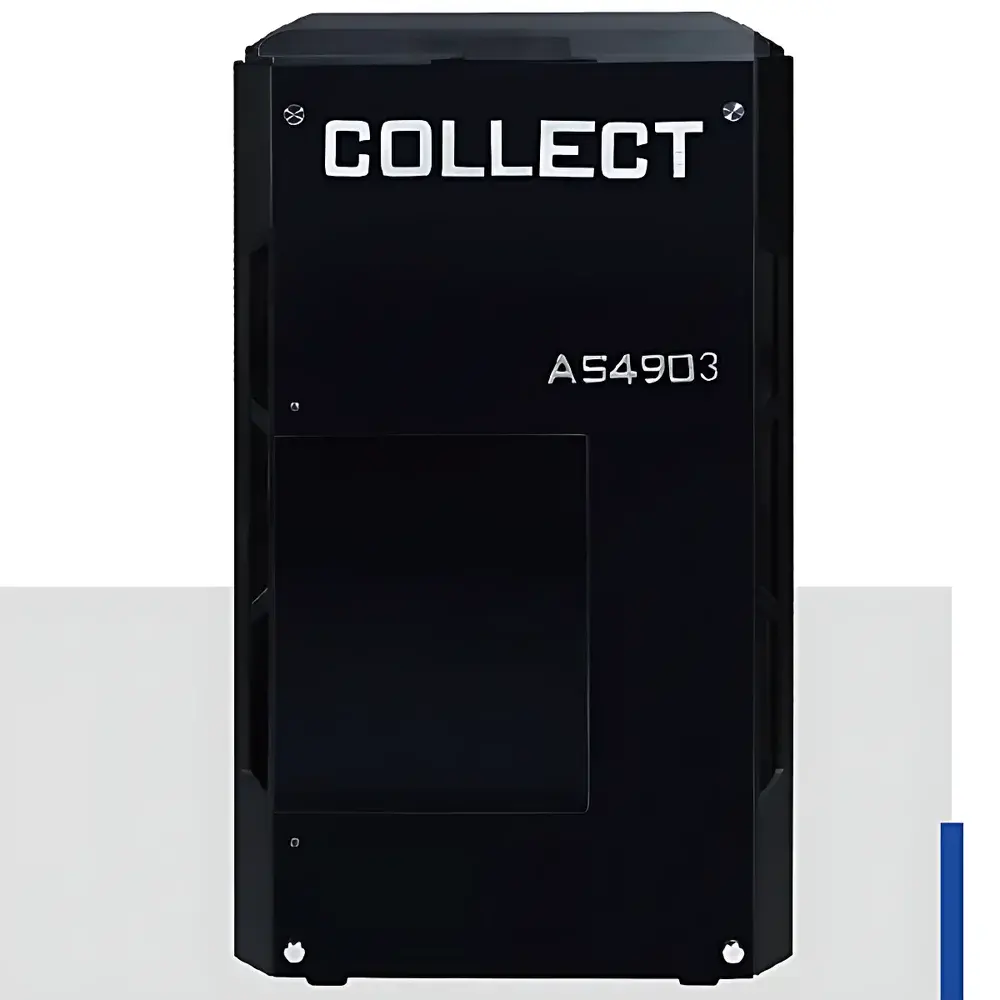
Claretech AS-4903 Multifunctional Ion Chromatography Autosampler
| Brand | Claretech |
|---|---|
| Origin | Henan, China |
| Manufacturer Type | Manufacturer |
| Product Category | Domestic |
| Model | AS-4903 |
| Instrument Type | Multifunctional Autosampler |
| Max Sample Volume | 500 µL |
| Min Sample Volume | 0.1 µL |
| Loop Volume (Standard) | 20 µL |
| Loop Volume (Optional) | 10 µL, 50 µL, 100 µL, 500 µL |
| Positioning Accuracy | <0.1 mm |
| Motion Mechanism | Rotary Carousel |
| Needle Wash | Internal & External Wall Cleaning, Unlimited Cycles |
| Repeat Injection Count | 1–99 |
Overview
The Claretech AS-4903 is a high-precision, multifunctional autosampler engineered specifically for ion chromatography (IC) systems. It operates on a rotary carousel architecture with encoder-based closed-loop position feedback, ensuring deterministic sample positioning and repeatable injection timing across extended unattended operation cycles. Designed to meet the stringent demands of quantitative anion and cation analysis in environmental, pharmaceutical, food safety, and industrial QC laboratories, the AS-4903 supports full bidirectional communication with both domestic and international IC platforms—including Thermo Fisher Dionex, Metrohm, and Shodex systems—via standardized RS-232, USB, and opto-isolated digital I/O interfaces. Its core function is to deliver precise, low-volume liquid samples into the IC flow path using syringe-driven aspiration and loop-based or direct-injection methodologies, minimizing carryover and maximizing method robustness in compliance with ISO 17025 and GLP-aligned workflows.
Key Features
- Encoder-synchronized rotary motion system delivering positional repeatability better than ±0.1 mm—critical for consistent needle alignment with vial septa and injection valve ports.
- Programmable syringe drive with adjustable aspiration, injection, and wash speeds; enables optimization for viscous or volatile matrices via user-defined viscosity delay (0–120 s).
- Dual-wall needle cleaning (internal + external) with configurable cycles (0–20) or unlimited execution—validated to achieve ≤0.01% carryover under routine IC operating conditions.
- Flexible loop configuration: standard 20 µL quantitative loop with optional 10/50/100/500 µL variants; supports full-loop, partial-loop, and zero-dead-volume (ZDV) injection modes.
- Three advanced injection modes: conventional, sandwich (for trace analyte enrichment), and programmable temperature vaporizing (PTV) mode with configurable dwell time up to 300 s (or unrestricted).
- 20 pre-stored injection methods with independent parameter sets per method—including needle depth, rinse volume, pump draw count, and valve actuation timing.
- Real-time error logging and step-level fault reporting via integrated software interface; supports remote diagnostics and audit-ready event history export.
Sample Compatibility & Compliance
The AS-4903 accommodates standard 2.0 mL screw-thread or crimp-top vials across 16- or 20-position trays; custom trays for 4.0 mL vials are available upon request. Syringe options include 10 µL, 50 µL, 100 µL, 250 µL, and 500 µL volumes—enabling accurate delivery from 0.1 µL to 500 µL with ≤0.3% RSD precision (n = 6, 10 µL aqueous standard). All fluidic pathways employ chemically inert PEEK and ETFE components compatible with eluents containing carbonate, hydroxide, methanesulfonic acid, or nitric acid. The device conforms to IEC 61326-1 (EMC for laboratory equipment) and meets mechanical safety requirements per ISO 13857. Data integrity features—including electronic signatures, method locking, and tamper-evident audit trails—are implemented in accordance with FDA 21 CFR Part 11 when used with validated third-party LIMS or CDS software.
Software & Data Management
The AS-4903 is controlled through a Windows-based native application supporting English-language UI, multi-user role assignment (operator, supervisor, administrator), and full method import/export in XML format. Communication protocols—including Modbus RTU and ASCII command sets—are fully documented and provided to facilitate integration with custom-developed control environments or enterprise-level chromatography data systems (CDS). All run logs, error events, and calibration records are timestamped and stored locally with automatic backup to network drives. Software updates are delivered via signed firmware packages with SHA-256 verification. Optional OPC UA server support enables seamless interoperability with MES and SCADA platforms in regulated manufacturing settings.
Applications
- High-throughput anion analysis in drinking water (Cl⁻, NO₃⁻, SO₄²⁻, F⁻) per EPA Method 300.0 and ISO 10304-1.
- Cation profiling in battery electrolytes (Li⁺, Na⁺, K⁺, NH₄⁺) and semiconductor process chemicals.
- Organic acid quantification (acetate, formate, oxalate) in fermentation broths and dairy products.
- Trace iodide and bromide detection in pharmaceutical excipients per USP .
- Multi-component speciation of chromium (Cr³⁺/Cr⁶⁺) and arsenic (As³⁺/As⁵⁺) in environmental solid leachates following EPA Method 6800.
FAQ
Is the AS-4903 compatible with non-Claretech chromatography data systems?
Yes—it supports ASCII command protocol and Modbus RTU over RS-232/USB, enabling integration with Agilent OpenLab, Waters Empower, Chromeleon, and custom LabVIEW or Python-based controllers.
What validation documentation is supplied with the instrument?
Factory calibration certificates for loop volume accuracy and positional repeatability are included; IQ/OQ documentation templates compliant with ISO/IEC 17025 are available upon request.
Can the AS-4903 perform gradient injections or sequential multi-loop sampling?
It does not support real-time gradient formation, but it enables sequential injection from multiple loops via method chaining and timed valve switching—suitable for internal standard addition or column-switching workflows.
Does the system meet requirements for GMP-regulated environments?
When deployed with Part 11-compliant CDS software and configured with electronic signatures, audit trail logging, and method access controls, the AS-4903 satisfies baseline GMP data integrity expectations for QC release testing.
How is carryover performance verified during installation qualification?
A standardized blank–standard–blank sequence using 100 ppm chloride is performed; residual peak area in the second blank must be ≤0.01% of the standard’s peak area to pass acceptance criteria.






