
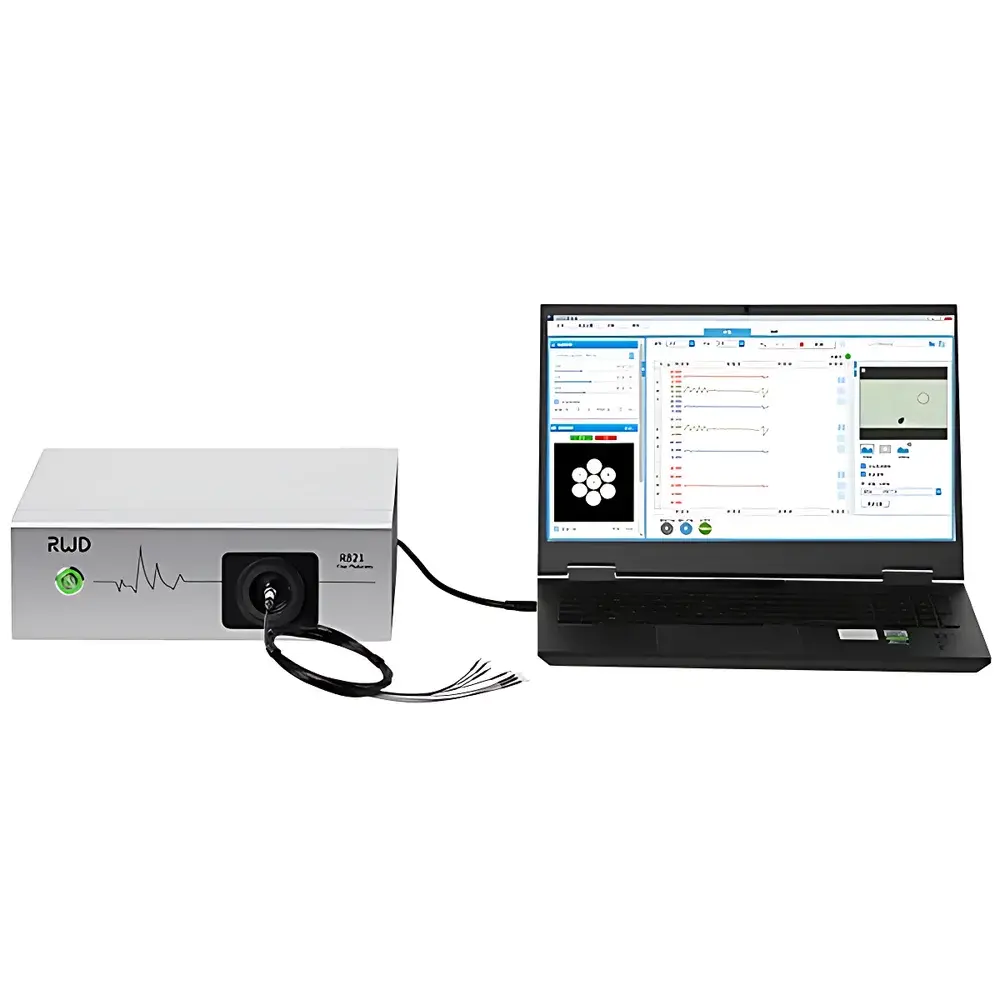
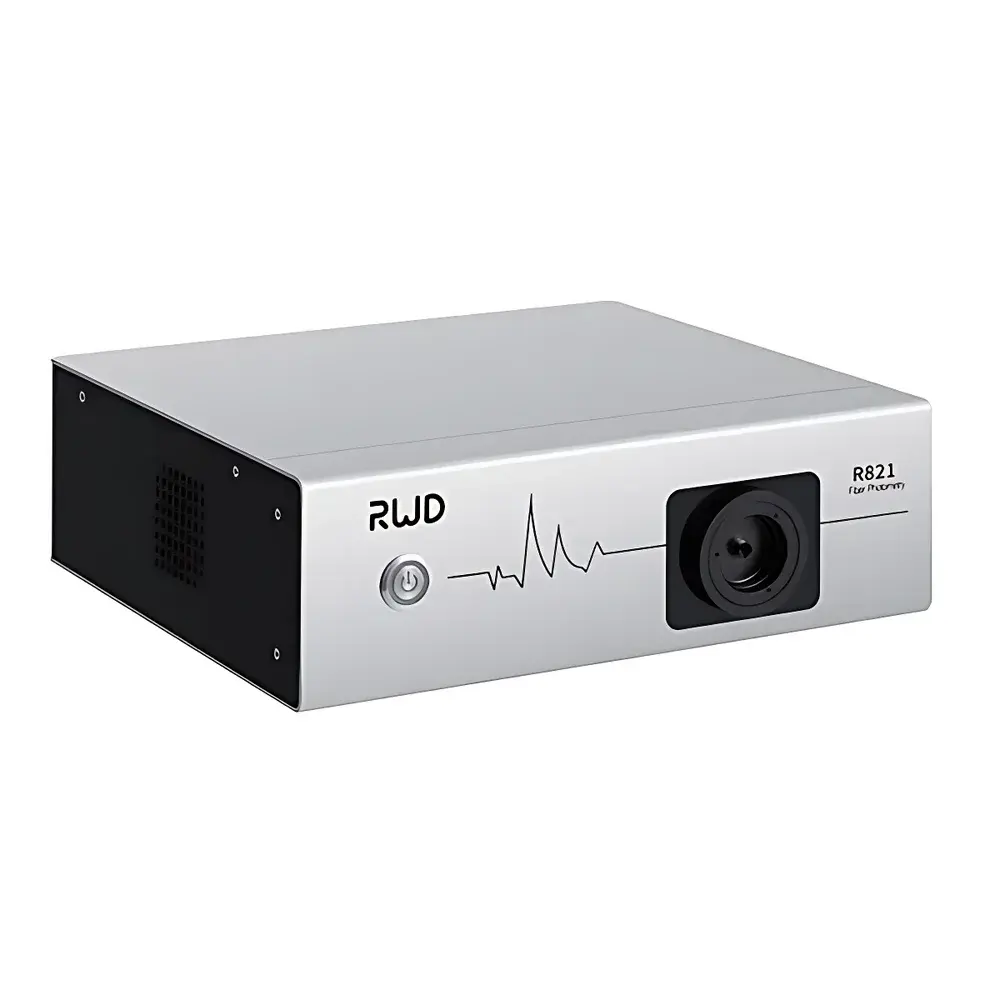
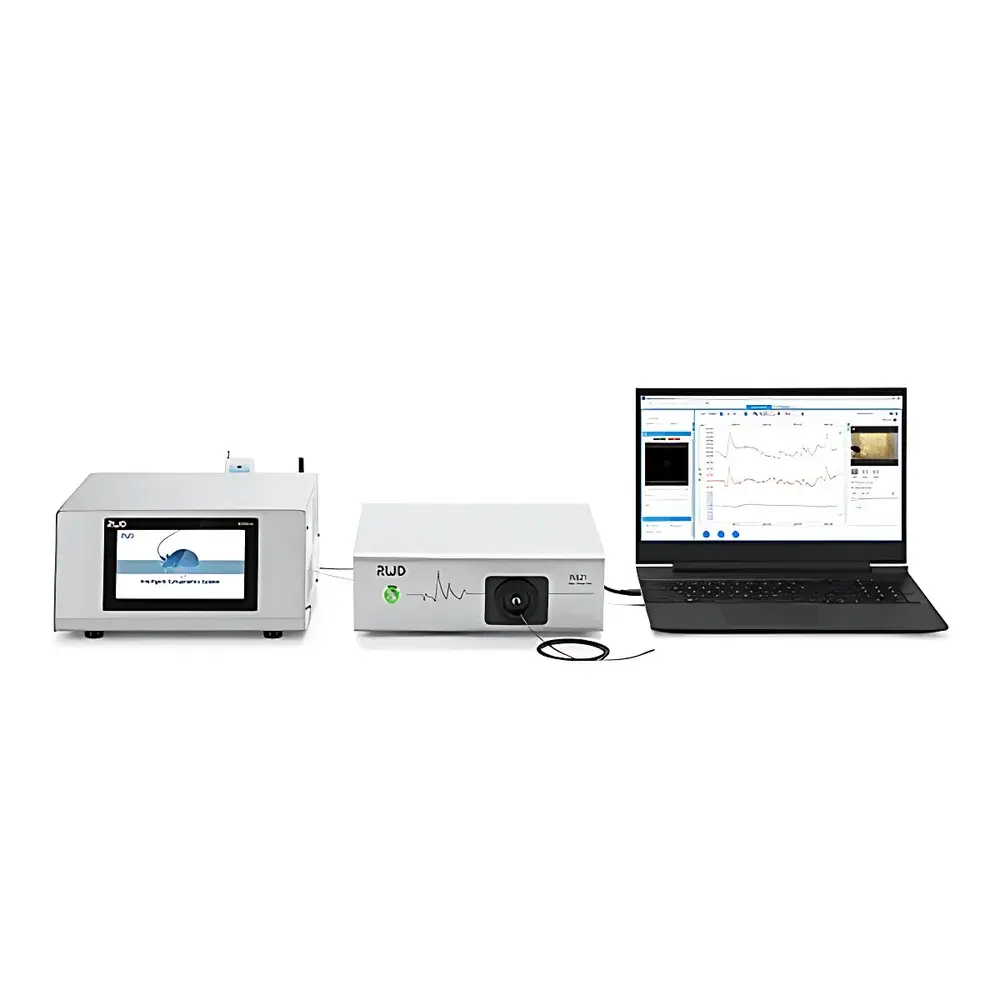
RWD R821/R811 Multi-Channel Tri-Color Fiber Photometry System
| Brand | RWD |
|---|---|
| Origin | Guangdong, China |
| Manufacturer Type | Original Equipment Manufacturer (OEM) |
| Product Category | Domestic |
| Model | R821 / R811 |
| Pricing | Upon Request |
Overview
The RWD R821/R811 Multi-Channel Tri-Color Fiber Photometry System is a high-fidelity, benchtop optical recording platform engineered for quantitative in vivo measurement of population-level neuronal activity in freely behaving rodents. Leveraging fiber photometry—a technique grounded in fluorescence intensity modulation via genetically encoded calcium or neurotransmitter indicators—the system enables real-time detection of dynamic changes in intracellular Ca²⁺, dopamine, serotonin, or other analytes through implanted optical fibers. Unlike single-channel or dual-color systems, the R821/R811 supports simultaneous acquisition across up to nine independent optical channels, with dedicated excitation pathways for blue (470 nm), green (560 nm), and red (630 nm) fluorophores—enabling robust ratiometric quantification and cross-spectral crosstalk suppression. Its architecture integrates time-division multiplexing (TDM) with dual high-sensitivity sCMOS cameras, ensuring temporal alignment between fluorescence signals and behavioral video streams without frame loss or latency-induced misregistration.
Key Features
- Nine independent optical recording channels with configurable LED excitation sources (470 nm, 560 nm, 630 nm)
- Six programmable LED operation modes supporting flexible excitation sequencing for multi-fluorophore experiments
- Dual high-quantum-efficiency sCMOS detectors with low read noise (85% quantum efficiency at peak wavelengths
- Integrated fluorescence bleaching control module to minimize tissue autofluorescence drift and improve signal-to-background ratio over extended recordings (>24 h)
- Real-time TTL synchronization: 4 input and 4 output TTL ports for hardware-triggered event marking, optogenetic stimulation gating, and external device coordination
- Onboard fluorescence preview and live TTL signal monitoring with millisecond-level timestamp accuracy
Sample Compatibility & Compliance
The system is validated for use with transgenic and virally transduced rodent models (mice, rats), including head-fixed and freely moving paradigms. Optical fiber implants (200–400 µm core diameter, NA 0.39–0.50) are fully supported, and coupling efficiency is optimized via adjustable collimation optics and calibrated power calibration routines. Data acquisition and processing workflows comply with GLP-aligned documentation standards, supporting audit-ready metadata logging—including excitation power, exposure time, gain settings, and TTL event annotations. While not certified under FDA 21 CFR Part 11, the software architecture permits implementation of user-defined electronic signature protocols and export of raw HDF5-formatted datasets compatible with third-party analysis pipelines (e.g., Python-based CaImAn, MATLAB-based Suite2p).
Software & Data Management
The bundled RWD FiberPhotometry Suite provides integrated acquisition, visualization, and preprocessing modules. It supports synchronized acquisition of fluorescence traces and high-resolution behavioral video (up to 1080p @ 60 fps), with automatic spatial registration between regions of interest (ROIs) on video frames and corresponding photometric channels. Over 20 customizable event markers—including lever press, nose poke, locomotion onset, and optogenetic pulse triggers—are definable via GUI or script-based configuration. All processed data (ΔF/F₀, z-scored traces, motion-corrected video, ROI trajectories) are exported in standardized formats (CSV, MAT, HDF5) with embedded timestamps and experimental metadata. The software includes batch-processing capabilities for longitudinal studies and supports plugin extensions for custom algorithm integration.
Applications
- Correlating neural ensemble dynamics with ethologically relevant behaviors (e.g., reward seeking, fear conditioning, social interaction)
- Longitudinal monitoring of neuromodulator release (dopamine, norepinephrine, acetylcholine) during pharmacological challenge or disease progression
- Multi-site interrogation of circuit-level interactions across distributed brain regions (e.g., VTA→NAc, BLA→mPFC)
- Combined fiber photometry and optogenetics experiments with precise light delivery timing and feedback-controlled illumination
- Validation of novel GECIs or GRAB sensors in awake, behaving animals under controlled environmental conditions
FAQ
What is the maximum number of simultaneous recording channels supported?
The R821 model supports up to nine independent optical channels; the R811 supports four. Both share identical excitation and detection specifications.
Does the system support real-time behavioral tracking integration?
Yes—synchronized video acquisition is natively supported with automated ROI-based trajectory extraction and event-triggered frame annotation.
Can I export raw fluorescence data for offline analysis in Python or MATLAB?
Yes—HDF5 exports include full metadata, timestamps, and unprocessed analog/digital signal streams for reproducible reanalysis.
Is the system compatible with third-party optogenetic stimulators?
Yes—via TTL input/output interfaces and configurable trigger delay/width parameters, enabling tight synchronization with laser diodes or LED drivers.
What maintenance is required for long-term stability of fluorescence signals?
The built-in bleaching compensation module and auto-calibration routine reduce baseline drift; users are advised to perform weekly optical power verification using NIST-traceable photodiode sensors.





