
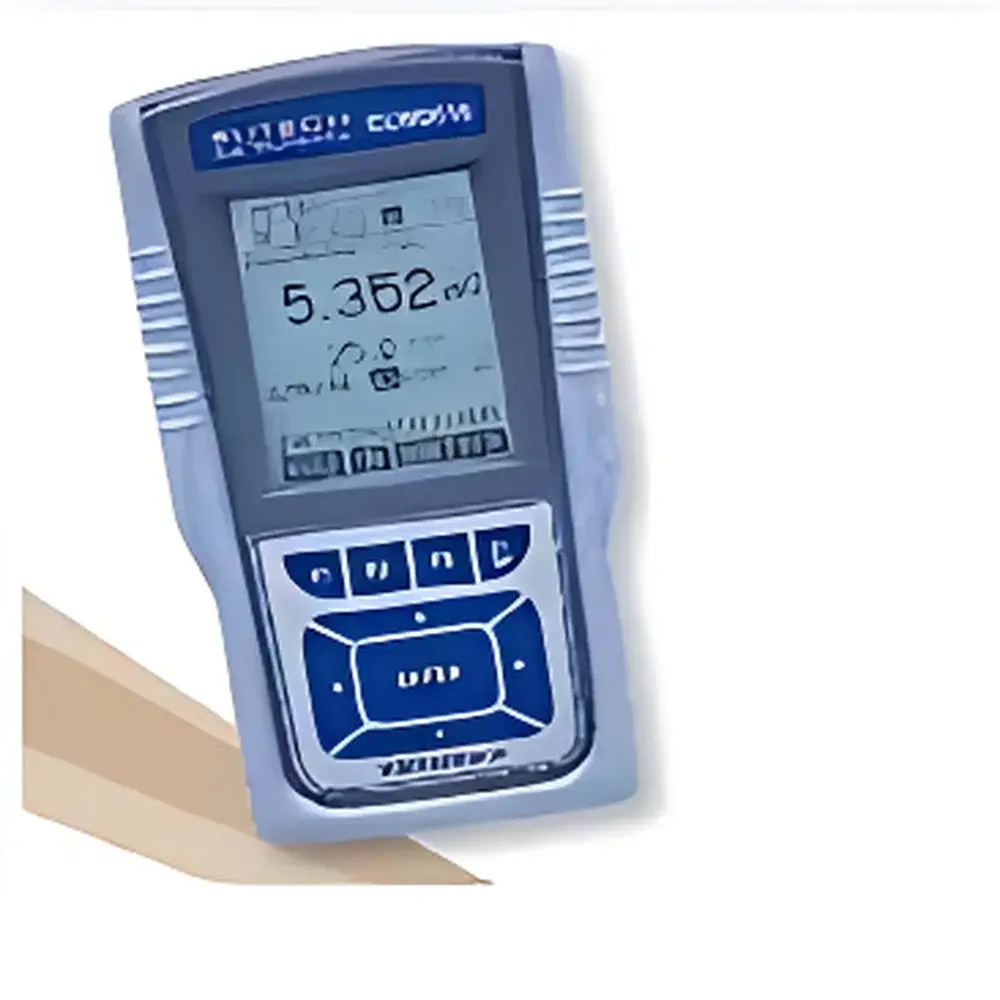
Thermo Fisher Scientific COND600 Portable Conductivity Meter
| Brand | Thermo Fisher Scientific |
|---|---|
| Model | COND600 |
| Origin | USA |
| Instrument Type | Portable Conductivity/TDS/Temp Meter |
| IP Rating | IP67 |
| GLP Compliance | Yes |
| Measurement Principles | Two-electrode AC conductivity, temperature-compensated TDS calculation (linear α coefficient), NIST-traceable calibration |
| Key Ranges | Conductivity 0–200.0 mS/cm (5-range auto-ranging) |
| Resolution | 0.01 µS/cm (low range) to 0.1 mS/cm (high range) |
| Accuracy | ±1% of full scale + 1 LSD (conductivity & TDS) |
| Calibration | Up to 4-point automatic or 5-point manual using standard KCl solutions |
| Temperature Compensation | Linear, user-selectable α (0.00 to 10.00 %/°C), default 2.00 %/°C |
| Electrode Constant Range | 0.010–10.000 cm⁻¹ |
| Data Storage | 500 measurement sets with timestamp, temperature, and electrode ID |
| Connectivity | RS-232C serial port, IrDA infrared interface |
| Power | 4×AA alkaline batteries (≥200 h operation) or optional 9 V DC adapter (500 mA) |
| Dimensions (unit) | 18.3 × 9.5 × 5.7 cm |
| Weight (unit) | 460 g |
| Operating Environment | 0–50 °C, ≤95% RH non-condensing |
| Storage Environment | −25–70 °C |
| Display | Backlit LCD (5.4 × 7.1 cm active area), multi-parameter real-time view |
| Auto-off | Configurable 2–30 min idle timeout |
| Auto-hold | Yes |
| Certifications | CE, RoHS, FCC Class B |
Overview
The Thermo Fisher Scientific COND600 Portable Conductivity Meter is an engineered field-deployable instrument designed for precise, repeatable measurement of electrical conductivity, total dissolved solids (TDS), and temperature in aqueous samples across environmental monitoring, industrial process control, academic teaching labs, and regulatory-compliant water quality assessment. It operates on the principle of two-electrode alternating current (AC) conductivity measurement—eliminating polarization effects common in DC-based systems—while applying programmable linear temperature compensation (α-coefficient) to normalize readings to a user-defined reference temperature (15–30 °C). The meter’s five overlapping conductivity ranges (0–200.0 mS/cm) and corresponding TDS scales (0–200.0 ppt), coupled with selectable electrode constants (0.010–10.000 cm⁻¹), enable accurate quantification across ultrapure water, wastewater, brines, and electrolyte solutions without manual range switching.
Key Features
- IP67-rated rugged enclosure—fully dust-tight and submersible up to 1 m for 30 minutes—validated for field use in rain, humidity, or accidental immersion.
- GLP-compliant data integrity architecture: each stored reading includes date/time stamp, measured parameters, temperature, electrode constant, calibration status, and operator ID (if configured via software).
- High-resolution backlit LCD (5.4 × 7.1 cm active area) supports simultaneous display of conductivity, TDS, temperature, and status indicators—even under low-light or outdoor conditions.
- Dual calibration flexibility: automated 4-point conductivity calibration against certified KCl standards (e.g., 84 µS/cm, 1.413 mS/cm, 12.88 mS/cm, 111.8 mS/cm), or manual 5-point entry for custom standard values and non-standard media.
- Configurable auto-hold function locks stable readings; adjustable auto-off (2–30 min) preserves battery life without compromising workflow continuity.
- Integrated dual-power system: 4×AA alkaline cells deliver >200 hours of continuous operation, while the optional 9 V regulated DC input enables benchtop or vehicle-mounted extended-use scenarios.
Sample Compatibility & Compliance
The COND600 accommodates a broad spectrum of liquid-phase samples—from deionized water (0.055 µS/cm at 25 °C) to saturated NaCl brines (~200 mS/cm)—via interchangeable conductivity cells (sold separately) with electrode constants optimized for specific conductance regimes. Its linear temperature compensation model aligns with ASTM D1125 and ISO 7888 requirements for reporting conductivity at standardized temperatures. The device meets CE marking directives (EMC 2014/30/EU, LVD 2014/35/EU), RoHS 2011/65/EU, and FCC Part 15 Class B emission limits. While not intrinsically safe, its non-sparking design and sealed electronics make it suitable for non-hazardous area deployment per IEC 60079-0 general requirements.
Software & Data Management
Data export is supported via bidirectional RS-232C serial communication (using standard null-modem cabling) or IrDA infrared link (compliant with IrDA 1.1 physical layer). When connected to Thermo Fisher’s optional LabTrack™ PC software (v3.2+), users can download full 500-entry datasets—including calibration logs, drift history, and electrode diagnostics—for audit-ready reporting. The software enforces FDA 21 CFR Part 11–compatible electronic signatures, audit trails, and role-based access controls—enabling compliance with GLP, GMP, and ISO/IEC 17025 documentation requirements. Raw ASCII output formats are compatible with LIMS integration and third-party statistical analysis tools (e.g., JMP, Minitab).
Applications
- Environmental fieldwork: stream, lake, and groundwater conductivity profiling; salinity mapping in estuarine zones; wastewater effluent compliance checks per EPA Method 120.1.
- Pharmaceutical water systems: USP purified water and water-for-injection (WFI) conductivity verification at multiple temperature points (10–30 °C).
- Food & beverage QC: sugar syrup concentration estimation via TDS correlation; cleaning-in-place (CIP) rinse water validation.
- Academic laboratories: electrochemistry teaching modules on ionic strength, Kohlrausch’s law, and Debye-Hückel limiting behavior.
- Industrial cooling towers: real-time cycle-of-concentration tracking and blowdown optimization based on conductivity trends.
FAQ
Does the COND600 support non-linear (e.g., natural log or polynomial) temperature compensation?
No—it implements only linear temperature compensation (α-coefficient), consistent with ASTM D1125 and widely accepted for routine water analysis. Non-linear models require laboratory-grade benchtop meters with advanced firmware.
Can I use a 4-ring conductivity cell with this meter?
No—the COND600 is designed exclusively for two-electrode cells with configurable K-values (0.010–10.000 cm⁻¹). Four-ring cells require dedicated instrumentation with separate voltage/current excitation circuitry.
Is the 500-point memory retained during battery replacement?
Yes—non-volatile flash memory preserves all stored data and settings even when batteries are removed or fully depleted.
What calibration standards are recommended for routine verification?
NIST-traceable KCl solutions: 84.0 µS/cm (25 °C), 1.413 mS/cm (25 °C), and 12.88 mS/cm (25 °C); certified reference materials from suppliers such as Traceable® or Hanna Instruments.
Does the meter provide direct resistivity calculation?
No—resistivity (Ω·cm) must be manually derived as the reciprocal of conductivity (S/cm), adjusted for electrode geometry. The device reports only conductivity and TDS.




