
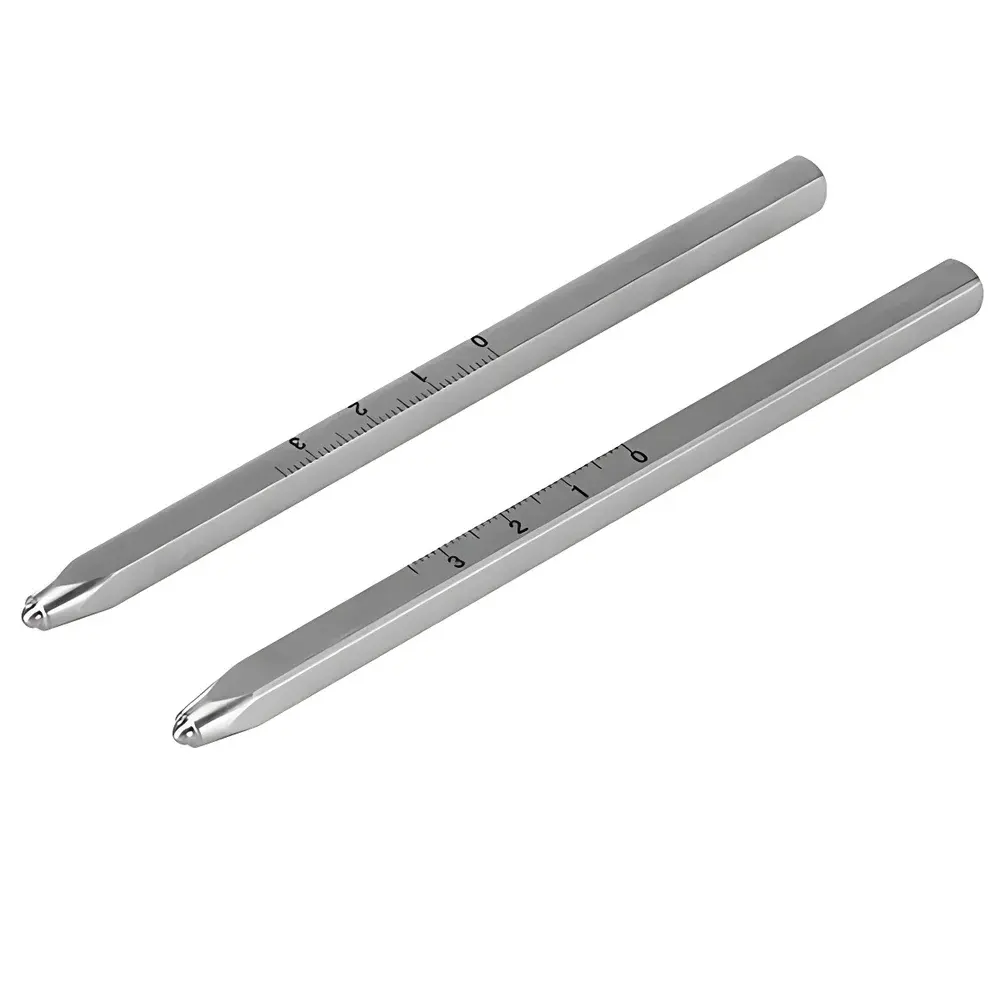
RWD 68304 45° Ear Bar for Cats and Non-Human Primates
| Brand | RWD |
|---|---|
| Origin | Shenzhen, China |
| Manufacturer Type | Original Equipment Manufacturer (OEM) |
| Country of Origin | China |
| Model | 68304 |
| Pricing | Upon Request |
Overview
The RWD 68304 45° Ear Bar is a precision-engineered stereotaxic accessory designed specifically for secure, low-stress head fixation of feline and non-human primate subjects during neurophysiological, imaging, or behavioral experiments. Unlike standard 0° or 90° ear bars, the 45° angled tip follows the natural anatomical orientation of the external auditory meatus in cats and macaques, enabling optimal alignment of the skull’s stereotaxic plane without excessive force or lateral torque on the temporal bone. This design minimizes mechanical strain on the tympanic membrane and surrounding soft tissues—critical for longitudinal studies requiring repeated restraint over days or weeks. Constructed from medical-grade stainless steel (AISI 316L), the ear bar features electropolished surfaces to ensure biocompatibility, corrosion resistance, and ease of sterilization between procedures.
Key Features
- 45° beveled tip geometry optimized for anatomical fit in cats (e.g., domestic shorthair, Siamese) and non-human primates (e.g., rhesus macaque, cynomolgus monkey)
- Dull-edged, rounded apex to prevent perforation or pressure-induced trauma to the tympanic membrane
- Integrated depth-stop mechanism with millimeter-scale刻度 (calibrated scale) for consistent insertion depth across sessions
- Threaded mounting interface compatible with standard RWD and Kopf stereotaxic frames (M4 × 0.7 mm pitch)
- Autoclavable up to 134°C (273°F) for repeated use under GLP-compliant surgical protocols
- Non-ferromagnetic construction suitable for concurrent use in MRI-compatible stereotaxic setups
Sample Compatibility & Compliance
The RWD 68304 is validated for use with adult cats (body weight ≥ 2.5 kg) and medium-to-large non-human primates (e.g., Macaca fascicularis, body weight ≥ 3.0 kg). It complies with ISO 10993-5 (biological evaluation of medical devices — cytotoxicity testing) and meets ASTM F899 standards for surgical stainless steel performance. When used within approved institutional animal care and use committee (IACUC) protocols, the device supports adherence to NIH Guide for the Care and Use of Laboratory Animals and EU Directive 2010/63/EU. Its low-profile profile avoids interference with cranial window implants, chronic electrode arrays, or optical fiber cannulae mounted in posterior cortical or subcortical targets.
Software & Data Management
While the 68304 ear bar is a passive mechanical component, its geometric consistency directly contributes to measurement reproducibility in digital stereotaxic workflows. When paired with RWD’s STS-1000 Digital Stereotaxic System or third-party platforms such as NeuroStar or AngleTwo, the fixed 45° orientation enables reliable registration of bregma–lambda coordinates across multiple experimental sessions. All dimensional tolerances (±0.05 mm) are traceable to NIST-certified gauges, supporting audit readiness for FDA-regulated preclinical neuroscience studies under 21 CFR Part 58 (Good Laboratory Practice for Nonclinical Laboratory Studies). Calibration logs and sterilization records may be maintained in electronic lab notebooks compliant with ALCOA+ principles.
Applications
- Chronic electrophysiology: stable head fixation for multi-day single-unit or LFP recordings in awake, behaving primates
- Functional MRI (fMRI) and diffusion tensor imaging (DTI) in anesthetized cats, where minimal acoustic coupling and vibration transmission are essential
- Stereotaxic injection of AAV vectors or pharmacological agents into thalamic, basal ganglia, or limbic targets
- Optogenetic stimulation experiments requiring precise co-registration of light delivery and electrode placement
- Longitudinal structural MRI tracking of neurodegenerative progression in feline models of lysosomal storage disease
FAQ
Is the 68304 ear bar compatible with rodent stereotaxic frames?
No—this model is anatomically scaled for cats and non-human primates only. Rodent applications require RWD models 68301 (15°) or 68302 (0°) ear bars.
Can the ear bar be resterilized using ethylene oxide (EtO)?
Yes; however, autoclaving at 134°C for 18 minutes is the preferred method per RWD validation data, ensuring full material integrity and surface passivation.
Does RWD provide IACUC protocol language for this device?
Yes—template language describing ergonomic justification, tissue-sparing design rationale, and reuse validation is available upon request through RWD Technical Support.
What is the maximum recommended insertion depth for macaque subjects?
For rhesus macaques (Macaca mulatta), insertion depth should not exceed 8.5 mm from the external auditory meatus opening, as verified by CT-guided anatomical mapping in RWD’s preclinical validation study #RWD-PR-2023-047.




