
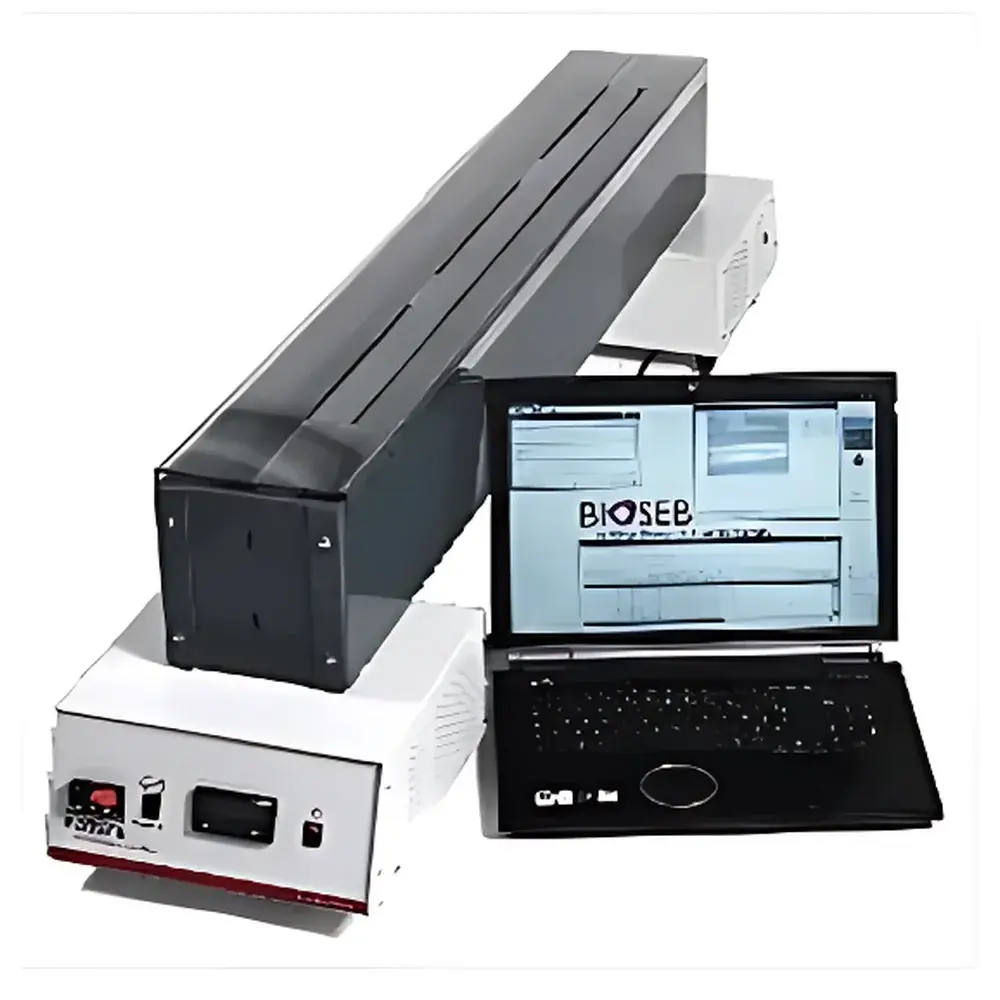
Bioseb BIO-TGT2 Thermal Gradient Nociception Analyzer for Rodents (Single Rat or Dual Mouse Configuration with Integrated Software and Synchronized Video Recording)
| Origin | France |
|---|---|
| Manufacturer Type | Authorized Distributor |
| Origin Category | Imported Instrument |
| Model | BIO-TGT2 (Supports 1 Rat or 2 Mice Simultaneously) |
| Pricing | Available Upon Request |
| Temperature Range | 5–55 °C (±1 °C stability under 20–25 °C ambient, 45–55% RH) |
| Gradient Platform Length | 120 cm |
| Data Output Parameters | Total Trial Duration, Real-Time Zone Temperatures (up to 20 discrete zones), Dwell Time per Zone, Cumulative Locomotor Distance |
| Data Integrity | AES-256 Encrypted Acquisition with Frame-Synchronized Video Logging |
Overview
The Bioseb BIO-TGT2 Thermal Gradient Nociception Analyzer is a purpose-engineered platform for quantitative assessment of thermally evoked nociceptive behavior in rodent models. It operates on the principle of thermal preference testing—leveraging the animal’s innate aversion to noxious heat or cold to derive objective, ethologically relevant pain thresholds without forced stimulation. Unlike reflex-based assays (e.g., tail-flick or hot-plate), the BIO-TGT2 enables spontaneous, non-invasive evaluation of thermal sensitivity across a continuous, linear gradient. The system maintains precise spatial and temporal thermal control over a 120 cm stainless-steel platform, allowing animals to freely explore and select preferred thermal microenvironments. This paradigm aligns with modern refinements in animal welfare (ARRIVE 2.0, EU Directive 2010/63/EU), minimizing handling stress and eliminating confounding motor artifacts associated with acute withdrawal responses.
Key Features
- High-stability thermal gradient generation (5–55 °C) with ±1 °C accuracy across the full length, validated under controlled ambient conditions (20–25 °C, 45–55% RH).
- Dual-species compatibility: Configurable for single-rat (standard weight range: 200–350 g) or dual-mouse (each ≤35 g) testing—platform geometry and software algorithms are optimized for interspecies locomotor scaling.
- Real-time, multi-parameter data acquisition: Simultaneous logging of total trial duration, zone-specific dwell time (per up to 20 user-defined thermal segments), cumulative path length, and instantaneous position coordinates.
- Hardware-synchronized video capture at 30 fps with embedded temperature metadata; all frames timestamped to the millisecond and cryptographically hashed for audit integrity.
- Integrated thermal calibration traceability: Each session includes automated reference-point validation using calibrated PT100 sensors embedded at 5 fixed positions along the gradient.
Sample Compatibility & Compliance
The BIO-TGT2 supports standard laboratory rodent strains (e.g., Sprague-Dawley rats, C57BL/6 and BALB/c mice) and accommodates common pharmacological and neuropathic pain models—including chronic constriction injury (CCI), streptozotocin-induced diabetic neuropathy, and inflammatory hyperalgesia (CFA). All hardware components meet IEC 61000-6-3 (EMC) and IEC 61010-1 (safety) standards. Data acquisition workflows comply with GLP requirements per OECD Series on Principles of Good Laboratory Practice (No. 1, 1998) and support FDA 21 CFR Part 11 readiness through role-based user authentication, electronic signatures, and immutable audit trails for both behavioral metrics and video archives.
Software & Data Management
The proprietary Bioseb TGT-Soft v4.2 application provides a validated, stand-alone Windows environment for experiment design, real-time monitoring, and post-hoc analysis. Users define thermal segmentation, session duration, acclimation protocols, and exclusion criteria (e.g., immobility >60 s) prior to acquisition. Raw data export is available in CSV and HDF5 formats; video exports retain synchronized thermal metadata in MP4 (H.264) with embedded timecode and zone temperature overlays. The software implements AES-256 encryption for local storage and supports network backup to secure NAS endpoints. Audit logs record every parameter change, user login/logout, and file export event—enabling full traceability during regulatory inspections.
Applications
- Preclinical evaluation of analgesic efficacy: Dose-response characterization of NSAIDs, opioids, TRPV1 antagonists, and novel biologics targeting thermal hypersensitivity.
- Neuropathic pain phenotyping: Longitudinal tracking of thermal allodynia/hyperalgesia progression in genetic, chemically induced, or surgically modeled neuropathies.
- Thermoregulatory dysfunction studies: Assessment of hypothalamic-pituitary axis modulation in sepsis, cancer cachexia, or CNS inflammation models.
- Behavioral pharmacokinetic-pharmacodynamic (PK-PD) correlation: Alignment of plasma drug concentrations with dynamic shifts in thermal preference profiles.
- Validation of transgenic lines: Functional phenotyping of ion channel knockout/knock-in models (e.g., TRPM8−/−, TRPA1−/−) under graded thermal challenge.
FAQ
What is the minimum required ambient environmental control for stable gradient operation?
The system requires ambient temperature maintenance between 20–25 °C and relative humidity of 45–55% RH to ensure ±1 °C thermal stability across the full 120 cm platform.
Can the BIO-TGT2 be used for longitudinal studies across multiple treatment days?
Yes—software supports session grouping by subject ID, automatic baseline normalization, and statistical comparison of dwell-time distributions across timepoints using non-parametric ANOVA (Friedman test) or mixed-effects modeling.
Is video analysis automated, or does it require manual scoring?
Behavioral quantification is fully automated via pixel-based motion tracking; video review remains optional for qualitative verification but is not necessary for primary endpoint extraction.
Does the system support integration with third-party electrophysiology or metabolic monitoring equipment?
While the BIO-TGT2 operates as a standalone platform, its API allows TTL pulse synchronization with external devices (e.g., EEG amplifiers, indirect calorimeters) for multimodal experimental designs.
How is data integrity ensured during long-duration trials (e.g., >60 minutes)?
Continuous checksum validation is performed on both behavioral data streams and video frames; any corruption triggers immediate alerting and automatic fallback to redundant buffer storage.




