
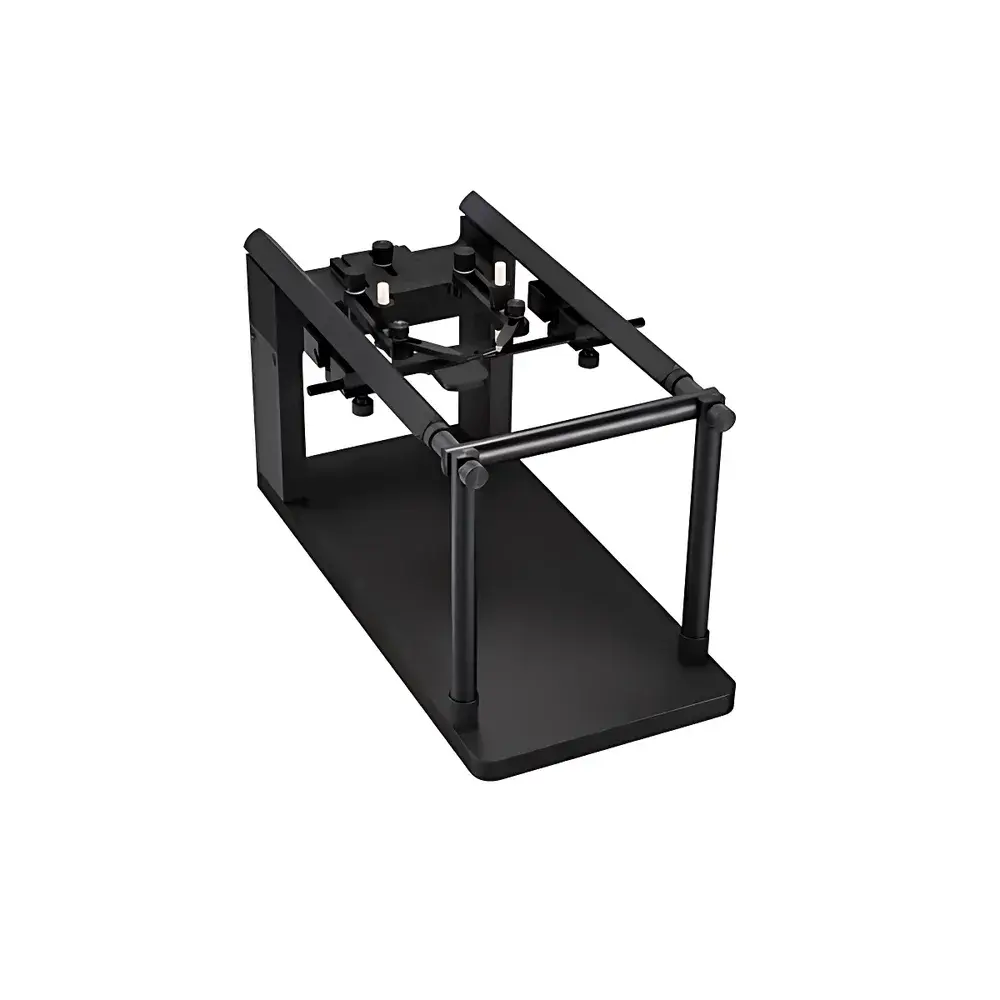
RWD 68915 MRI-Compatible Stereotaxic Instrument for Canine and Non-Human Primate Neuroscientific Research
| Brand | RWD |
|---|---|
| Origin | Shenzhen, China |
| Manufacturer | Yes |
| Country of Origin | China |
| Model | 68915 |
| Price Range | USD 1,400 – 7,000 |
| Material | Non-metallic (MRI-safe polymer composite) |
| Rail Cross-section | 19.00 mm (W) × 19.00 mm (H) |
| Center-to-Center Rail Spacing | 178.5 mm |
| Rail Length | 325 mm |
| Zero-Reference Alignment | Ear-bar centerline coincident with rail 0-mm mark |
| Bidirectional Rail Scale Range | ±100 mm (1 mm graduation) |
| Distance from Rail Zero to Rear End | 120 mm |
| Base Plate Dimensions | 420 mm (L) × 200 mm (W) |
| Orbital Press-Bar Adjustment Range (Anterior–Posterior) | 95 mm |
| Palatal Fixation Plate Adjustment (A–P) | 80 mm |
| (Vertical) | 35 mm |
| Adapter Mounting Adjustment (A–P) | 40 mm |
| Compatible Accessories | 68941/68942 (mechanical 2D arms), 68944/68945 (digital 2D arms), 68104AP (50 µm microdrive) |
Overview
The RWD 68915 MRI-Compatible Stereotaxic Instrument is an engineered solution for high-precision intracranial targeting in large-animal neuroscientific research conducted within magnetic resonance imaging (MRI) environments. Unlike conventional stereotaxic frames constructed with ferromagnetic or conductive metals, this instrument is fabricated entirely from non-metallic, radiofrequency-transparent polymer composites—ensuring zero electromagnetic interference, no image distortion, and full compatibility with 1.5 T, 3 T, and 7 T MRI systems. Its design adheres to the mechanical and spatial constraints imposed by MRI bore geometry and gradient coil safety zones, enabling stable, reproducible head fixation during functional MRI (fMRI), diffusion tensor imaging (DTI), or simultaneous electrophysiological recording inside the scanner. The system implements classical stereotaxic coordinate geometry—based on bregma–lambda reference points and standardized brain atlases (e.g., Paxinos & Watson for primates, Schaltenbrand–Wahren for canines)—to deliver sub-millimeter spatial accuracy under static and dynamic scanning conditions.
Key Features
- MRI-safe construction: Fully non-metallic frame, ear bars, orbital press-bar, palatal plate, and adapter mounts—certified for use in Class I MRI environments per ASTM F2503-22 (Standard Practice for Marking Medical Devices and Other Items for Safety in the Magnetic Resonance Environment)
- Dual-species adaptability: Precision-engineered canine and non-human primate (NHP) adapters featuring conical ear-bar inserts that engage the external auditory meatus without tissue compression, minimizing physiological stress and motion artifact
- Three-axis mechanical stability: Rigid 19 mm × 19 mm square-section rails with 178.5 mm center spacing provide torsional rigidity against head rotation; calibrated ±100 mm scale (1 mm resolution) referenced precisely to ear-bar centerline
- Multi-degree-of-freedom fixation: Independent anterior–posterior adjustment of orbital press-bar (95 mm range) and palatal fixation plate (80 mm A–P, 35 mm vertical), enabling optimal cranial alignment across variable skull morphology
- Modular accessory integration: Standardized dovetail interface supports left/right 2D mechanical arms (models 68941/68942), digital readout arms (68944/68945), and AP microdrives (68104AP, 50 µm step resolution) without compromising RF shielding integrity
Sample Compatibility & Compliance
The RWD 68915 accommodates intact, sedated, or anesthetized canines (body weight ≥8 kg) and non-human primates (e.g., Macaca fascicularis, Macaca mulatta; body weight ≥3 kg). All contact surfaces are autoclavable or compatible with hospital-grade disinfectants (e.g., 70% ethanol, hydrogen peroxide vapor). The instrument conforms to ISO 14971:2019 (risk management for medical devices) and supports GLP-compliant experimental workflows. While not a medical device per FDA 21 CFR Part 820, its design facilitates audit-ready documentation when used in preclinical neuroscience studies aligned with NIH Guide for the Care and Use of Laboratory Animals and AAALAC International standards.
Software & Data Management
The RWD 68915 operates as a hardware platform requiring no embedded firmware or proprietary software. Coordinate registration is performed manually using anatomical landmarks and atlas-derived coordinates. When paired with digital accessories (e.g., 68944/68945 arms), positional data may be exported via RS-232 or USB to third-party acquisition platforms (e.g., Spike2, MATLAB, LabVIEW) for synchronization with MRI pulse sequences or electrophysiology timestamps. All position adjustments are mechanically locked and retain calibration over repeated thermal cycles (operating range: 15–30 °C), eliminating drift-related uncertainty in longitudinal studies.
Applications
- In-bore fMRI-guided electrode implantation in awake or lightly sedated NHPs for chronic neural interface development
- Diffusion-weighted MRI tractography validation via targeted tracer injections in canine models of white matter injury
- Simultaneous EEG/fMRI acquisition with minimal susceptibility artifact in translational epilepsy models
- Longitudinal stereotactic drug delivery studies requiring repeated MRI monitoring over weeks or months
- Validation of computational brain registration algorithms using ex vivo MRI and histological ground-truth alignment
FAQ
Is the RWD 68915 certified for use inside the MRI scanner bore?
Yes—it is constructed exclusively from non-ferromagnetic, non-conductive polymers validated for use in static magnetic fields up to 7 T and gradient switching rates typical of clinical and preclinical MRI systems.
Can it be used with both dogs and rhesus macaques?
Yes—the included species-specific adapters feature anatomically scaled ear-bar cones and adjustable fixation geometry to accommodate interspecies variations in temporal bone anatomy and cranial vault dimensions.
Does the instrument support real-time position feedback during scanning?
No—positioning is manual and verified pre-scan; however, digital arm variants (68944/68945) provide repeatable, traceable coordinate readouts compatible with DICOM-based planning workflows.
Are replacement parts and calibration services available internationally?
Yes—RWD maintains a global distribution network with certified service centers in the EU, US, and APAC regions offering technical support, recalibration verification, and accessory replacement under ISO 9001-certified quality management protocols.






