
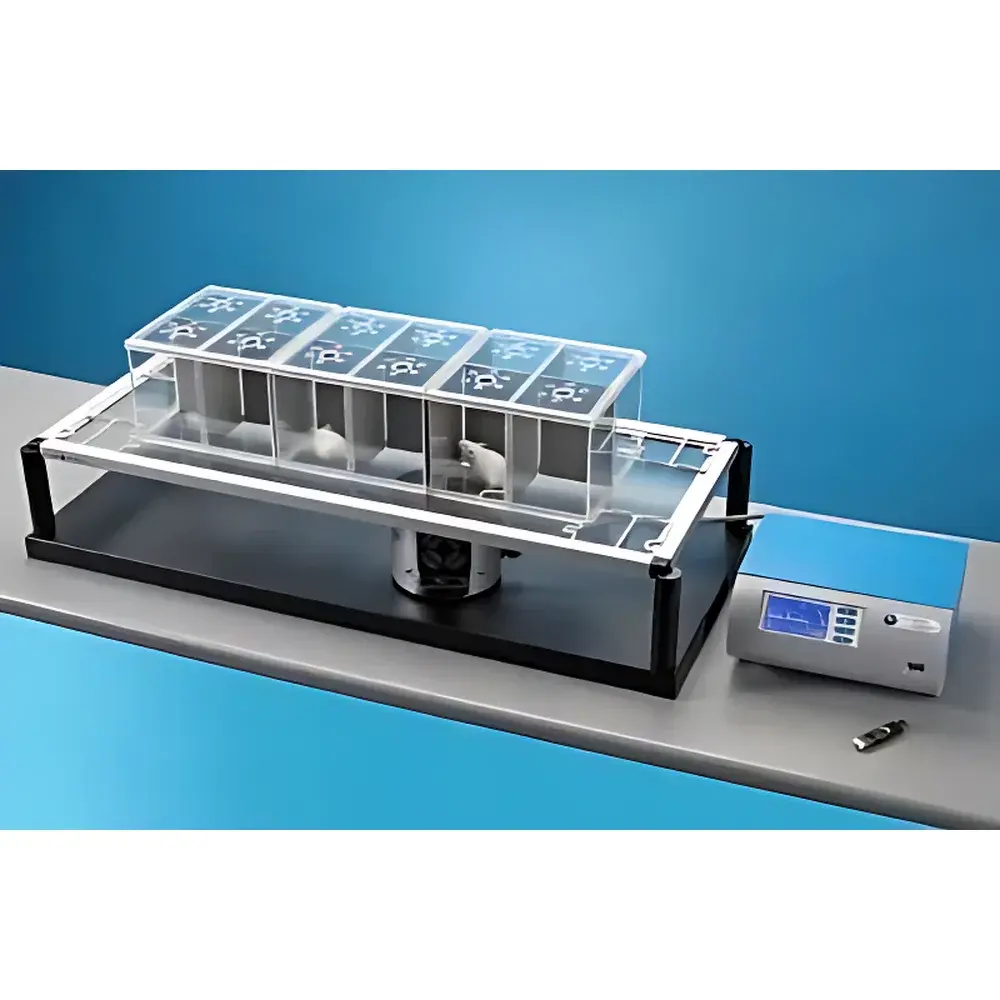
Ugo Basile Model 37570 Infrared Paw Withdrawal Nociception Analyzer
| Origin | Italy |
|---|---|
| Supplier Type | Authorized Distributor |
| Import Status | Imported Instrument |
| Model | 37570 |
| Price Range | USD 6,800 – 13,600 |
| Stimulus Type | Adjustable Infrared Thermal Beam |
| Response Detection | Automated Foot Withdrawal Timing |
| Temporal Resolution | 0.1 s |
| Intensity Range | 10–99 (arbitrary units) |
| Chamber Configuration | Triple Independent Testing Chambers |
| Data Output | LED Display + Optional PC Interface + Printer Support |
| Calibration Option | Compatible with Ugo Basile Radiometer Model 37300 |
Overview
The Ugo Basile Model 37570 Infrared Paw Withdrawal Nociception Analyzer is a precision-engineered instrument designed for quantitative assessment of thermal nociceptive thresholds in rodents. It operates on the principle of focused infrared radiant heat stimulation applied to the plantar surface of the hind paw, inducing a reflexive withdrawal response when the thermal stimulus exceeds the animal’s nociceptive threshold. The system automatically detects the onset of paw movement using high-sensitivity optical sensors and records latency—the time interval between stimulus onset and withdrawal—with 0.1-second resolution. Unlike mechanical or chemical modalities, this non-contact thermal method minimizes handling stress and avoids tissue deformation, supporting adherence to the 3Rs principles (Replacement, Reduction, Refinement) in preclinical pain research. The device is widely deployed in pharmacological screening of analgesics, neuropathic pain modeling, and longitudinal studies requiring high intra- and inter-subject reproducibility under controlled environmental conditions.
Key Features
- Triple independent testing chambers enable parallel assessment of up to three animals without cross-stimulus interference, improving throughput while maintaining experimental consistency.
- Digitally adjustable infrared thermal source (intensity range: 10–99 arbitrary units) allows precise titration of stimulus intensity across studies and strain-specific baselines.
- Automated real-time detection of paw withdrawal via synchronized optical sensing—no manual timing or observer bias.
- Integrated LED display provides immediate readout of latency values, stimulus intensity, and chamber ID for rapid data verification during acquisition.
- Modular architecture supports optional integration with external peripherals: thermal calibration via Ugo Basile Radiometer Model 37300 ensures traceable irradiance validation per ISO/IEC 17025-aligned protocols.
- No physical restraint required—animals remain freely ambulatory within standardized acrylic chambers, reducing stress-induced confounding variables in baseline latency measurements.
Sample Compatibility & Compliance
The Model 37570 is validated for use with mice (C57BL/6, CD-1, BALB/c) and rats (Sprague-Dawley, Wistar) aged 6–24 weeks and weighing 18–350 g. Chamber dimensions comply with OECD Test Guideline 407 and NIH Office of Laboratory Animal Welfare (OLAW) spatial requirements for acute thermal assays. All electronic components meet CE marking standards for laboratory equipment (2014/30/EU EMC Directive and 2014/35/EU LVD). When used in GLP-compliant environments, the system supports audit-ready documentation through optional timestamped CSV export and configurable user access levels—aligning with FDA 21 CFR Part 11 requirements when paired with validated software modules.
Software & Data Management
Data acquisition and analysis are supported via Ugo Basile’s proprietary Bioseb Nociception Suite (v4.2+), compatible with Windows 10/11 (64-bit). The software enables batch parameter configuration, real-time latency plotting, outlier detection based on predefined latency windows (e.g., 30 s), and automated calculation of group mean ± SEM. Export formats include CSV, Excel (.xlsx), and PDF reports compliant with journal submission standards (e.g., *Pain*, *Neuropharmacology*). Audit trails log operator ID, session timestamps, calibration events, and parameter modifications—essential for regulatory submissions under ICH E6(R3) and ISO 14155.
Applications
- Preclinical evaluation of opioid and non-opioid analgesics (e.g., morphine, gabapentin, duloxetine) in inflammatory and neuropathic pain models.
- Characterization of genetic knockouts or transgenic lines exhibiting altered thermal sensitivity (e.g., TRPV1−/−, Nav1.7 mutants).
- Longitudinal monitoring of pain hypersensitivity following chronic constriction injury (CCI), spared nerve injury (SNI), or chemotherapy-induced peripheral neuropathy (CIPN).
- Standardized thermal threshold profiling in toxicology studies assessing neurotoxic side effects of candidate compounds.
- Method validation and cross-laboratory harmonization in multi-center pain research consortia (e.g., IMI-PAIN-CARE).
FAQ
Is the infrared source calibrated to absolute irradiance values?
Yes—when used with the optional Ugo Basile Radiometer Model 37300, the system permits traceable calibration against NIST-traceable standards, reporting irradiance in mW/cm² per intensity unit.
Can latency data be exported in machine-readable format for statistical analysis?
Yes—CSV export includes columns for subject ID, chamber number, stimulus intensity, latency (ms), trial number, date/time stamp, and operator ID.
What environmental controls are recommended during testing?
Ambient temperature must be maintained at 22 ± 2°C with relative humidity 40–60%; chambers require ≥30 min acclimatization prior to testing to stabilize basal thermal sensitivity.
Does the system support randomized stimulus order across chambers?
Yes—the Bioseb Nociception Suite allows programmable randomization of stimulus initiation sequence to eliminate temporal bias in multi-chamber sessions.
Is firmware update capability available remotely?
Firmware updates are delivered via secure USB key or authenticated download portal; version history and SHA-256 checksums are provided for GxP traceability.




