
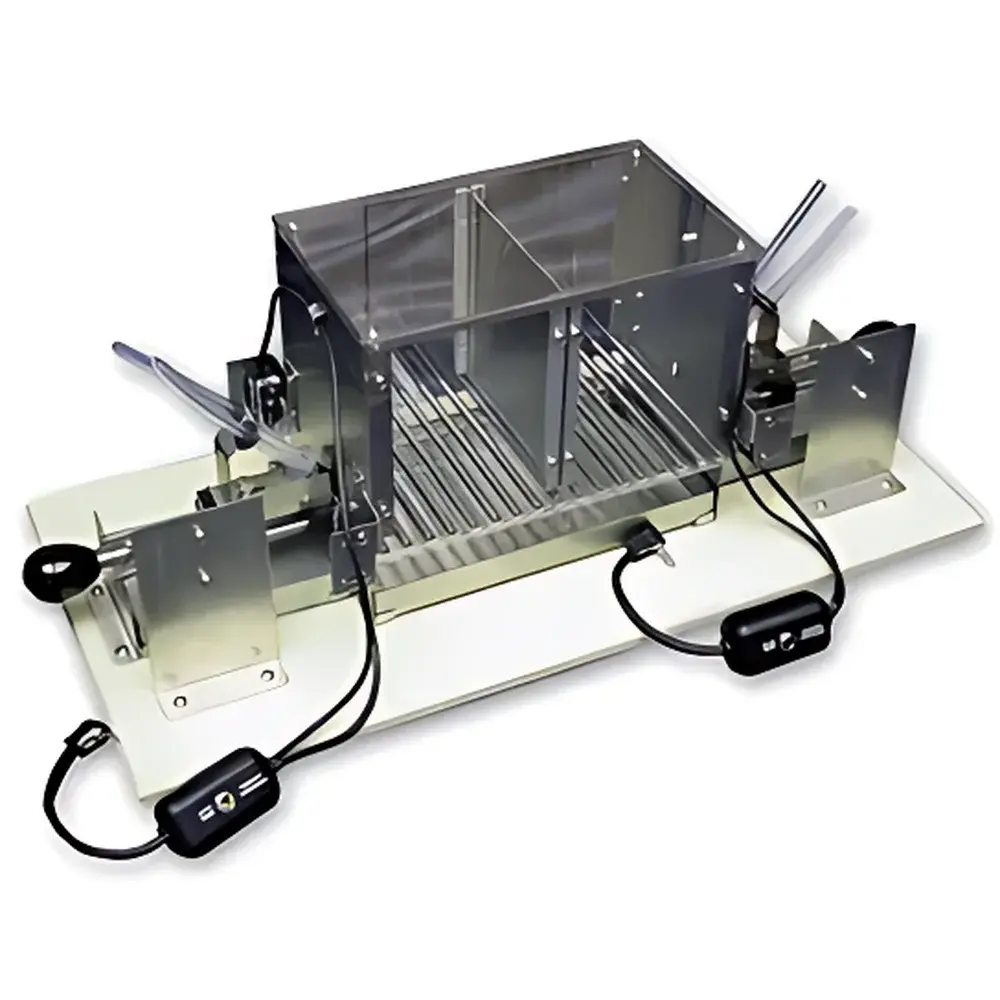
RWD Lafayeette Mouse Voluntary Grasping Test Cage
| Brand | RWD |
|---|---|
| Origin | Shenzhen, China |
| Manufacturer Type | Manufacturer |
| Country of Origin | China |
| Model | Lafayette 80870 |
| Pricing | Upon Request |
Overview
The RWD Lafayette Mouse Voluntary Grasping Test Cage (Model 80870) is a standardized, dual-chamber behavioral apparatus engineered for the quantitative assessment of motor coordination, cognitive processing, and motivational drive in murine subjects. Based on the well-established Lafayette grasping paradigm, this system implements a food-motivated operant task grounded in skilled forelimb use—specifically, voluntary reaching and grasping of food pellets through calibrated apertures. The test leverages natural foraging motivation while isolating fine motor control and decision-making under controlled sensory conditions. Measurement principles rely on infrared beam interruption detection for precise temporal resolution of paw entry, grasp attempts, and pellet retrieval events. The apparatus operates within a modular framework compatible with ABET II or equivalent behavioral control software, enabling time-stamped event logging, automated stimulus sequencing, and integration with complementary operant modules (e.g., nose-poke, lever-press, auditory/visual cueing). Designed for reproducible longitudinal studies, it supports GLP-aligned experimental protocols in preclinical neuroscience, neuropharmacology, and translational models of Parkinson’s disease, stroke recovery, and frontostriatal dysfunction.
Key Features
- Dual independent test chambers allow simultaneous, parallel assessment of two mice without cross-contamination of behavioral data.
- Removable inter-chamber partition enables flexible configuration for single- or dual-subject paradigms.
- Stainless-steel food pellet funnel (Model 80875) ensures consistent pellet presentation and prevents scooping; aperture geometry enforces true grasping over raking behavior.
- Integrated infrared photobeam arrays quantify grasp attempt latency, total attempts, successful retrievals, and pellet drop location (cage floor vs. waste tray).
- Side-wall stimulus ports support spatially counterbalanced baited/unbaited configurations for cognitive discrimination tasks.
- Modular interface compatibility: direct connection to AWM interface boxes or ABET II I/O packages for synchronized event timestamping and real-time behavioral logic execution.
- Optional add-ons include programmable LED stimulus lights, tone generators, pellet dispensers with bait-status feedback, and nose-poke/lever-press actuators for compound task design.
Sample Compatibility & Compliance
The system is validated for C57BL/6, BALB/c, CD-1, and transgenic mouse strains (e.g., BACHD, Q175, 6-OHDA-lesioned models). All structural components comply with ASTM F2100-21 standards for laboratory animal housing hardware integrity and material biocompatibility. Electrical interfaces meet IEC 61000-6-3 EMC emission limits. Data acquisition workflows support audit-trail generation per FDA 21 CFR Part 11 requirements when deployed with ABET II v4.0+ and validated computer systems. Experimental protocols align with NIH Guide for the Care and Use of Laboratory Animals and ARRIVE 2.0 reporting guidelines.
Software & Data Management
Behavioral control and data capture are managed via ABET II software (v4.2 or later), which provides deterministic real-time scheduling, conditional branching logic, and multi-channel I/O synchronization. Event logs export in CSV and HDF5 formats, preserving microsecond-level timestamps for grasp onset, pellet removal, and reward delivery. Built-in analysis tools compute primary endpoints including: grasp attempt latency (s), success rate (%), inter-attempt interval (s), lateralized preference index, and baited-vs-unbaited response ratio. Raw beam-break data can be imported into MATLAB or Python (via PyABET) for custom kinematic modeling or machine-learning-based behavioral classification.
Applications
- Quantification of forelimb dexterity deficits post-cortical or striatal lesion.
- Evaluation of dopaminergic or cholinergic pharmacotherapy effects on motor initiation and cognitive flexibility.
- Longitudinal tracking of motor learning curves during rehabilitation paradigms.
- Discrimination testing using visual cues (wall markings) or auditory stimuli to assess attentional set-shifting.
- Integration with optogenetic or chemogenetic interventions requiring precise temporal coupling between neural manipulation and behavioral output.
- Validation of human-relevant biomarkers in genetic models of Huntington’s or Alzheimer’s disease.
FAQ
Is the test cage compatible with automated video tracking systems?
Yes—while infrared beam detection serves as the primary quantification method, the transparent acrylic walls and top-mounted camera port enable concurrent EthoVision or DeepLabCut-based pose estimation for supplementary kinematic analysis.
Can the apparatus be sterilized between subjects?
All non-electronic components—including funnels, partitions, and trays—are autoclavable stainless steel or chemical-resistant acrylic; electronic housings are wipe-clean only with 70% ethanol.
What is the minimum recommended acclimation period before testing?
A minimum of three 10-minute habituation sessions over two days is advised to reduce neophobia and establish baseline exploratory behavior.
Does the system support weight-based pellet dispensing?
No—the standard funnel delivers fixed-diameter 20-mg dustless precision pellets; optional gravimetric feeders require third-party integration via ABET digital outputs.
How is “successful grasp” operationally defined in data analysis?
A successful grasp is recorded when the pellet passes completely through the mesh floor into the waste tray—distinguishing retrieval from accidental displacement onto the cage floor.




