
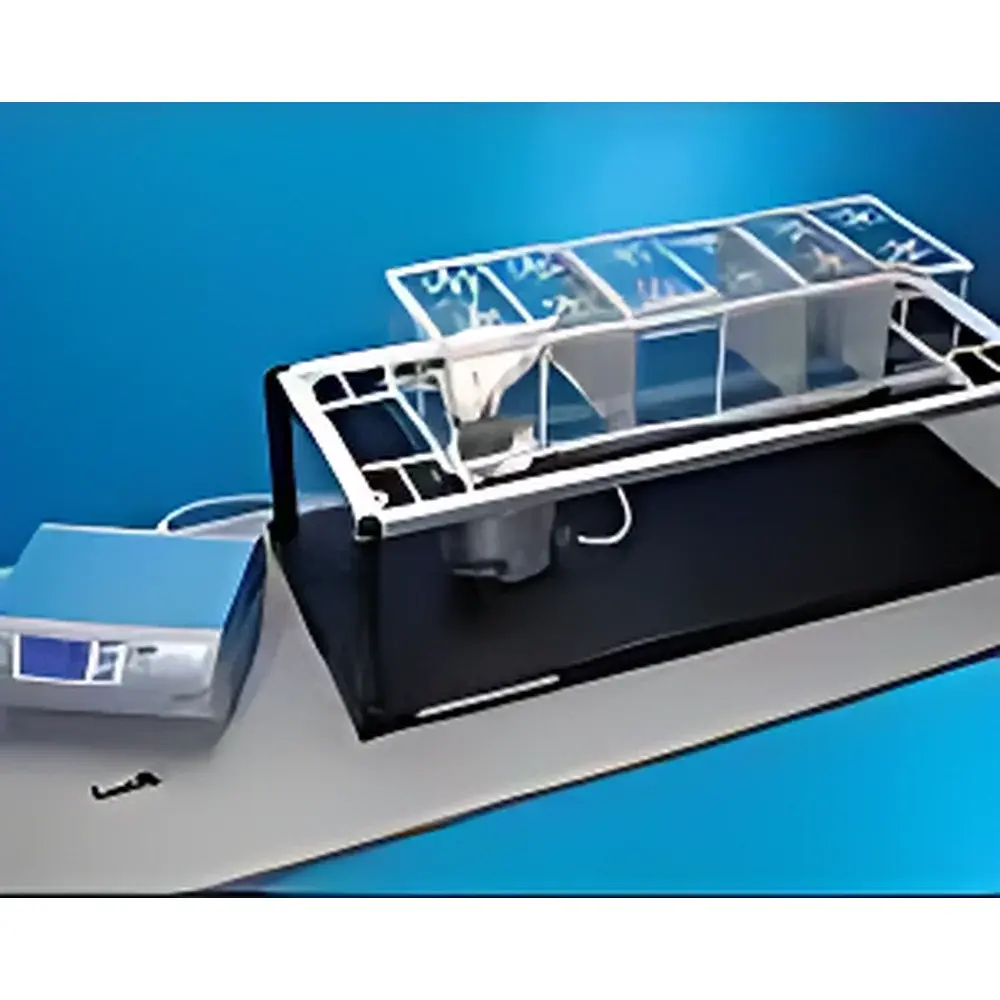
Clarisense 37550 Von Frey Paw Withdrawal Threshold Analyzer
| Origin | Italy |
|---|---|
| Manufacturer Type | Authorized Distributor |
| Origin Category | Imported Instrument |
| Model | 37550 |
| Price Range | USD 7,000 – 14,000 |
Overview
The Clarisense 37550 Von Frey Paw Withdrawal Threshold Analyzer is a precision-engineered, semi-automated mechanical allodynia and hyperalgesia assessment system designed for preclinical rodent models. It operates on the validated principle of calibrated filament-based mechanical stimulation—applying incremental, quantifiable force to the plantar surface of the hind paw until a reproducible withdrawal reflex is elicited. This method adheres to established behavioral neuroscience protocols for measuring mechanical nociceptive thresholds, widely cited in peer-reviewed literature (e.g., Chaplan et al., J. Neurosci. Methods, 1994) and aligned with IASP (International Association for the Study of Pain) guidelines for preclinical pain evaluation. The device integrates force transduction, real-time motion detection, and programmable stimulus ramping to eliminate observer bias and ensure inter-session consistency across longitudinal studies.
Key Features
- High-resolution digital force measurement with ±0.1 g accuracy over a 0–50 g dynamic range, enabling precise quantification of mechanical withdrawal thresholds.
- Adjustable stimulus ramp rate: 1–20 s per trial (1 s increments), allowing protocol customization for acute vs. chronic pain models or pharmacological time-course assessments.
- Controlled probe displacement of 12 mm at constant velocity, ensuring consistent contact geometry and minimizing shear artifacts during plantar stimulation.
- Automated endpoint detection with 100 ms temporal resolution (0.1 s reaction latency threshold), triggered by unambiguous paw retraction—validated against high-speed video synchronization studies.
- Stepwise force increment of 0.5 g per stimulus cycle, supporting both up-down (Dixon) and ascending staircase paradigms per NIH/NCI recommended testing frameworks.
- Dual-output data interface: real-time thermal printing for immediate lab documentation and USB-connected PC software for raw data export (CSV, TXT), timestamped event logging, and batch analysis.
Sample Compatibility & Compliance
The Clarisense 37550 is optimized for use with adult mice (C57BL/6, BALB/c, CD-1) and rats (Sprague-Dawley, Wistar), accommodating standard restraint enclosures (diameter: 8–12 cm) with non-slip mesh flooring. All hardware components comply with CE marking requirements for laboratory medical devices (Class I, Annex VIII). The system supports GLP-compliant workflows through audit-trail-enabled software (optional add-on module), including user authentication, electronic signatures, and immutable session logs traceable to ISO/IEC 17025 and FDA 21 CFR Part 11 standards when paired with validated third-party LIMS integration.
Software & Data Management
The included Clarisense Analysis Suite (v3.2+) provides cross-platform compatibility (Windows 10/11, macOS 12+) and supports multi-animal cohort management, automatic threshold calculation (via Dixon up-down algorithm), and statistical overlay of longitudinal datasets. Raw force-time curves are stored with millisecond timestamps, permitting post-hoc review of stimulus onset, peak force, and withdrawal latency. Export formats include ANSI-standard CSV for SPSS, GraphPad Prism, and R integration. Software validation documentation (IQ/OQ/PQ templates) is provided upon request for regulated environments.
Applications
- Preclinical evaluation of analgesic efficacy (e.g., NSAIDs, opioids, novel TRPV1 or Nav1.7 modulators).
- Neuropathic pain modeling: CCI, SNI, and streptozotocin-induced diabetic neuropathy.
- Inflammatory pain assessment: CFA- or carrageenan-induced edema models.
- Genetic screening: phenotyping transgenic/knockout lines with altered mechanosensory pathways (e.g., PIEZO2, MEC-4 orthologs).
- Toxicity studies: monitoring chemotherapy-induced peripheral neuropathy (CIPN) progression.
- Behavioral pharmacokinetic-pharmacodynamic (PK-PD) correlation studies requiring repeated-measures design.
FAQ
What species and age ranges are validated for use with the Clarisense 37550?
The system is validated for adult mice (6–20 weeks) and rats (8–24 weeks). Juvenile animals require manual calibration verification due to lower baseline thresholds.
Is calibration traceable to NIST or equivalent national metrology institutes?
Yes—each unit ships with a factory calibration certificate traceable to EU-accredited standards (DAkkS-certified load cells), with annual recalibration recommended.
Can the device be integrated into automated behavioral testing suites?
It supports TTL trigger input/output for synchronization with video tracking systems (e.g., EthoVision XT, ANY-maze) and environmental control modules.
Does the software meet regulatory requirements for GCP or IND-enabling studies?
When deployed with the optional 21 CFR Part 11 Compliance Pack, it fulfills ALCOA+ data integrity principles and supports audit-ready reporting for regulatory submissions.
What maintenance is required for long-term operational stability?
Routine cleaning of the stainless-steel probe tip and enclosure mesh; biannual verification of force sensor linearity using certified test weights (supplied).




