
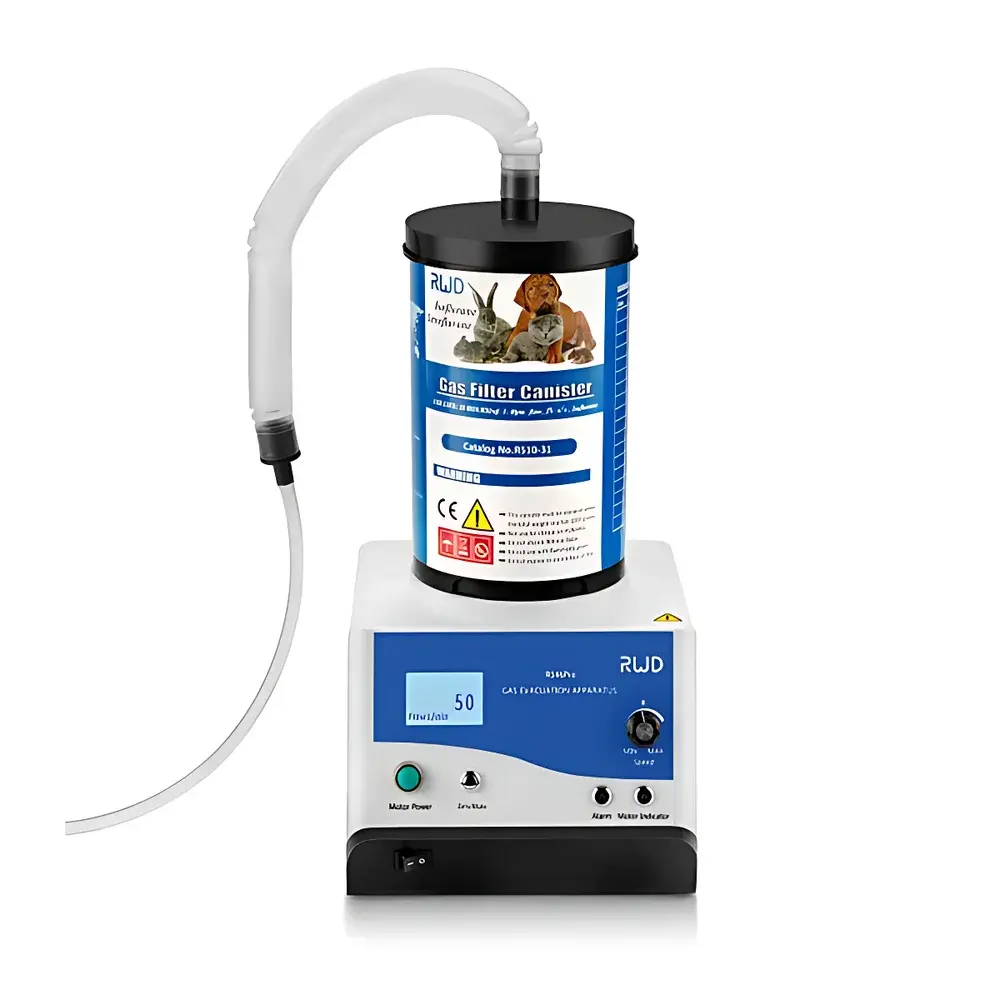
RWD R546Pro Gas Scavenging System
| Brand | RWD |
|---|---|
| Origin | Guangdong, China |
| Manufacturer Type | Original Equipment Manufacturer (OEM) |
| Country of Origin | China |
| Model | R546Pro |
| Price Range | USD 140–700 (FOB) |
| Airflow Range | 8–60 L/min |
| Noise Level | <50 dB(A) |
| Dimensions (W×D×H) | 232 × 200 × 184 mm |
| Operating Temperature | 5–40 °C |
| Weight Classification | Triple-Stage Load Monitoring (990 g / 1010 g thresholds) |
Overview
The RWD R546Pro Gas Scavenging System is an engineered solution for active waste anesthetic gas (WAG) capture in rodent and small-mammal inhalation anesthesia workflows. Designed to interface seamlessly with standard small-animal anesthesia platforms—including cone masks, tube masks, and stereotaxic nose cones—the R546Pro establishes a controlled negative-pressure environment that actively draws exhaled and leaked anesthetic vapors (e.g., isoflurane, sevoflurane) away from the operator workspace. Unlike passive scavenging or uncontrolled room ventilation, this system directs effluent through a certified activated carbon filter cartridge, where volatile anesthetics are adsorbed with high retention efficiency. The device complies with occupational exposure limits defined by OSHA PEL (Permissible Exposure Limits) and ACGIH TLV (Threshold Limit Values) for halogenated anesthetics, supporting institutional adherence to laboratory safety protocols under GLP and IACUC-reviewed animal use protocols.
Key Features
- Adjustable vacuum airflow from 8 to 60 L/min—digitally displayed in real time on a high-contrast LED interface for precise, repeatable flow calibration across single- or multi-animal setups.
- Integrated triple-stage load monitoring system with patented temperature-compensated weighing technology; maintains ±1.5 g accuracy across 5–40 °C ambient conditions, enabling reliable detection of filter saturation.
- Two-tier audible/visual alarm thresholds: Stage 1 warning at 990 g (amber LED + intermittent tone), Stage 2 critical alert at 1010 g (red LED + continuous tone), ensuring timely filter replacement without workflow interruption.
- Four-sided acoustic enclosure design reduces motor-generated noise to <50 dB(A) at 1 m distance—minimizing auditory stress in behavioral and electrophysiological studies where animal responsiveness must remain unperturbed.
- One-touch mute function silences alarm tones while preserving visual indicators and vacuum operation—critical during sensitive recording sessions or overnight experiments.
- Ergonomic arc-shaped chassis (232 × 200 × 184 mm, <3.2 kg net weight) facilitates repositioning between procedure stations and integration into compact surgical rigs or imaging suites.
Sample Compatibility & Compliance
The R546Pro is validated for use with standard 1–5 channel rodent anesthesia systems operating at flow rates up to 2 L/min per animal. It accommodates commercially available 100–150 g activated carbon canisters (e.g., RWD SC-100 series), which meet ASTM D5228-18 requirements for adsorption capacity testing. Filter service life is determined empirically based on cumulative anesthetic dose, exposure duration, and ambient humidity; typical replacement intervals range from 40–120 hours under continuous isoflurane use (2–3% v/v). The unit’s mechanical design conforms to IEC 61000-6-3 (EMC emission standards) and carries CE marking for laboratory equipment. While not FDA-cleared as a medical device, it supports compliance with NIH OLAW guidelines and AAALAC International Standard 3.3.12 on occupational health and WAG control.
Software & Data Management
The R546Pro operates as a standalone hardware module with no embedded firmware or cloud connectivity. All operational parameters—including real-time airflow, cumulative runtime, and filter weight—are conveyed via physical LED display and tactile feedback. No data logging, USB export, or audit trail functionality is provided; however, the system’s deterministic analog-digital signal path ensures traceable, non-volatile status indication. For institutions requiring 21 CFR Part 11–compliant records, external digital scales calibrated to NIST-traceable standards may be used in parallel with manual logbook entries referencing timestamped weight readings and alarm events.
Applications
- Multi-animal isoflurane/sevoflurane maintenance during longitudinal neuroimaging (fMRI, PET) or optogenetic stimulation protocols.
- High-throughput surgical preparation (e.g., craniotomy, cannulation) where consistent operator exposure control is mandated across shifts.
- Behavioral phenotyping assays requiring low-noise environments—such as prepulse inhibition, fear conditioning, or social interaction tests.
- Teaching laboratories performing introductory rodent anesthesia, where visual flow feedback supports trainee competency development.
- Core facility shared-resource settings needing rapid deployment, minimal maintenance, and interoperability with third-party vaporizers and flowmeters.
FAQ
Does the R546Pro require calibration before first use?
No—factory-zeroed load cell and pre-calibrated airflow sensor eliminate user calibration. Verification of zero-point stability is recommended after initial unpacking and every 6 months using a 100 g certified test weight.
Can the R546Pro be used with nitrous oxide or desflurane?
Not recommended. The activated carbon formulation is optimized for isoflurane and sevoflurane; adsorption efficiency for desflurane is significantly reduced, and nitrous oxide is not retained by standard carbon media.
Is the filter cartridge reusable or refillable?
No. RWD SC-series cartridges are single-use, pre-packed units with sealed end caps to prevent premature desorption. Reuse or refilling invalidates performance certification and poses exposure risk.
How does ambient temperature affect weighing accuracy?
The integrated thermal compensation algorithm corrects for drift across 5–40 °C. Outside this range, measurement uncertainty increases beyond ±3 g; operation below 5 °C may cause condensation-induced filter mass artifacts.
What maintenance is required beyond filter replacement?
Biannual inspection of inlet tubing integrity, cleaning of external vents with dry lint-free cloth, and verification of LED brightness and alarm tone output constitute the full preventive maintenance schedule.




