
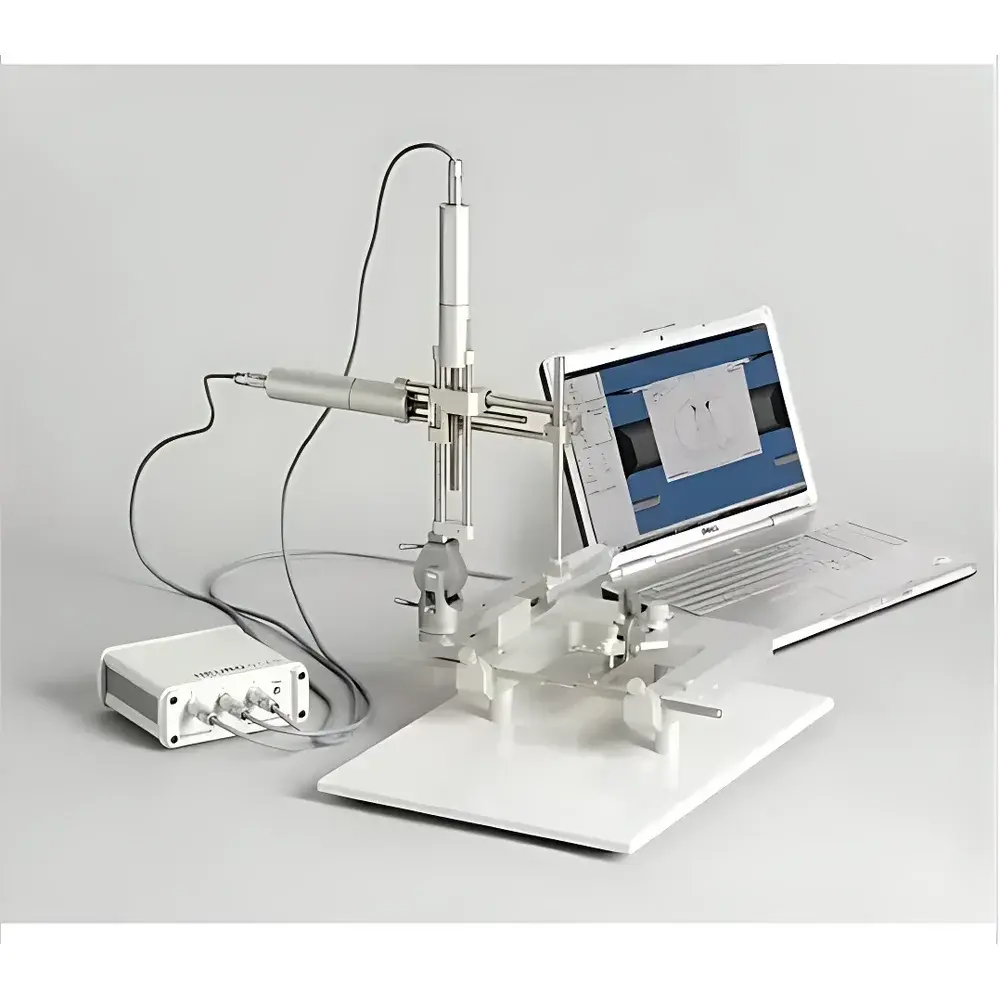
RWD 68930 Electric Stereotaxic Instrument for Rodents
| Brand | RWD |
|---|---|
| Origin | Shenzhen, China |
| Manufacturer Type | Original Equipment Manufacturer (OEM) |
| Regional Classification | Domestic (China) |
| Model | 68930 |
| Pricing | Available Upon Request |
Overview
The RWD 68930 Electric Stereotaxic Instrument is an electromechanically actuated, computer-controlled stereotaxic system engineered for high-precision neurosurgical interventions in rodent models. It operates on the principle of orthogonal three-dimensional coordinate navigation—X (anterior–posterior), Y (medial–lateral), and Z (dorsal–ventral)—relative to standardized bregma–lambda skull landmarks, enabling reproducible targeting of subcortical and cortical brain structures. Unlike manually operated stereotaxic frames, the 68930 integrates stepper motor-driven linear actuators with closed-loop positional feedback, ensuring sub-micron repeatability and eliminating operator-induced mechanical drift. Designed specifically for electrophysiology, optogenetics, viral vector delivery, and microinjection workflows, the system supports both acute and chronic implantation protocols under aseptic surgical conditions. Its architecture conforms to fundamental requirements for GLP-compliant preclinical neuroscience research, including traceable axis calibration, deterministic motion control, and compatibility with standard stereotaxic atlases.
Key Features
- Fully motorized, PC-based control via USB-connected software interface; optional joystick module available for real-time manual override without interrupting coordinate tracking
- Integrated digital stereotaxic atlas library supporting Paxinos & Watson (7th ed.) and Franklin & Paxinos (4th ed.) for rats and mice—rendered in interactive 3D with adjustable opacity, layer toggling, and cross-sectional slice navigation
- Orthogonal XYZ translation range: 80 mm per axis, with resolution of 0.001 mm (1 µm) and repeatability ±0.002 mm
- Independent or coupled X/Y-axis tilt capability: ±90° rotation about either axis, facilitating angled electrode or cannula insertion for deep midline targets (e.g., VTA, SNc, habenula)
- 360° continuous rotation of the manipulator arm with zero-backlash harmonic drive, preserving angular orientation during multi-step trajectories
- Modular mounting platform compatible with standard Kopf-style base plates, ear bars, and incisor bars; optional mouse-specific adapters and low-profile ear bars available for C57BL/6, BALB/c, and CD-1 strains
Sample Compatibility & Compliance
The RWD 68930 is validated for use with adult Sprague-Dawley and Wistar rats (250–500 g) and mice (20–35 g) under IACUC- or AAALAC-accredited animal facilities. All structural components—including the cast aluminum frame, stainless steel guide rails, and titanium-coated manipulator arm—are autoclavable or compatible with ethanol/isopropanol disinfection protocols. The system meets electromagnetic compatibility (EMC) standards per IEC 61326-1 for laboratory equipment and complies with mechanical safety requirements outlined in ISO 13857 for accessible moving parts. While not certified for clinical use, its design aligns with principles referenced in ISO 14155 (clinical investigation of medical devices) for preclinical validation studies intended to support regulatory submissions.
Software & Data Management
Control and data acquisition are managed through RWD’s proprietary StereoControl Suite v3.2, a Windows-based application supporting x64 architecture and .NET Framework 4.8. The software provides audit-trail functionality compliant with FDA 21 CFR Part 11 requirements—including user authentication, electronic signatures, and immutable session logs. Coordinate entry supports direct atlas-based targeting (e.g., “AP −3.2 mm, ML +1.8 mm, DV −4.5 mm relative to bregma”), as well as custom coordinate import via CSV or Excel. All position changes, tilt angles, and rotation states are timestamped and exportable in HDF5 format for integration with MATLAB, Python (via h5py), or commercial electrophysiology platforms (e.g., Spike2, Open Ephys). Firmware updates are delivered via secure HTTPS endpoint with SHA-256 signature verification.
Applications
- Single-unit extracellular recordings using glass micropipettes or silicon probes in awake or anesthetized preparations
- Stereotactic intracranial injection of AAV vectors, lentiviruses, or pharmacological agents with volumetric precision down to 50 nL
- Chronic implantation of EEG/EMG electrodes, optrodes, or wireless neural dust sensors
- Targeted ablation or photostimulation experiments requiring precise spatial registration across multiple sessions
- Validation of functional MRI or PET findings through post-hoc histological correlation using coordinate-mapped sectioning
FAQ
Is the RWD 68930 compatible with third-party electrophysiology amplifiers or imaging systems?
Yes—the instrument features TTL-triggered I/O ports (4 input, 4 output) and RS-232 serial communication for hardware synchronization with commercial recording systems (e.g., Intan, Tucker-Davis Technologies, Neuralynx) and behavioral video tracking platforms.
Can the system be calibrated independently by the end user?
Yes—StereoControl Suite includes a guided calibration workflow using NIST-traceable gauge blocks and optical alignment tools; calibration certificates are generated and stored within the audit log.
What is the maximum payload capacity of the manipulator arm?
The arm supports up to 500 g static load at full extension while maintaining specified positional accuracy; dynamic load rating is 300 g for continuous motorized movement.
Does the software support multi-animal batch protocols?
Yes—users can define and queue sequential procedures across multiple subjects, including automatic axis repositioning, tilt angle sequencing, and time-stamped injection volume ramping.
Are service and technical support available outside mainland China?
RWD maintains authorized service partners in the US, Germany, Japan, and Australia; firmware updates and remote diagnostics are provided globally via secure cloud portal access.





