
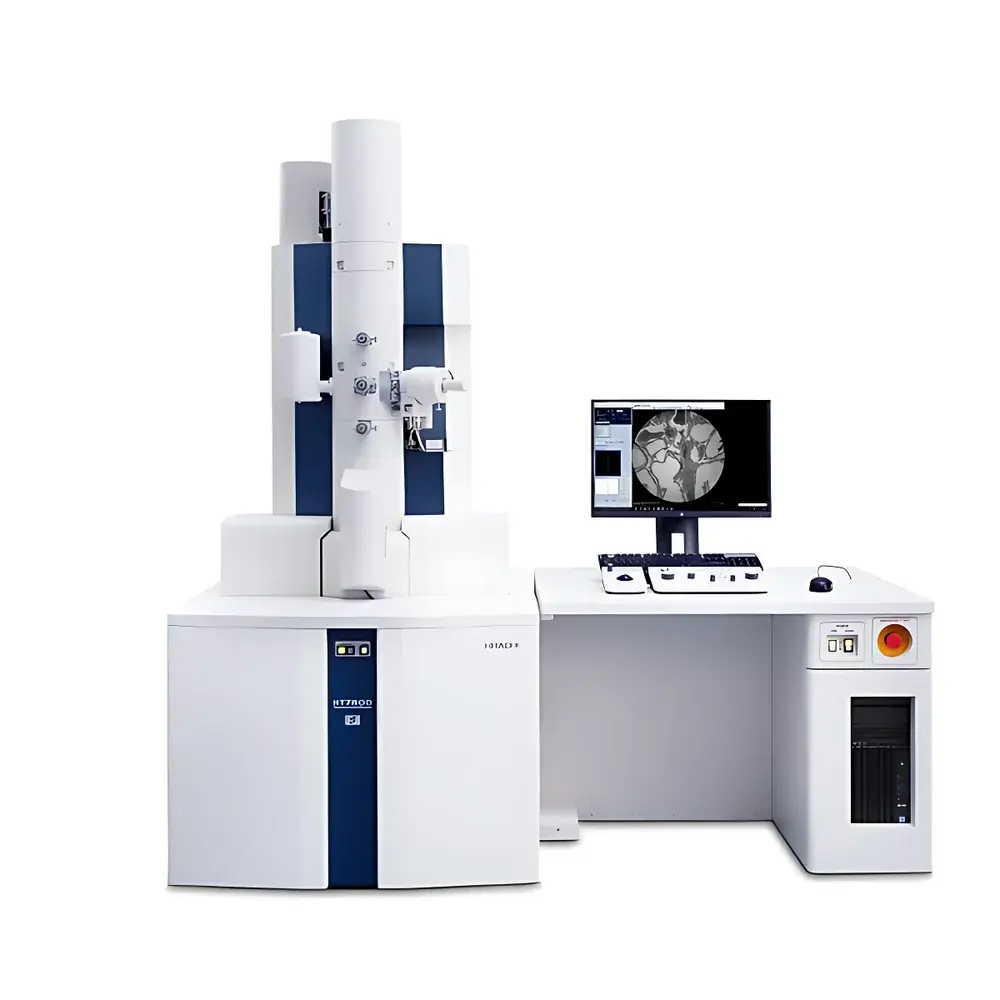
Hitachi HT7800 Series 120 kV Transmission Electron Microscope
| Brand | Hitachi |
|---|---|
| Origin | Japan |
| Manufacturer Type | Original Equipment Manufacturer (OEM) |
| Product Origin | Imported |
| Model | HT7800 Series |
| Accelerating Voltage | 20–120 kV |
| Magnification Range | ×200–×200,000 (High Contrast Mode) |
Overview
The Hitachi HT7800 Series is a fully digital 120 kV transmission electron microscope (TEM) engineered for high reproducibility, operational efficiency, and multi-modal imaging capability in academic, pharmaceutical, and industrial R&D laboratories. Built upon Hitachi’s second-generation dual-gap objective lens design, the HT7800 implements a unified optical architecture that simultaneously supports both high-contrast (HC) and high-resolution (HR) imaging modes—without mechanical reconfiguration or mode-switching compromises. This dual-mode functionality enables seamless transition between low-magnification wide-field survey imaging (e.g., for nanoparticle dispersion analysis or cellular ultrastructure screening) and atomic-scale lattice imaging (e.g., crystallographic characterization of catalysts or 2D materials), all within a single instrument platform. The system operates on conventional thermionic LaB₆ electron sources, delivering stable beam current and long-term emission consistency under variable accelerating voltages (20–120 kV), making it particularly suitable for beam-sensitive biological specimens, polymers, and soft nanomaterials where lower kV operation reduces radiation damage.
Key Features
- Second-generation dual-gap objective lens enabling concurrent optimization of contrast and resolution across magnification ranges
- Integrated high-speed, high-dynamic-range CMOS fluorescent screen camera replacing traditional phosphor screens—enabling real-time, ambient-light TEM operation with full digital workflow integration
- Standard ultra-high vacuum (UHV) system comprising oil-free scroll backing pump and turbo-molecular pump (TMP), achieving base pressure <5×10⁻⁷ Pa for stable imaging and extended column lifetime
- Motorized ±70° tilt sample stage with precise angular repeatability (±0.1°), enabling acquisition of tilt-series datasets for tomographic reconstruction without external add-ons
- Automated mosaic imaging: combines stage translation and beam-shift stitching to generate gigapixel-scale, distortion-corrected images at any magnification; preserves stage coordinates and specimen holder rotation metadata for accurate alignment and post-processing
- Intelligent batch acquisition: supports up to 10,000 pre-defined image positions with automated focus, stigmation, and exposure control—executed unattended with traceable audit logs compliant with GLP/GMP documentation requirements
Sample Compatibility & Compliance
The HT7800 accommodates standard 3.05 mm diameter TEM grids (including lacey carbon, ultrathin carbon, and holey film variants) via a double-tilt or single-tilt specimen holder. Its 120 kV operating voltage provides optimal balance between penetration depth and reduced knock-on damage for organic, hydrated, and beam-labile specimens—making it compatible with cryo-TEM workflows when integrated with optional cryo-transfer systems. The system meets ISO 14644-1 Class 5 cleanroom compatibility standards for column assembly and conforms to IEC 61000-6-3 (EMC emission) and IEC 61000-6-2 (immunity) specifications. Vacuum interlocks, emergency shutdown protocols, and hardware-based beam blanking comply with national radiation safety regulations (e.g., US NRC 10 CFR Part 20, EU Directive 2013/59/Euratom).
Software & Data Management
Control and acquisition are managed through Hitachi’s proprietary TEM Navigator™ software suite, built on a modular, 64-bit Windows-based architecture. The interface supports DICOM-compliant image export, TIFF/EMD metadata embedding (including magnification, kV, spot size, aperture selection, and lens excitations), and direct integration with third-party tomography packages (e.g., IMOD, Dynamo, EMAN2). All user actions—including parameter changes, stage movements, and image captures—are time-stamped and logged in an encrypted audit trail, satisfying FDA 21 CFR Part 11 requirements for electronic records and signatures. Raw image data is stored in lossless 16-bit format with embedded calibration references, supporting quantitative intensity analysis and drift-corrected time-series registration.
Applications
- Materials science: Defect analysis in battery cathode materials, grain boundary mapping in polycrystalline alloys, and strain field quantification in semiconductor heterostructures
- Life sciences: Subcellular organelle morphology in fixed/frozen-hydrated sections, virus particle morphogenesis, and immunogold labeling localization
- Nanotechnology: Size distribution and crystallinity assessment of quantum dots, metal–organic frameworks (MOFs), and polymer nanoparticles
- Quality control: In-line validation of nanoparticle synthesis batches, coating uniformity verification, and contaminant identification in pharmaceutical excipients
- 3D structural biology: Sub-nanometer resolution tomograms of isolated macromolecular complexes and thin cellular lamellae
FAQ
What vacuum level does the HT7800 achieve, and how is it maintained?
The system achieves a base pressure of <5×10⁻⁷ Pa using a dual-pump configuration: a dry scroll backing pump and a 300 L/s turbo-molecular pump—both included as standard equipment.
Can the HT7800 perform electron tomography without additional hardware?
Yes. The standard ±70° motorized tilt stage, combined with integrated acquisition scripting and real-time dose management, enables full tilt-series collection and initial reconstruction without aftermarket upgrades.
Is the HT7800 compatible with cryogenic TEM workflows?
While the base system operates at room temperature, it is mechanically and electronically compatible with Hitachi’s HT7800-Cryo option, which includes a Gatan 626-type cryo-holder interface and anti-contamination cold trap.
How is image calibration validated across magnifications?
Each magnification step is factory-calibrated using certified diffraction grating replicas and verified via NIST-traceable lattice spacing measurements in silicon or gold standards; calibration data is embedded in every acquired image header.
Does the software support remote operation and multi-user access control?
Yes. TEM Navigator™ includes role-based authentication, session logging, and secure RDP/VNC-enabled remote access—configured to meet institutional IT security policies and HIPAA/FDA audit readiness requirements.




