
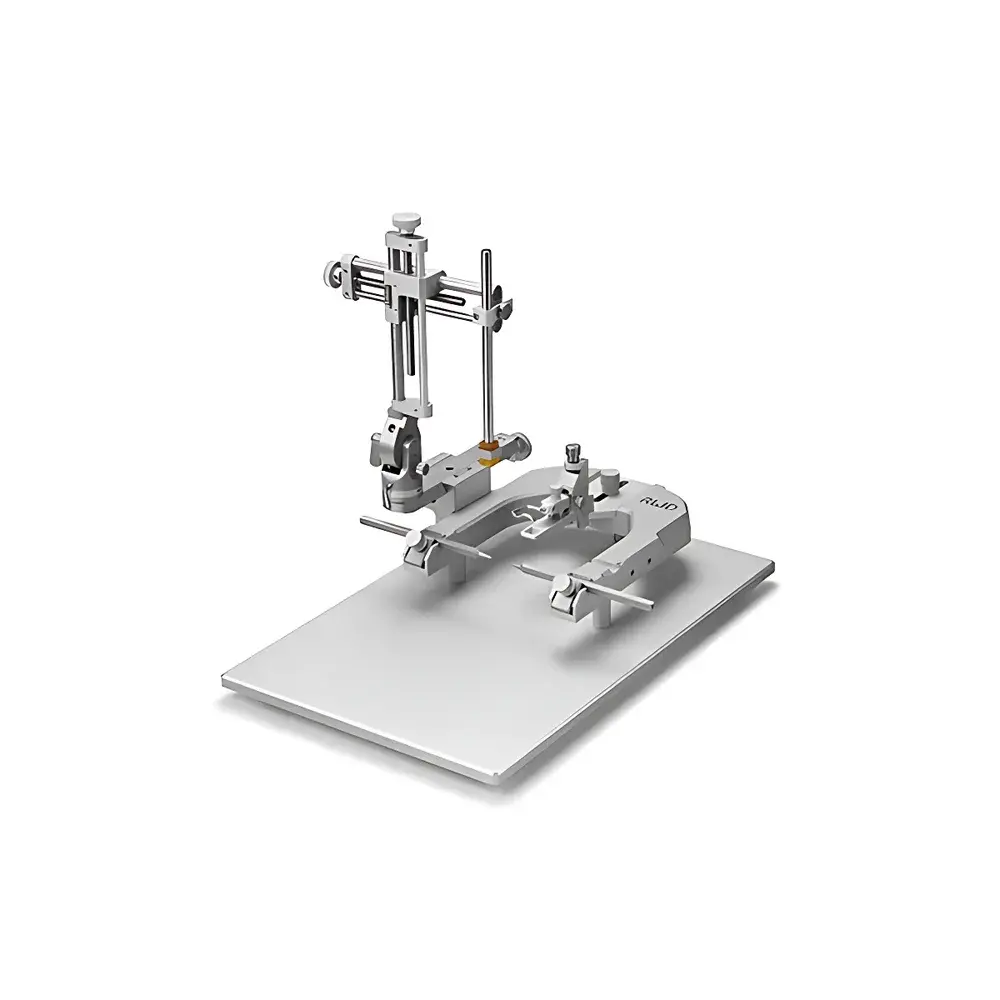
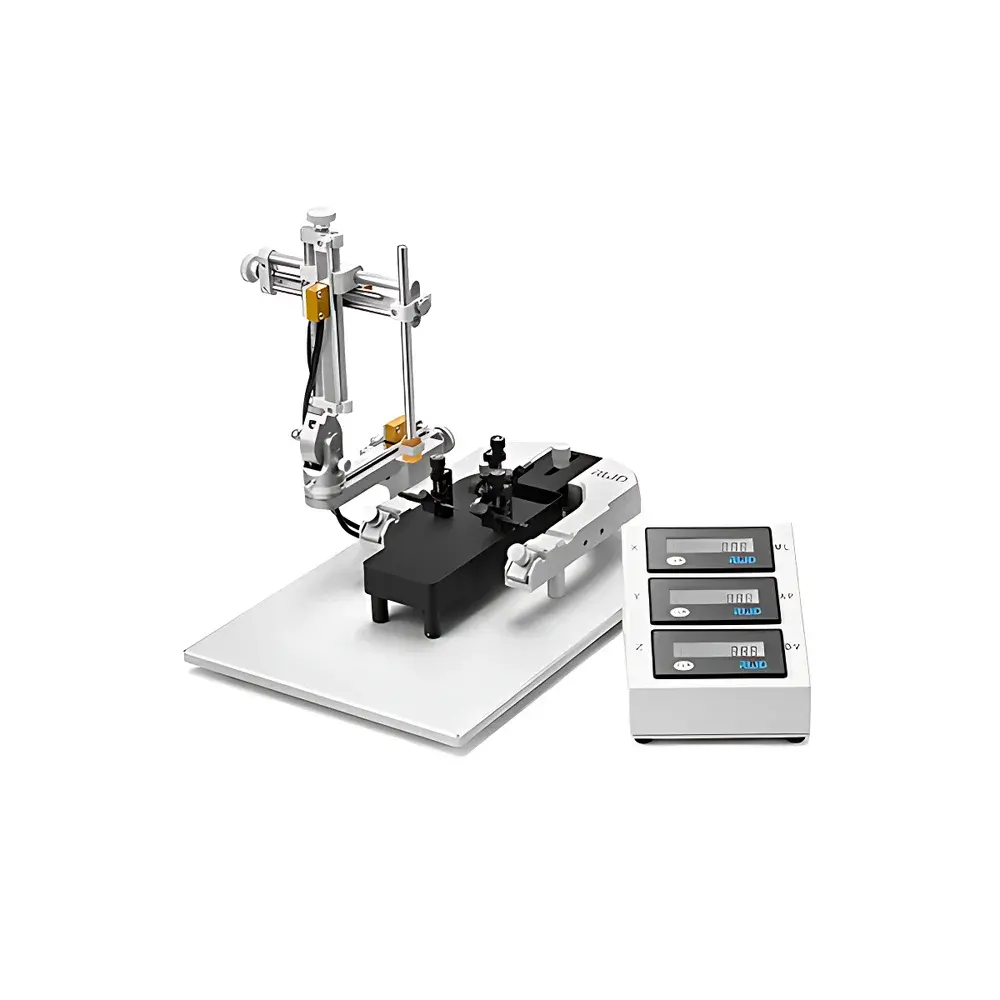
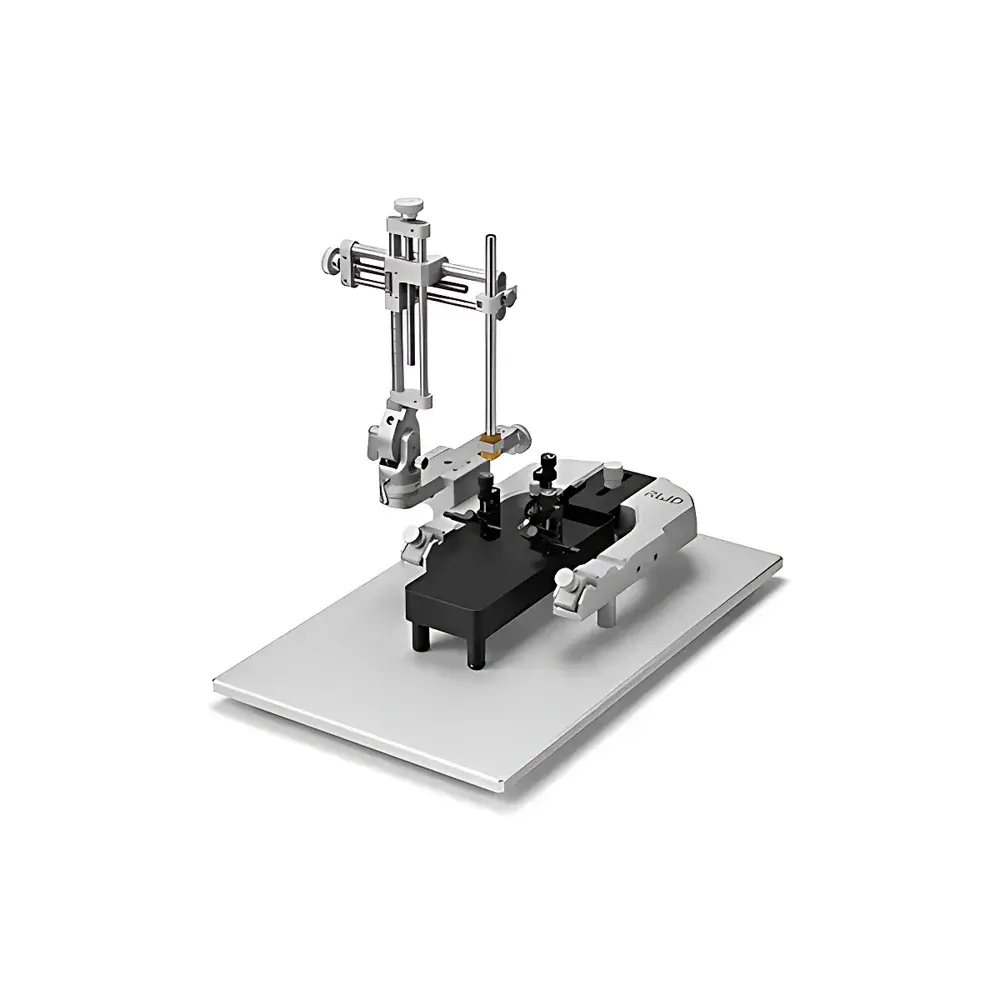
RWD Standard Stereotaxic Instrument for Rodents
| Brand | RWD |
|---|---|
| Origin | Shenzhen, China |
| Manufacturer Type | Direct Manufacturer |
| Regional Classification | Domestic (China) |
| Model | Standard |
| Positioning Accuracy | 100 µm / 10 µm (selectable) |
| Arm Configuration | Single-arm or Dual-arm options |
| Ear Bar Angles | 18°, 45°, or 60° |
| Compatibility | Mouse, Rat, and Juvenile Rat Adapters |
| Display Option | Analog or Digital Readout (optional) |
| Z-axis Orientation Marker | “UP” indicator engraved for operational safety |
Overview
The RWD Standard Stereotaxic Instrument for Rodents is a precision mechanical platform engineered for reproducible intracranial targeting in small animal neuroscience research. Based on the stereotactic coordinate system—anchored to bregma and lambda landmarks on the skull—the instrument enables three-dimensional (X-Y-Z) positioning of micro-manipulators relative to standardized brain atlases (e.g., Paxinos & Watson). Its core function is to guide neurosurgical interventions—including microinjection, electrode implantation, optical fiber cannulation, and cranial window placement—with high spatial fidelity. The device operates without electronic actuation; instead, it relies on calibrated micrometer-driven vernier scales and rigid stainless-steel construction to ensure mechanical stability and minimal drift during prolonged procedures. Designed for use under surgical anesthesia (compatible with RWD isoflurane vaporizers), it supports both acute and chronic experimental paradigms in behavioral, electrophysiological, optogenetic, and molecular neuroscience.
Key Features
- Mechanical Precision Engineering: Selectable resolution of 100 µm or 10 µm per scale division across all three axes, achieved via dual-range micrometer dials and hardened steel lead screws—ensuring consistent repeatability across multi-day experiments.
- Modular Animal Fixation System: Interchangeable ear bars (18°, 45°, and 60° configurations) and nose clamp adapters precisely center the skull by aligning external auditory meati and incisors, minimizing rotational error during craniotomy.
- Configurable Arm Architecture: Available in single-arm or dual-arm variants; dual-arm configuration permits simultaneous deployment of injection needles and recording electrodes—or optical fibers and cannulae—within the same surgical field.
- Digital Readout Integration (Optional): Upgradable analog base models support digital encoder kits that provide real-time X/Y/Z position feedback via USB interface, enabling timestamped coordinate logging compatible with LabVIEW or MATLAB-based automation workflows.
- Ergonomic Safety Design: Engraved “UP” directional marking on Z-axis handle prevents inadvertent downward overtravel during depth adjustment—a critical safeguard when targeting subcortical nuclei such as substantia nigra or ventral tegmental area.
- Broad Hardware Compatibility: Standardized 1/4″-20 and M6 mounting threads allow seamless integration with third-party accessories including syringe pumps (e.g., Harvard Apparatus PHD Ultra), microdrills (e.g., FHC MicroDrill), and fiber-optic patch cables.
Sample Compatibility & Compliance
The RWD Standard Stereotaxic Instrument accommodates mice (C57BL/6, BALB/c, CD-1), rats (Sprague-Dawley, Wistar), and juvenile rats via dedicated adapter sets. All components comply with ISO 13485–aligned manufacturing controls for medical-grade instrumentation. While not classified as an IVD or FDA-cleared device, its mechanical design adheres to GLP-relevant principles for traceability and procedural consistency—supporting audit-ready documentation when used in preclinical studies aligned with OECD Test Guidelines or NIH-funded protocols. Calibration certificates and dimensional verification reports are available upon request for laboratory accreditation submissions (e.g., AAALAC, UK Home Office).
Software & Data Management
For digitally equipped units, RWD provides Stereotaxic Control Suite v2.1—a lightweight Windows application supporting coordinate import/export in CSV format, atlas overlay referencing (Paxinos & Watson 7th edition coordinates), and synchronization with external timing systems via TTL triggers. Audit trail functionality logs operator ID, session timestamp, and final XYZ coordinates per procedure—meeting basic requirements for 21 CFR Part 11–aligned data integrity in regulated environments. Raw encoder data can be exported for post-hoc trajectory reconstruction using open-source tools such as BrainRender or SimpleITK.
Applications
- Stereotactic Viral Delivery: Precise AAV or lentivirus injection into defined nuclei (e.g., nucleus accumbens, hippocampal CA1) for circuit-specific gene expression or ablation.
- In Vivo Electrophysiology: Implantation of tungsten or silicon probes into deep brain structures for chronic single-unit or LFP recording during behavioral assays.
- Optogenetics & Fiber Photometry: Bilateral ceramic ferrule implantation targeting projection-defined pathways (e.g., mPFC→BLA) for light delivery or calcium signal acquisition.
- Chronic Cannulation Studies: Sterile placement of guide cannulae for repeated intracerebroventricular (ICV) or intra-nuclear drug administration across longitudinal behavioral testing.
- Disease Modeling: Targeted striatal 6-OHDA lesions for Parkinson’s disease modeling; hippocampal kainic acid microinjection for temporal lobe epilepsy induction.
FAQ
Is this instrument suitable for non-rodent species such as rabbits or ferrets?
No—this model is specifically engineered for murine and rat neuroanatomy. Custom fixation solutions for larger species require structural redesign and are not supported under standard warranty.
Does the digital readout option include wireless connectivity?
No—digital encoders connect via USB 2.0 only. Wireless transmission is intentionally omitted to eliminate RF interference risks during electrophysiological recordings.
Can I use this stereotaxic frame with a cryo-stage or heating pad?
Yes—base plate mounting holes conform to standard 40 mm grid spacing, allowing secure attachment to temperature-controlled stages (e.g., Warner Instruments TC-344B) without obstructing arm mobility.
What maintenance is required to preserve long-term accuracy?
Annual recalibration of micrometer scales against NIST-traceable gauge blocks is recommended. Lubrication of lead screws with silicone-free white grease every 6 months ensures smooth operation without particulate contamination.
Are replacement ear bars and adapters available separately?
Yes—all consumable and modular components—including angled ear bars, nose clamps, and juvenile rat adapters—are sold individually with full part-number traceability (e.g., 68077-60° mouse ear bar, 68030 juvenile rat adapter kit).



