
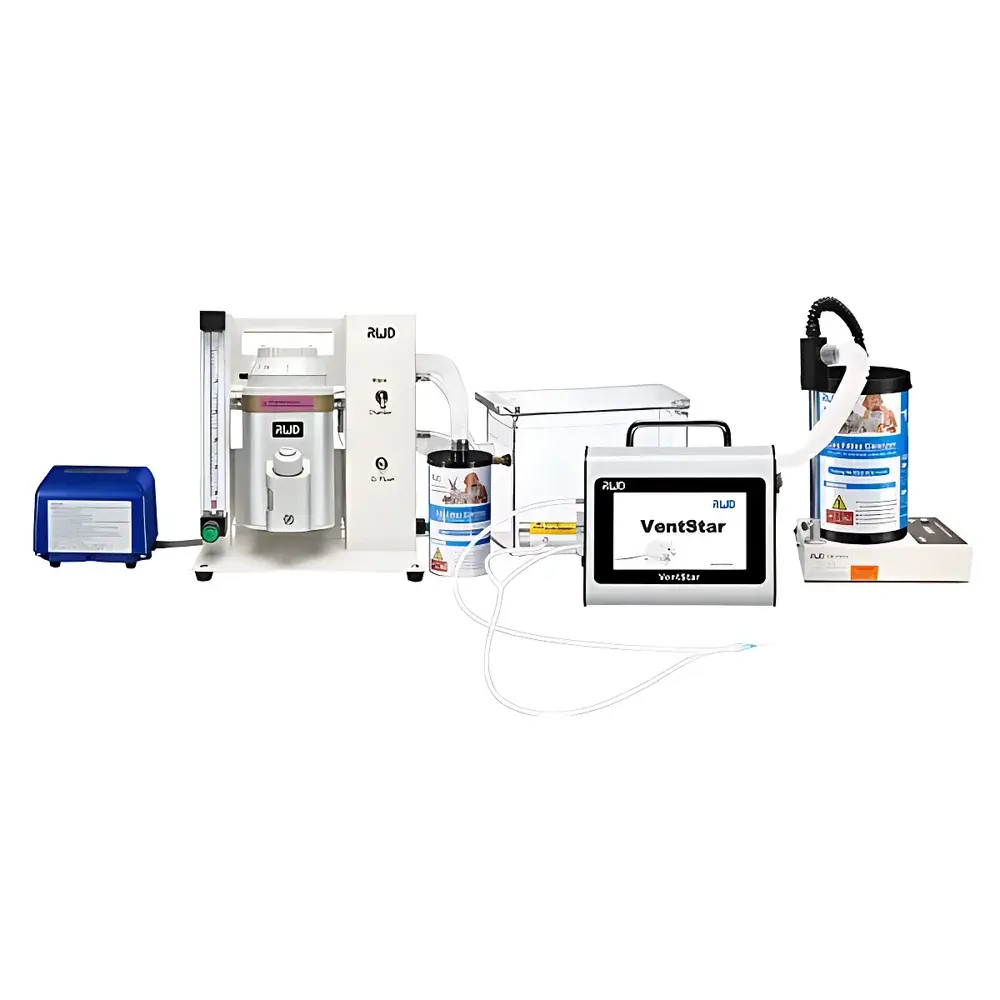
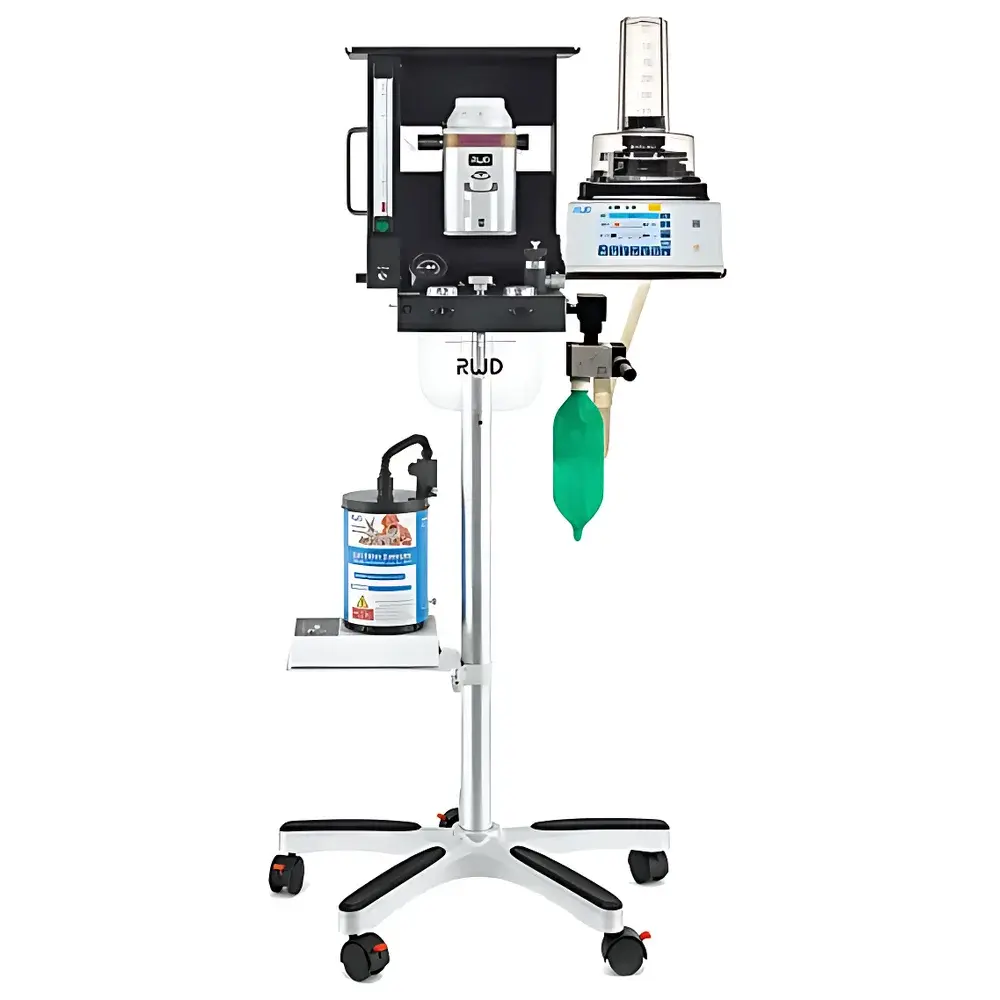
RWD Animal Anesthesia and Ventilation System for Rodents and Large Animals
| Brand | RWD |
|---|---|
| Origin | Shenzhen, China |
| Manufacturer | RWD Life Science Co., Ltd. |
| Type | Domestic |
| Model | RWD Series |
| Price Range | USD 1,400 – 2,800 |
| Weight Capacity | Up to 1 kg (rodents) and up to 100 kg (large animals) |
| Anesthetic Agents Supported | Isoflurane, Sevoflurane |
| Vaporizer Types | Pour-fill, Easy-fill, Key-fill |
| Induction/Recovery Time | 2–5 min |
| Waste Gas Scavenging | <9 s purge time |
| Ventilation Modes | VCV, PCV, APNEA |
| Integrated Tracheal Intubation System | Wireless fiber-optic illumination with non-thermal, low-stimulus light source |
| Compliance | Designed for GLP-compliant preclinical research environments |
Overview
The RWD Animal Anesthesia and Ventilation System is an integrated, dual-tier platform engineered for precise, physiologically appropriate anesthetic delivery and mechanical ventilation across a broad weight spectrum—from rodents (≤1 kg) to large animals (≤100 kg). It combines a calibrated precision vaporizer module with a microprocessor-controlled ventilator, operating on the principles of controlled inhalational anesthesia and pressure/volume-targeted intermittent positive pressure ventilation (IPPV). The system adheres to fundamental respiratory physiology requirements: tidal volume (mL/kg), respiratory rate (breaths/min), inspiratory-to-expiratory (I:E) ratio, and peak inspiratory pressure (PIP) are dynamically adjusted based on user-input animal weight and selected species-specific protocols. Its closed-circuit air/oxygen pathway ensures stable gas composition, minimal rebreathing, and consistent anesthetic partial pressure—critical for maintaining surgical plane depth while minimizing cardiorespiratory depression.
Key Features
- Two-tier modular architecture: Separate optimized configurations for small-animal (mouse, rat, guinea pig, hamster) and large-animal (dog, cat, non-human primate, swine) applications—each validated for physiological fidelity and operational safety.
- Intelligent ventilator with one-touch weight input: Automatically calculates and applies default tidal volume (6–10 mL/kg), respiratory rate (60–120 bpm for rodents; 12–30 bpm for large animals), and I:E ratio (1:2 to 1:3), adjustable via intuitive touchscreen interface.
- RWD-certified anesthetic vaporizers supporting both isoflurane and sevoflurane: Available in Pour-fill, Easy-fill, and Key-fill configurations with ISO 8535-1 compliant output accuracy (±10% at 1–3% setting) and temperature-compensated flow splitting.
- Patented wireless fiber-optic tracheal intubation system: Delivers cold, collimated illumination directly at the laryngeal inlet without thermal load or photic stress—eliminating reflex bronchospasm and reducing operator-induced trauma during endotracheal tube placement.
- Integrated waste gas scavenging: Rapid oxygen flush (<9 s) clears induction chamber anesthetic vapor, meeting OSHA and NIOSH threshold limit value (TLV) recommendations for ambient isoflurane exposure (<2 ppm).
- Three clinically validated ventilation modes: Volume-Controlled Ventilation (VCV), Pressure-Controlled Ventilation (PCV), and Apnea mode—with real-time waveform display (flow-time, pressure-time) and alarm thresholds for high/low PIP, apnea duration, and disconnection events.
Sample Compatibility & Compliance
The system supports standardized rodent models (C57BL/6, Sprague-Dawley, Wistar, Hartley guinea pigs) and common large-animal species under institutional animal care and use committee (IACUC) and AAALAC International guidelines. All pneumatic components comply with ISO 80601-2-12 (medical ventilators) and ISO 8535-1 (anesthetic vaporizers) for performance, leakage, and material biocompatibility. Gas pathways meet USP Class VI elastomer requirements. The ventilator’s pressure and flow sensors are traceable to NIST standards. Data logging meets GLP audit trail requirements (user ID, timestamp, parameter changes, alarm events), and optional FDA 21 CFR Part 11-compliant software modules are available for regulated pharmacology and toxicology studies.
Software & Data Management
Embedded firmware enables continuous recording of airway pressure, flow rate, tidal volume, minute ventilation, and anesthetic concentration (via optional inline IR sensor). Export formats include CSV and MATLAB-compatible .mat files. Remote monitoring is supported via Ethernet or Wi-Fi (IEEE 802.11ac), allowing integration into centralized lab data acquisition systems (e.g., LabChart, Spike2, or custom Python-based pipelines). Audit logs capture all configuration modifications, ensuring full traceability for regulatory submissions. No cloud storage is performed by default—data remains on-device or local network unless explicitly configured per institutional IT policy.
Applications
- Neurosurgical procedures requiring stable cerebral perfusion (e.g., middle cerebral artery occlusion, craniotomy, intracranial electrode implantation)
- Cardiovascular interventions including thoracotomy, echocardiography-guided catheterization, and ischemia-reperfusion modeling
- Pulmonary functional studies (e.g., methacholine challenge, allergen sensitization, ARDS modeling) where precise FiO₂ and PEEP control are essential
- Long-duration electrophysiology recordings (>6 h) demanding hemodynamic stability and minimal anesthetic drift
- Translational surgical training programs for veterinary and biomedical students using canine, porcine, or non-human primate models
- Preclinical efficacy and safety assessment of novel anesthetics, respiratory therapeutics, or neuromuscular blocking agents
FAQ
What species and weight ranges does this system support?
It accommodates rodents (mouse, rat, guinea pig, hamster) up to 1 kg and large animals (dog, cat, swine, non-human primate) up to 100 kg—each with dedicated tubing sets, vaporizer calibrations, and ventilation algorithms.
Is the system compatible with both isoflurane and sevoflurane?
Yes—RWD vaporizers are certified for both agents, with agent-specific calibration curves and fail-safe interlocks preventing incorrect agent selection.
Does the ventilator provide breath-by-breath data export?
Yes—real-time flow and pressure waveforms, along with calculated parameters (e.g., dynamic compliance, resistance), are logged at ≥100 Hz and exportable in timestamp-synchronized CSV format.
How is waste anesthetic gas managed?
The system includes an active charcoal canister and passive scavenging port compatible with standard hospital-grade vacuum-assisted waste gas evacuation systems (≥40 L/min flow capacity).
Can the system be used in GLP-regulated toxicology studies?
When equipped with the optional Part 11-compliant software module, it supports electronic signatures, audit trails, and role-based access control—fully aligned with OECD GLP Principles and FDA guidance for nonclinical laboratory studies.



