
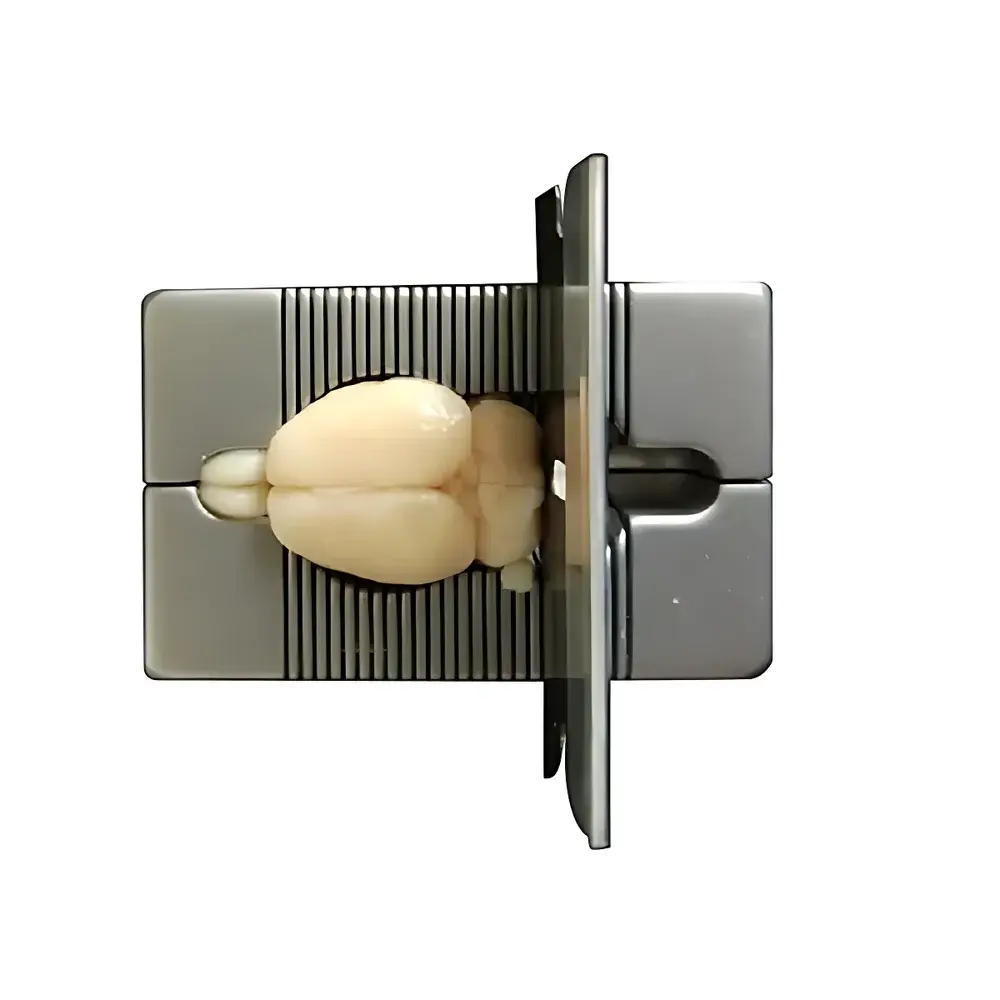
RWD 68707 Stainless Steel Mouse and Juvenile Rat Brain Matrix (Coronal, 1 mm Thickness)
| Brand | RWD |
|---|---|
| Origin | Shenzhen, China |
| Manufacturer Type | OEM Manufacturer |
| Country of Origin | China |
| Model | 68707 |
| Cutting Thickness | 1 mm |
| Orientation | Coronal |
| Compatible Species | Mouse / Juvenile Rat (40–75 g) |
| Material | Medical-Grade Stainless Steel (AISI 304) |
| Sterilization | Autoclavable (121°C, 20 min), Heat-Resistant, Cryo-Compatible |
| Groove Depth | 7.40 mm |
| Dimensions (A–E) | 3.18 × 11.1 × 8.73 × 19.1 × 12.5 mm |
Overview
The RWD 68707 Stainless Steel Brain Matrix is a precision-engineered neuroanatomical tool designed for reproducible, standardized sectioning of mouse and juvenile rat (40–75 g) brains in the coronal plane. Constructed from medical-grade AISI 304 stainless steel, this matrix enables consistent slice generation at a fixed thickness of 1 mm—critical for quantitative histological analysis, regional tissue isolation, and stereotactic alignment in preclinical neuroscience research. Its design adheres to established neuroanatomical landmarks, incorporating a midline suture reference groove to facilitate bilateral symmetry verification and hemispheric separation. Unlike polymer-based alternatives, the fully metal construction ensures dimensional stability across thermal cycles (−80°C to +121°C), eliminating warping during cryosectioning or post-fixation handling. The device operates as a passive mechanical guide: brain tissue—embedded in optimal cutting temperature (OCT) compound or agarose—is placed into the cavity, aligned using anatomical cues (e.g., optic chiasm, anterior commissure), and sectioned with a razor blade or vibratome blade guided by parallel stainless-steel slots. This eliminates operator-dependent variability in slice angle and thickness, directly supporting GLP-compliant experimental workflows where inter-laboratory reproducibility is mandated.
Key Features
- Precision-machined stainless steel construction (AISI 304) for long-term durability, corrosion resistance, and autoclavability (20 min at 121°C, 15 psi)
- Consistent 1 mm coronal slicing capability with ±0.05 mm tolerance across all slots, verified via coordinate measuring machine (CMM) calibration
- Integrated sagittal midline groove (0.3 mm width, centered along A-axis) enabling rapid visual confirmation of medial orientation and facilitating clean hemispheric dissection
- Cryo-compatible geometry: optimized cavity depth (7.40 mm) and slot spacing accommodate standard OCT-embedded specimens without overflow or compression artifacts
- Thermal stability across −80°C (cryostat use) to +121°C (autoclaving), with no measurable deformation after 50 sterilization cycles
- Compatible with both manual razor-blade sectioning and motorized vibratome systems (e.g., Leica VT1000S, Thermo Fisher HM650V)
Sample Compatibility & Compliance
The RWD 68707 matrix is validated for use with perfusion-fixed or fresh-frozen mouse (C57BL/6, BALB/c, CD-1) and juvenile rat (Sprague-Dawley, Wistar; 40–75 g) brains. It supports standard fixation protocols (4% paraformaldehyde, 10% neutral buffered formalin) and embedding media including OCT compound, low-melting-point agarose (2%), and gelatin-sucrose. All models comply with ISO 13485:2016 requirements for manufacturing controls of laboratory instrumentation. While not a medical device per FDA 21 CFR Part 820, its material certification (RoHS, REACH, EN 10088-1) and traceable production batch documentation support audit readiness under GLP (OECD Principles) and AAALAC-accredited animal facility standards. No lubricants, adhesives, or coatings are applied—ensuring zero leachable contaminants in downstream IHC, ISH, or proteomic applications.
Software & Data Management
As a mechanical sectioning aid, the RWD 68707 requires no embedded electronics or proprietary software. However, it integrates seamlessly into digital pathology and spatial omics workflows: standardized slice geometry enables reliable registration of serial sections in 3D reconstruction platforms (e.g., Amira, Neurolucida, BigStitcher). When used with automated slide scanners (Zeiss Axioscan 7, Hamamatsu NanoZoomer), the consistent 1 mm interval supports accurate volumetric quantification of region-specific biomarker expression (e.g., c-Fos, Iba1, GFAP) across ≥20 consecutive sections. Experimental metadata—including specimen weight, fixation time, embedding medium, and section number—is recommended to be logged in LIMS-compatible formats (CSV, JSON-LD) aligned with MIAME/MINSEQE reporting guidelines.
Applications
- Stereotaxic regional dissection of hippocampus, striatum, cortex, and amygdala for qPCR, Western blot, or single-cell RNA-seq
- Preparation of matched-section series for multiplex immunohistochemistry (mIHC) and spatial transcriptomics (Visium, Xenium)
- Validation of lesion extent or viral vector spread in behavioral neuroscience models (e.g., MPTP, 6-OHDA, AAV-mediated optogenetics)
- Quality control of brain banking protocols—ensuring uniform sampling across donor cohorts in translational neurodegeneration studies
- Training platform for graduate students in neuroanatomy, emphasizing reproducible orientation and landmark identification
FAQ
Can the RWD 68707 be used for adult rat brains?
No—this model is dimensionally optimized for mouse and juvenile rat (40–75 g) brains. For adult rats (175–300 g or 300–600 g), select models 68709/68710 (1 mm) or 68715/68716 (0.5 mm) instead.
Is the matrix compatible with freezing microtomes?
Yes—its thermal mass and non-porous surface prevent ice crystal adhesion; pre-chill at −20°C for 10 min prior to cryosectioning to minimize chatter.
How should the matrix be cleaned between uses?
Rinse with 70% ethanol, followed by sterile PBS; air-dry vertically. Avoid abrasive pads or chlorine-based disinfectants to preserve surface polish and dimensional integrity.
Does RWD provide validation data for section thickness accuracy?
Yes—certified CMM measurement reports (traceable to NIST standards) are available upon request for each production lot, including slot parallelism (≤0.02° deviation) and depth uniformity (±0.03 mm).
Can this matrix be modified for custom slice intervals?
RWD offers OEM customization services—including alternate thicknesses (e.g., 0.8 mm), species-specific scaling, or laser-etched fiducial marks—for institutional contracts meeting minimum order quantities (MOQ: 50 units).






