
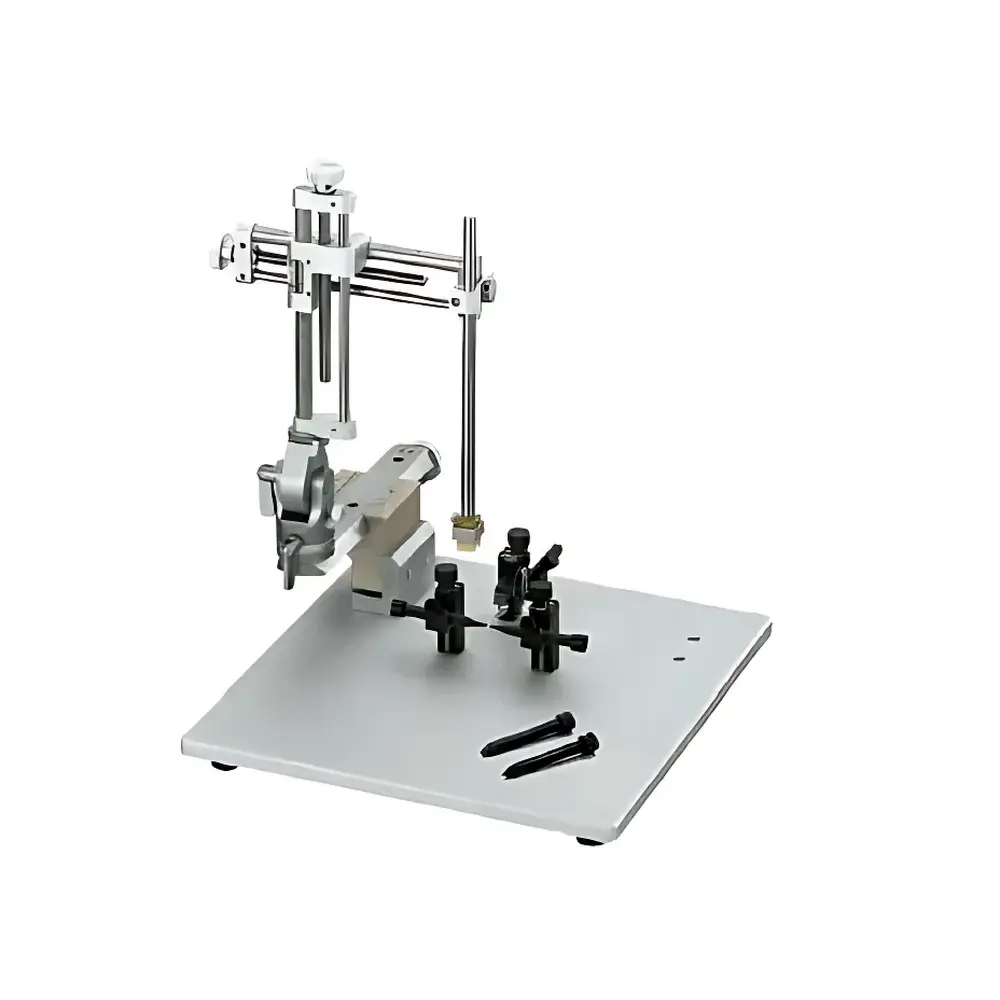
RWD 68507 Lightweight Mouse Stereotaxic Instrument
| Brand | RWD |
|---|---|
| Origin | Guangdong, China |
| Manufacturer Type | Direct Manufacturer |
| Regional Classification | Domestic (China) |
| Model | 68507 |
| Price Range | USD 1,400 – 7,000 |
Overview
The RWD 68507 Lightweight Mouse Stereotaxic Instrument is an engineered precision device designed for accurate intracranial targeting in murine neuroscientific research. It operates on the stereotaxic principle—using standardized bregma–lambda coordinates referenced to the mouse skull’s anatomical landmarks—to enable reproducible placement of electrodes, cannulae, microinjection needles, or optical fibers into defined brain regions. Unlike conventional U-frame stereotaxic systems, this model employs a modular adapter block architecture that eliminates structural obstruction above the animal’s head, delivering unimpeded vertical and lateral access during surgical setup and intervention. Its compact footprint and optimized mechanical layout support high-throughput behavioral neuroscience workflows, particularly in facilities where bench space, ergonomics, and procedural efficiency are critical constraints.
Key Features
- Compact base plate (255 mm × 255 mm) minimizes benchtop footprint while maintaining stable anchoring to standard vibration-dampened stereotaxic tables.
- Lightweight ear bars fabricated from polyoxymethylene (POM), offering high stiffness-to-weight ratio, chemical resistance, and low thermal expansion—critical for long-duration procedures requiring thermal stability.
- Adjustable incisor bar with ±20 mm vertical travel (0 to +20 mm range), enabling precise rostrocaudal alignment relative to bregma without repositioning the animal.
- Dual-axis ear bar adjustment: 0–20 mm vertical translation with integrated 1 mm graduation scale for bilateral symmetry verification and balanced skull fixation.
- Two-point ear bar insertion design: 18° blunted tip and concentric serrated hollow geometry distribute clamping force evenly across the auditory bullae, minimizing risk of temporal bone deformation or tympanic membrane injury.
- Modular arm interface supports interchangeable single-arm configurations (model 68507), dual-arm assemblies (68510), and digital readout variants (68513/68516) without requiring frame replacement.
Sample Compatibility & Compliance
The RWD 68507 is validated for use with adult C57BL/6, BALB/c, CD-1, and ICR mice (typically 20–35 g). Its mechanical tolerances accommodate natural cranial size variation within these strains while maintaining coordinate fidelity within ±0.15 mm under standard mounting conditions. The device complies with ISO 13485-aligned manufacturing protocols and conforms to general laboratory equipment safety standards (IEC 61010-1). While not a medical device per FDA 21 CFR Part 820, its design facilitates adherence to GLP-compliant experimental documentation practices—including traceable instrument calibration logs, operator training records, and procedural SOPs required for preclinical CNS drug development studies conducted under OECD GLP or NIH-funded grant reporting frameworks.
Software & Data Management
The 68507 is a manually operated mechanical instrument and does not incorporate embedded electronics or proprietary software. However, it is fully compatible with third-party digital workflow ecosystems: coordinate inputs can be exported from stereotaxic atlases (e.g., Paxinos & Franklin’s *The Mouse Brain in Stereotaxic Coordinates*, 4th ed.) into electronic lab notebooks (ELNs) such as LabArchives or Benchling. When paired with optional digital micromanipulators (e.g., Narishige MO-10 or Scientifica PatchStar), positional data—including depth, angle, and timestamped coordinates—can be logged via RS-232 or USB interfaces for audit-ready data capture. All mechanical adjustments are manually indexed and documented, supporting 21 CFR Part 11-compliant signature-enabled ELN entries when integrated into validated laboratory information management systems (LIMS).
Applications
- Chronic implantation of bilateral microelectrode arrays for in vivo electrophysiology (single-unit and LFP recording).
- Site-specific intracerebroventricular (ICV) or intraparenchymal microinjection of viral vectors, siRNA, or pharmacological agents.
- Optogenetic fiber optic cannula implantation with angular trajectory control for deep-brain targets (e.g., VTA, SNc, DRN).
- Lesion studies using electrolytic or excitotoxic methods requiring submillimeter spatial accuracy.
- Validation of functional MRI (fMRI) or PET activation loci through targeted histological correlation.
- Training platform for graduate neuroscience courses emphasizing stereotaxic surgery fundamentals and aseptic technique.
FAQ
Is the RWD 68507 compatible with rat stereotaxic procedures?
No—it is dimensionally optimized for mice (20–35 g). For rats, RWD recommends models 68820 or 68830, which feature extended ear bar travel, reinforced base plates, and higher load-bearing capacity.
Can the ear bars be sterilized using autoclaving?
Polyoxymethylene (POM) components withstand steam sterilization at 121°C for 20 minutes; however, repeated autoclaving may accelerate surface wear. Ethylene oxide or hydrogen peroxide plasma sterilization is preferred for long-term material integrity.
Does the 1 mm刻度刻线 meet ISO 9001 calibration traceability requirements?
The engraved scale serves as a visual alignment aid—not a metrologically certified measuring instrument. For GLP/GMP applications requiring traceable dimensional verification, users should perform independent calibration using NIST-traceable dial indicators or coordinate measuring machines (CMM) prior to study initiation.
What mounting accessories are required for integration with a Kopf stereotaxic frame?
The 68507 uses standard 1/4″-20 threaded mounting holes spaced at 75 mm intervals, ensuring mechanical compatibility with Kopf, Stoelting, and other major-brand stereotaxic bases without adapters.
Is technical support available in English for international customers?
Yes—RWD provides multilingual documentation (English, German, Japanese) and remote engineering support via email and video consultation, with response times under 48 business hours for critical operational inquiries.




