
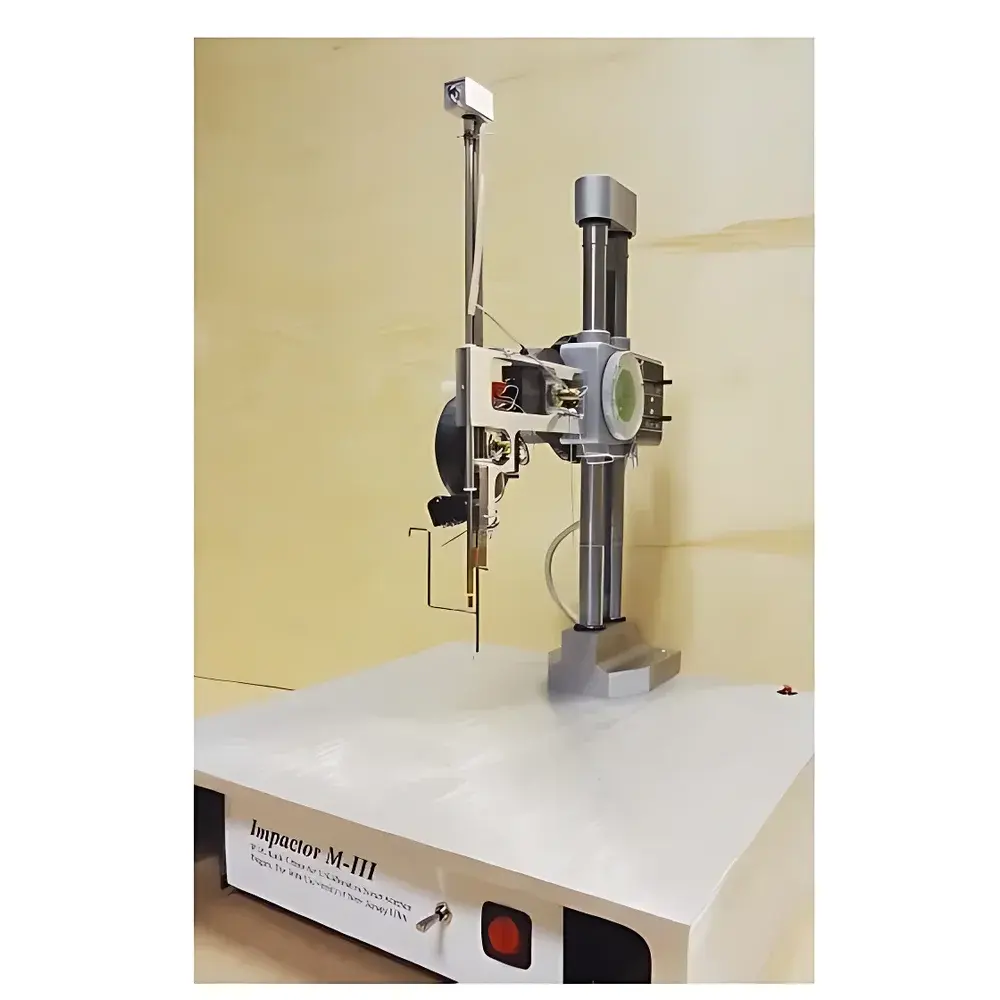
W.M. Keck Model III Spinal Cord Impactor
| Origin | Shenzhen, China |
|---|---|
| Manufacturer Type | Authorized Distributor |
| Origin Category | Domestic (China) |
| Model | Model III |
| Quotation | Upon Request |
| Impact Heights | 3.00, 6.25, 9.00, 12.50, 25.00, 50.00, 75.00 mm |
| Impactor Tip Diameter/Weight | Rat: 2.5 mm / 10 g |
| Mouse | 1.2 mm / 5 g |
| Vertical Positioning Accuracy | 0.001 mm |
| Resolution | 0.01 mm |
| Temporal Resolution for Impactor Motion | 10 µs |
| Timing Accuracy | ±10 ms |
| Real-time Parameters Measured | Impact Velocity (ImpV), Cord Compression Distance (Cd), Compression Time (Ct), Compression Rate (Cr), Vertebral Displacement |
Overview
The W.M. Keck Model III Spinal Cord Impactor is a precision-engineered, computer-controlled impact device designed for the reproducible induction of standardized thoracic spinal cord injuries in rodent models—primarily rats and mice. It operates on the principle of controlled gravitational impact, where a calibrated impounder tip is dropped from defined heights onto the exposed dura at the T9–T10 vertebral level under stereotaxic guidance. This method enables quantitative biomechanical characterization of injury severity through real-time acquisition of kinetic and kinematic parameters—including impact velocity (ImpV), cord compression distance (Cd), compression time (Ct), and compression rate (Cr). Developed over a decade ago and validated across more than 100 academic and pharmaceutical research laboratories, the Model III serves as the de facto standard in preclinical spinal cord injury (SCI) modeling. Its widespread adoption is reflected in its use in over 50% of peer-reviewed SCI literature, with published protocols and outcome correlations (e.g., BBB locomotor scores, tissue Na⁺/K⁺ homeostasis) directly derived from instrument-specific calibration and empirical usage data.
Key Features
- Computer-controlled electromagnetic actuation system with closed-loop feedback for precise impounder release and deceleration monitoring
- Seven programmable impact heights (3.00, 6.25, 9.00, 12.50, 25.00, 50.00, and 75.00 mm) enabling graded injury severity modeling
- Dual-species impounder configurations: 2.5 mm diameter / 10 g for rat studies; 1.2 mm diameter / 5 g for mouse studies
- Sub-micron vertical positioning accuracy (0.001 mm) and 0.01 mm resolution for consistent dural contact alignment
- 10 µs temporal resolution for impounder motion capture, supporting high-fidelity kinetic profiling
- Integrated LED surface detection indicator and audible alert system to confirm optimal dura exposure prior to impact
- Real-time synchronized acquisition of vertebral displacement, impounder trajectory, and dynamic compression metrics
Sample Compatibility & Compliance
The Model III is optimized for use with adult Sprague-Dawley rats (250–350 g) and C57BL/6 or BALB/c mice (20–30 g), requiring concurrent use with a stereotaxic frame compatible with rodent spinal fixation (e.g., spinal clamps or vertebral stabilizers). All mechanical and software operations comply with GLP-aligned documentation standards. Data acquisition logs include timestamped metadata, operator ID, impact sequence number, and raw sensor outputs—supporting audit readiness for regulatory submissions. While not FDA-cleared as a medical device, the system adheres to ISO 13485–informed design controls for research instrumentation and meets essential requirements outlined in ISO/IEC 17025 for test equipment used in accredited preclinical laboratories.
Software & Data Management
The proprietary control software provides intuitive GUI-based protocol setup, real-time waveform visualization (position vs. time, velocity vs. time), and automated export of CSV- and MATLAB-compatible binary files. Each experimental session generates a structured dataset containing calibrated ImpV, Cd, Ct, Cr, and vertebral displacement traces, along with operator annotations and hardware status flags. Audit trails record all parameter modifications, user logins, and export events—enabling full traceability per FDA 21 CFR Part 11 principles. Exported datasets are compatible with common statistical platforms (GraphPad Prism, R, Python SciPy) and support integration into LIMS environments via API-accessible metadata headers.
Applications
- Preclinical evaluation of neuroprotective, anti-inflammatory, or regenerative therapeutics in contusive SCI models
- Biomechanical correlation studies linking impact parameters (e.g., Cd and Ct) to histopathological outcomes (cavitation volume, axonal sparing, glial scar formation)
- Validation of functional recovery metrics—including BBB scoring, grid walk, CatWalk gait analysis—against quantified injury severity
- Electrophysiological investigations (e.g., motor-evoked potentials) requiring tightly controlled lesion consistency
- Multi-center translational studies where inter-laboratory reproducibility of injury magnitude is critical
- Development and refinement of computational finite-element models of spinal cord deformation
FAQ
Is the Model III compatible with third-party stereotaxic frames?
Yes—it interfaces mechanically with standard rodent stereotaxic systems via adjustable mounting brackets and supports optical or tactile dura detection alignment workflows.
Can impact parameters be modified during an ongoing experiment?
No—parameter sets are locked per trial to ensure intra-session consistency; changes require explicit protocol reinitialization and recalibration verification.
What maintenance is required for long-term calibration stability?
Annual verification of encoder linearity, impounder mass certification, and drop-height sensor calibration is recommended using NIST-traceable reference standards.
Does the system support automated batch-mode operation for high-throughput studies?
Yes—the software includes scripting capability for sequential multi-animal protocols with customizable inter-trial delays and auto-reset sequences.
Are raw sensor signals accessible for custom signal processing?
Yes—high-speed analog output ports provide unfiltered position and acceleration signals at 100 kHz sampling, suitable for external DAQ integration.
Related Products




