
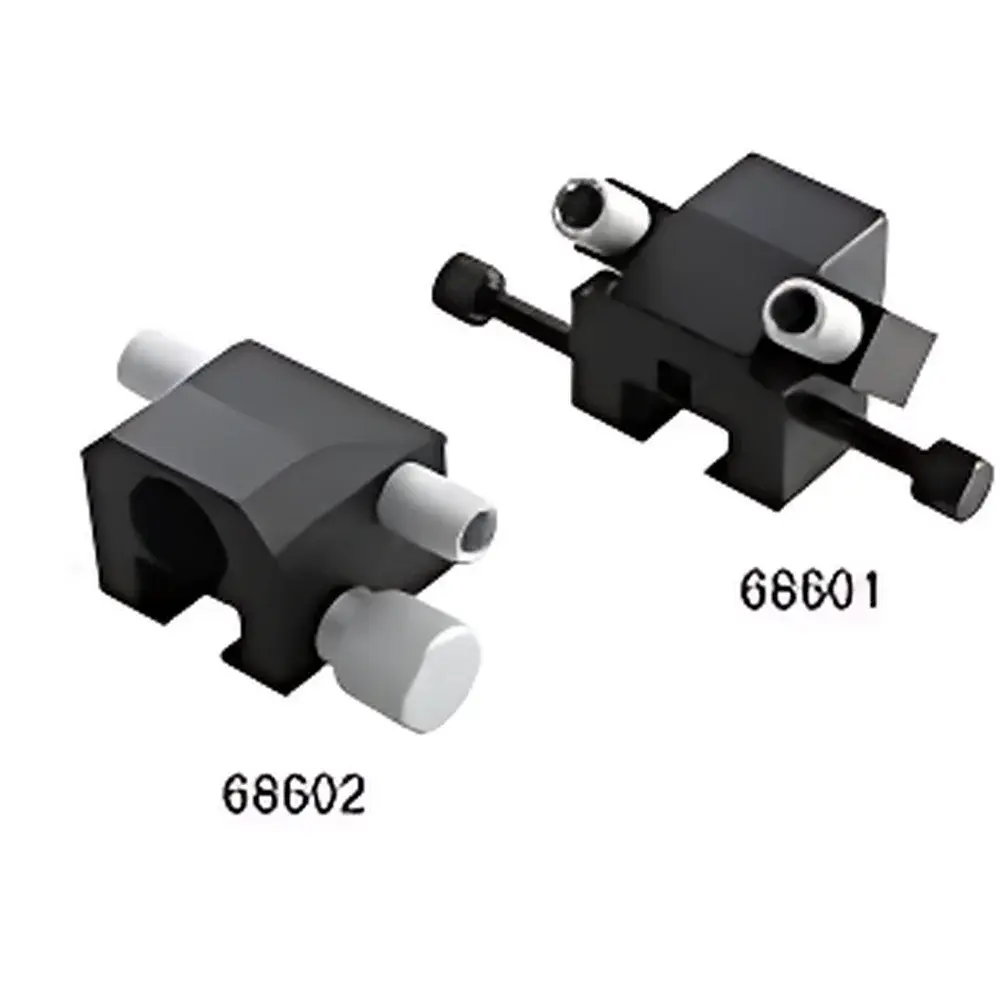
Animal Anesthesia Mask for Stereotaxic Instruments
| Origin | Guangdong, China |
|---|---|
| Manufacturer Type | Distributor |
| Origin Category | Domestic |
| Model | 68601 (Mouse), 68602 (Rat) |
| Pricing | Upon Request |
Overview
The Animal Anesthesia Mask for Stereotaxic Instruments is a precision-engineered accessory designed to integrate seamlessly with standard rodent stereotaxic frames and gas anesthesia delivery systems. It functions as a critical interface between the anesthesia vaporizer and the animal subject during neurosurgical, electrophysiological, or imaging procedures requiring precise head immobilization under inhalational anesthesia (e.g., isoflurane or sevoflurane). The mask operates on a passive gas containment principle: its conical aperture forms a low-resistance, anatomically contoured seal around the rostral portion of the rodent’s head—ensuring consistent anesthetic agent concentration at the airway while minimizing ambient gas leakage. This design directly supports experimental reproducibility by maintaining stable physiological parameters (e.g., respiratory rate, blood oxygen saturation) throughout prolonged stereotaxic interventions.
Key Features
- Modular U-rod mounting system compatible with widely used stereotaxic adapters (e.g., David Kopf, Stoelting, and RWD models), enabling rapid installation and alignment without tools.
- Two anatomically optimized variants: Model 68601 for mice (body weight range: 18–35 g) and Model 68602 for rats (body weight range: 200–500 g), each featuring a tapered inlet port engineered to match nasopharyngeal geometry and reduce dead space.
- Chemically resistant construction using medical-grade polycarbonate and silicone elastomer components—fully autoclavable (121°C, 20 min) and compatible with common disinfectants including 70% ethanol and hydrogen peroxide vapor.
- Low-profile profile minimizes interference with electrode positioning, cranial window placement, or optical access in two-photon microscopy or optogenetic setups.
- Integrated gas flow channeling ensures laminar delivery to the nares, reducing turbulence-induced stress responses and improving induction/recovery kinetics.
Sample Compatibility & Compliance
The masks are validated for use with C57BL/6, BALB/c, Sprague-Dawley, and Wistar strains under standard IACUC-approved protocols. Each model conforms to ISO 10993-5 (biological evaluation of medical devices — cytotoxicity) and meets RoHS Directive 2011/65/EU requirements for hazardous substance restrictions. While not classified as a Class II medical device under FDA 21 CFR Part 870, the design adheres to GLP-aligned documentation practices for preclinical instrumentation—supporting traceability in regulatory submissions (e.g., IND-enabling toxicology studies). Compatibility testing confirms no interference with MRI field homogeneity (up to 9.4 T) when used with non-ferromagnetic stereotaxic frames.
Software & Data Management
As a hardware-only accessory, the anesthesia mask does not incorporate embedded electronics or firmware. However, it is fully interoperable with third-party anesthesia monitoring platforms—including Kent Scientific’s BioDAQ, Nonin Medical’s PalmSAT series, and ADInstruments’ PowerLab systems—via standardized analog output interfaces (0–5 V DC for O2/CO2 sensors) and digital TTL synchronization triggers. All associated calibration certificates, material safety data sheets (MSDS), and sterilization validation reports are provided in English and comply with ISO/IEC 17025 documentation standards for accredited laboratories.
Applications
- Stereotaxic intracranial injections (viral vectors, tracers, or cell suspensions) requiring stable head fixation and uninterrupted anesthetic depth.
- In vivo electrophysiology (single-unit recording, LFP, or EEG) where mask-induced motion artifact must be minimized.
- Functional imaging modalities including fMRI, intrinsic signal optical imaging, and calcium fluorescence microscopy (e.g., GCaMP).
- Chronic implantation surgeries involving cranial windows, microdialysis probes, or osmotic minipumps.
- Behavioral assays conducted under light anesthesia (e.g., whisker stimulation paradigms, auditory evoked potentials).
FAQ
Can these masks be used with non-rodent species such as guinea pigs or rabbits?
No—Models 68601 and 68602 are dimensionally calibrated exclusively for mouse and rat craniofacial morphology. Use with other species may compromise seal integrity and anesthetic efficacy.
Is the silicone face seal replaceable?
Yes—the silicone gasket is a field-replaceable component (part number SM-GSK-686xx); replacement kits include two gaskets per size and installation torque specifications.
Do the masks meet USP environmental control requirements for sterile compounding areas?
While not intended for human pharmaceutical compounding, the masks’ autoclavability and low particulate shedding (<0.1 µm particles/cm² after 10 cycles) align with USP Annex A cleanliness benchmarks for ancillary equipment in controlled environments.
What is the recommended gas flow rate range for optimal performance?
For isoflurane: 0.5–1.0 L/min for mice (68601) and 1.0–1.5 L/min for rats (68602), as validated against NIST-traceable flow meters and calibrated vaporizer outputs.
Related Products



