
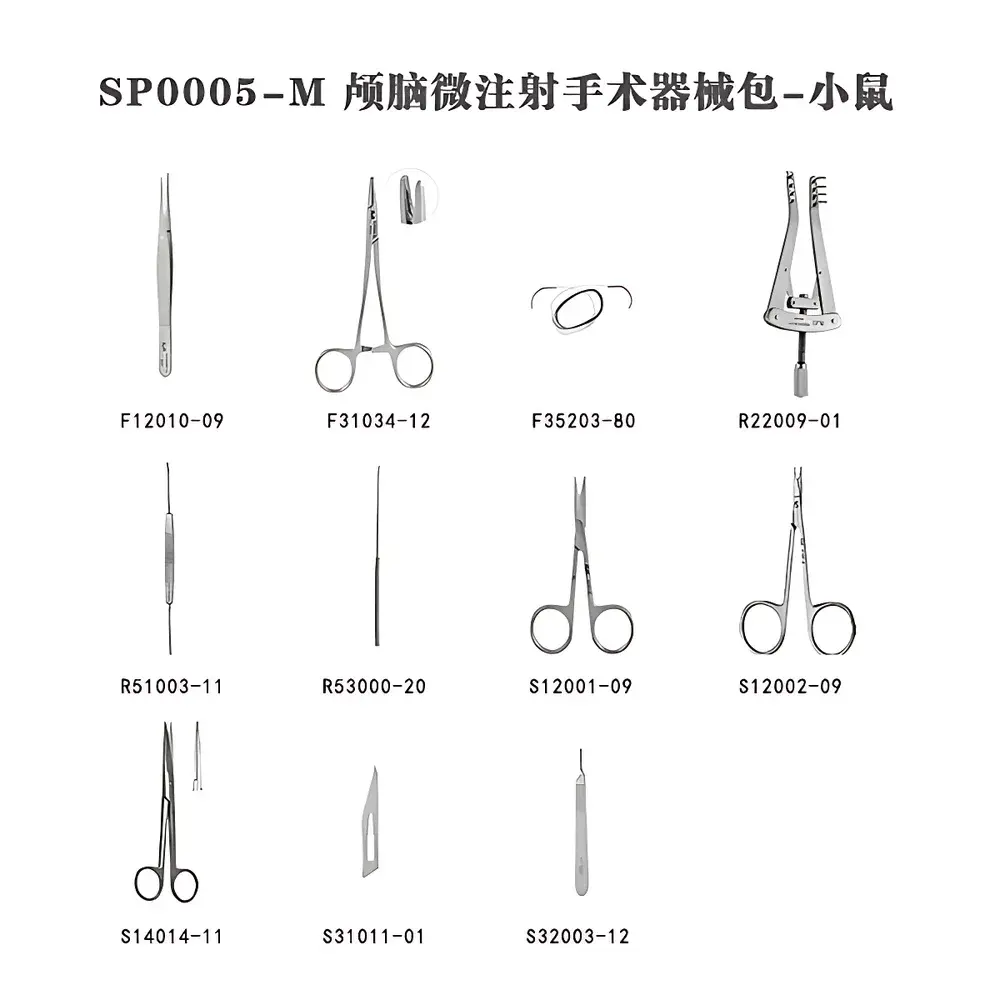
RWD SP0005-M Mouse Neurosurgical Microinjection Instrument Set
| Brand | RWD |
|---|---|
| Origin | Guangdong, China |
| Manufacturer Type | Direct Manufacturer |
| Country of Origin | China |
| Model | SP0005-M |
| Pricing | Available Upon Request |
Overview
The RWD SP0005-M Mouse Neurosurgical Microinjection Instrument Set is a purpose-engineered, sterile-ready surgical toolkit designed specifically for stereotactic intracranial microinjection procedures in murine models. This set supports high-precision delivery of viral vectors, tracers, pharmacological agents, or cell suspensions into discrete brain regions—including the hippocampus, striatum, prefrontal cortex, and substantia nigra—with minimal tissue displacement and consistent anatomical targeting. The instruments are fabricated from medical-grade stainless steel (AISI 420/440C), heat-treated for optimal hardness (52–56 HRC), and electropolished to reduce surface roughness (<0.2 µm Ra), thereby minimizing protein adhesion and facilitating effective sterilization via autoclaving (134 °C, 3 bar, 18 min) or ethylene oxide exposure. All components comply with ISO 7153-1:2016 (surgical instruments — Materials — Part 1: Stainless steels) and are supplied non-sterile unless specified; terminal sterilization must be performed per institutional biosafety and GLP-compliant protocols.
Key Features
- Modular, application-optimized configuration: Includes 14 distinct instrument types across 21 total units, each selected for defined functional roles in craniotomy, dura incision, parenchymal access, and needle-guided injection.
- Micro-scale precision geometry: Fine-tip ophthalmic forceps (0.8 mm tip width) and micro-dissection scissors (9.5 cm length, 0.15 mm blade clearance) enable manipulation under 10×–40× surgical magnification without slippage or deformation.
- Dual-angle microscrapers (R51003-11): Bent dual-tip design (2.0 mm × 0.3 mm working edges) facilitates controlled cortical surface cleaning and dural membrane separation while preserving pial integrity.
- Integrated needle-handling capability: Olsen-Hegar needle holder (F31047-12) incorporates integrated suture-cutting blades, enabling one-handed suture trimming during cranioplasty or wound closure—reducing procedural time and contamination risk.
- Traceable instrument lineage: Each set carries engraved batch identification and conforms to RWD’s internal traceability standard RW-TR-2023, supporting audit readiness for IACUC, AAALAC, and FDA-regulated preclinical studies.
Sample Compatibility & Compliance
This instrument set is validated for use with standard stereotactic frames (e.g., David Kopf Model 963, Stoelting 51700) and compatible with 26–33 G stainless-steel or fused-silica microinjection needles. All instruments meet biocompatibility requirements per ISO 10993-1:2018 (biological evaluation of medical devices) for short-term tissue contact (Category: Surface device, limited exposure ≤24 h). Packaging dimensions (31 × 21 cm) conform to ISO 11607-1:2019 for sterile barrier systems. The set is not intended for human use and is classified as a Class I non-sterile laboratory device under China NMPA regulatory framework (Registration No. Yue械备20220123); CE marking is not applicable per EU IVDR Annex XVI exclusion criteria for research-only tools.
Software & Data Management
While the SP0005-M is a manual mechanical instrument set (no embedded electronics or firmware), its design integrates seamlessly with digital preclinical workflow platforms. Instrument usage logs may be recorded within electronic lab notebooks (ELN) compliant with 21 CFR Part 11 (e.g., LabArchives, Benchling) using standardized ontology terms from the Experimental Factor Ontology (EFO) and NIFSTD. RWD provides optional CSV-based inventory templates aligned with MIAME/MINSEQE metadata standards for longitudinal tracking of instrument reuse cycles, sterilization events, and post-procedure inspection outcomes—supporting GLP audit trails and institutional animal care program documentation.
Applications
- Stereotactic delivery of AAV vectors for optogenetic or chemogenetic circuit mapping in C57BL/6J, BALB/c, or transgenic mouse lines.
- Intracerebral transplantation of neural progenitor cells or organoid fragments with sub-millimeter spatial fidelity.
- Localized administration of tau or α-synuclein preformed fibrils in neurodegeneration modeling studies.
- Co-injection of fluorescent dextrans with pharmacologic agents to validate injection spread and diffusion kinetics ex vivo.
- Acute microdialysis probe implantation where simultaneous dural repair and cranial window stabilization are required.
FAQ
Is this set compatible with rat neurosurgery?
The SP0005-M is optimized for mice (20–30 g); for rats (>200 g), we recommend the SP0005-R variant, which features extended-length instruments (e.g., 14 cm forceps, 13 cm scalpels) and wider-tip probes.
Can instruments be resterilized multiple times?
Yes—provided autoclave parameters do not exceed 134 °C/3 bar/18 min and chemical sterilants are validated for stainless steel compatibility (e.g., hydrogen peroxide plasma). Visual inspection for tip deformation or pitting is required before each reuse.
Are replacement parts available individually?
All components—including S31011-01 blades, F12005-10 forceps, and F35205-60 suture packs—are stocked separately under RWD’s consumables catalog and support just-in-time reordering via institutional procurement portals.
Does RWD provide surgical training materials?
Yes—registered customers receive access to RWD’s Neurosurgical Technique Library, including annotated video protocols (mouse intrahippocampal injection, thalamic AAV delivery), IACUC-compliant SOP templates, and troubleshooting guides for common complications (e.g., bleeding, needle clogging, cortical damage).





