
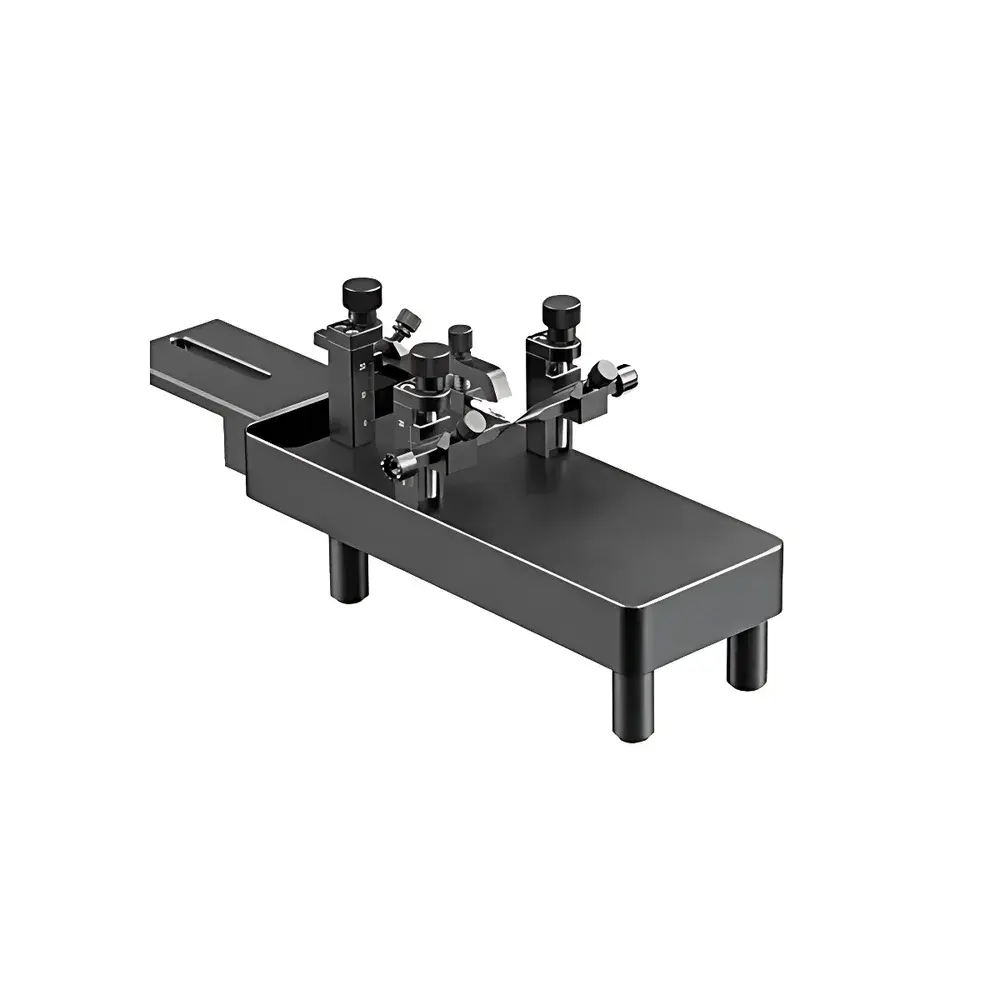
RWD 68030 Mouse and Juvenile Rat Stereotaxic Adapter
| Brand | RWD |
|---|---|
| Origin | Shenzhen, China |
| Manufacturer Type | OEM Manufacturer |
| Region Category | Domestic (China) |
| Model | 68030 |
| Pricing | Available Upon Request |
| Ear Bar Material | Medical-Grade Resin |
| Ear Bar Tip Geometry | Tapered (18° and 45° options included) |
| Adjustable Axes | Bilateral ear bar height, incisor bar height |
| Scale Markings | Integrated metric刻度 on all adjustment mechanisms |
| Juvenile Rat Fixation | Zygomatic clamp assembly (non-invasive alternative to ear bar insertion) |
| Included Components | 68034 (18° resin ear bars), 68313 (45° resin ear bars) |
Overview
The RWD 68030 Mouse and Juvenile Rat Stereotaxic Adapter is an engineered accessory designed for precise, reproducible head fixation in small rodent neurosurgical and electrophysiological procedures. It integrates biomechanical ergonomics with tissue-sparing design principles to support stereotactic accuracy while minimizing mechanical stress on delicate cranial structures. Unlike conventional stainless-steel ear bars—whose rigidity and thermal conductivity may induce localized pressure necrosis or thermal perturbation—the 68030 employs medical-grade resin ear bars with controlled taper geometry (18° and 45° variants supplied). This material selection reduces Young’s modulus mismatch with murine temporal bone, thereby distributing compressive load across a broader surface area and lowering peak contact stress at the tympanic bulla interface. For juvenile rats (P14–P28), whose external auditory canals remain underdeveloped and non-patent, the adapter incorporates a zygomatic arch clamp system that engages the lateral maxillary process without requiring canal insertion—eliminating risk of otic trauma, tympanic membrane perforation, or vestibular disturbance.
Key Features
- Resin-based ear bars (models 68034 and 68313) with calibrated conical tapers—18° for standard adult mouse positioning and 45° for enhanced sagittal plane stability during deep-brain targeting
- Bilateral ear bar height adjustment via precision-machined micrometer screws, each marked with 0.1 mm incremental scale engravings for inter-laboratory protocol alignment
- Independent incisor bar vertical translation (±5 mm range), enabling fine-tuning of skull pitch angle to achieve bregma–lambda coplanarity per stereotactic atlas standards
- Zygomatic fixation module: self-aligning polymer jaw with compliant elastomeric pads; applies uniform axial preload (1.2–1.8 N nominal) across the zygomatic arch without slippage or soft-tissue compression
- Modular mounting interface compatible with all RWD stereotaxic frames (e.g., 68010, 68020) and third-party systems adhering to ISO 9001-certified rail dimensions (30 × 30 mm T-slot)
Sample Compatibility & Compliance
The 68030 adapter accommodates C57BL/6, BALB/c, CD-1, and FVB mice (18–25 g) as well as juvenile Sprague-Dawley or Wistar rats (35–60 g, postnatal days 14–28). Its non-metallic contact surfaces comply with ISO 10993-5 (cytotoxicity) and ISO 10993-10 (irritation/sensitization) requirements for short-term implant-contact devices. The zygomatic clamp design conforms to NIH Guide for the Care and Use of Laboratory Animals (2011) Section IV.C.3.b, which mandates avoidance of invasive auditory canal fixation in developing rodents. All adjustment mechanisms meet ASTM F2971-14 specifications for repeatability of mechanical positioning in preclinical surgical instrumentation.
Software & Data Management
While the 68030 is a purely mechanical adapter with no embedded electronics, its dimensional consistency and scale-integrated adjustments ensure full compatibility with digital stereotactic planning workflows. When used with RWD’s NeuroLab Suite v3.2+ or third-party platforms (e.g., Paxinos-aligned atlas registration tools, MATLAB-based trajectory calculators), users can log physical setup parameters—including ear bar angle, incisor bar offset, and zygomatic clamp torque values—into structured metadata fields. Audit trails generated during GLP-compliant studies retain these settings alongside procedural timestamps, satisfying FDA 21 CFR Part 11 requirements for instrument configuration traceability.
Applications
- Intracranial cannula implantation for microdialysis or optogenetic fiber optic delivery in awake, head-fixed mice
- Stereotactic injection of AAV vectors into hippocampal subfields (CA1, DG) or prefrontal cortical layers (Cg1, IL)
- Chronic electrophysiology: silicon probe or tetrode insertion with sub-50 µm targeting variance across sessions
- Functional ultrasound (fUS) or intrinsic signal imaging requiring long-duration, motion-free cranial stabilization
- Developmental neuroscience studies involving longitudinal interventions in juvenile rats where traditional ear bar use is contraindicated
FAQ
Is the 68030 compatible with non-RWD stereotaxic frames?
Yes—its base plate conforms to standardized 30 × 30 mm T-slot rail geometry, enabling secure attachment to Stoelting, David Kopf, and other ISO-compliant frames.
Can the zygomatic clamp be sterilized using autoclave cycles?
The clamp body is autoclavable at 121°C, 15 psi for 20 minutes; elastomeric pads must be replaced after three cycles to maintain preload consistency.
What is the maximum recommended torque for ear bar tightening?
Resin ear bars require ≤0.15 N·m torque; over-tightening compromises taper engagement and increases risk of bullar deformation.
Are replacement ear bars available separately?
Yes—68034 (18°) and 68313 (45°) are stocked as consumables with lot-specific biocompatibility documentation.
Does the adapter include calibration certification?
Each unit ships with a factory-verified dimensional report (traceable to NIM China), including ear bar taper angle deviation (±0.3°) and height scale linearity error (≤±0.05 mm).




