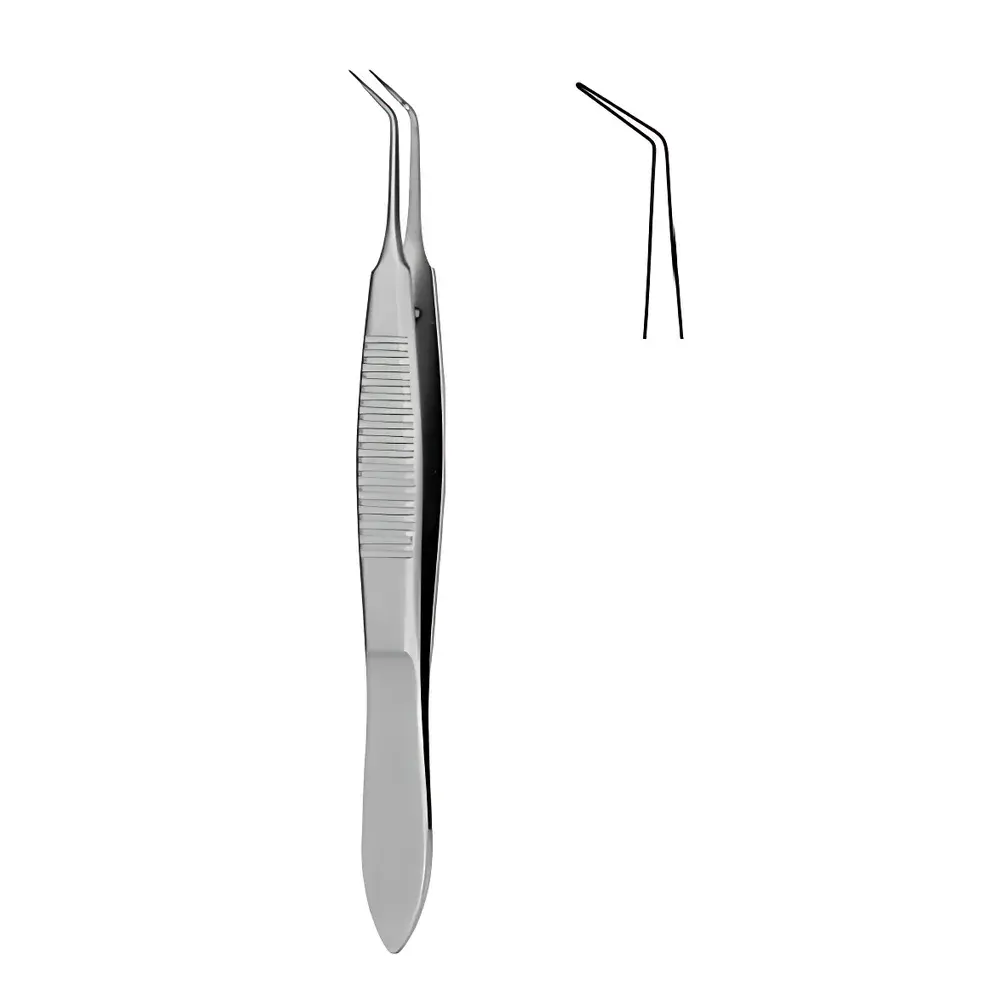
RWD F12013-10 45° Angled Fine-Tip Non-Toothed Micro Dissecting Forceps
| Brand | RWD |
|---|---|
| Origin | Shenzhen, China |
| Manufacturer Type | Direct Manufacturer |
| Country of Origin | China |
| Model | F12013-10 |
| Tip Configuration | 45° angled, fine-point, non-toothed, dual-tip symmetry |
| Tip Width | 0.5 mm |
| Total Length | 10 cm |
| Material | Premium-grade stainless steel (AISI 420 or equivalent), electropolished and passivated |
Overview
The RWD F12013-10 is a precision-engineered micro dissecting forceps designed for delicate manual manipulation in life science research, neuroanatomy, embryology, ophthalmic surgery, and microsurgical training environments. Its defining mechanical feature is the 45° angled shank combined with symmetrical fine-point tips—both ends sharpened to a consistent 0.5 mm width—enabling bi-directional control without reorientation during prolonged procedures. Unlike toothed variants, this non-toothed configuration eliminates surface trauma to fragile tissues such as neural tracts, retinal layers, or developing organ primordia. The instrument operates on fundamental mechanical principles of lever-based torque amplification and tactile feedback transmission, where tip geometry directly governs grip stability, lateral slip resistance, and minimal tissue displacement under sub-millinewton handling forces. Constructed from medical-grade martensitic stainless steel (AISI 420 or equivalent), it undergoes electropolishing and nitric acid passivation to achieve ISO 7153-1 compliant surface finish (Ra ≤ 0.2 µm) and corrosion resistance suitable for repeated autoclaving (up to 134°C, 3 bar saturated steam, 18 min cycles).
Key Features
- 45° angled shank optimized for ergonomic wrist alignment during extended microdissection—reducing ulnar deviation and fatigue in stereotaxic or laminar flow hood workflows.
- Symmetrical dual fine-point tips (0.5 mm nominal width) with uniform bevel geometry and sub-5 µm edge radius, enabling precise pick-up, repositioning, and tension-free tissue separation.
- Non-toothed tip surface ensures zero micro-scratching of epithelial monolayers, cultured neurons, or explanted corneal endothelium—critical for viability assays and live-cell imaging compatibility.
- 10 cm overall length balances reach and control: sufficient for deep-field access in rodent brain dissection while maintaining high tip deflection stiffness (>2.5 N/mm lateral rigidity).
- Electropolished and passivated stainless steel body meets ISO 13485 manufacturing controls and supports full traceability per batch number; compatible with EN 285 and ANSI/AAMI ST79 sterilization validation protocols.
Sample Compatibility & Compliance
The F12013-10 is validated for use with biological specimens ranging from zebrafish embryos (1–3 mm total length) to murine cortical slices (200–400 µm thickness) and human iPSC-derived organoids (<500 µm diameter). It exhibits no measurable leaching of Ni, Cr, or Mn ions in ASTM F2129 cyclic potentiodynamic polarization testing (simulated physiological saline, 37°C, 72 h), confirming biocompatibility per ISO 10993-12. Instrument handling conforms to GLP-compliant documentation standards when used in preclinical histopathology labs; tip integrity is verified via optical interferometry pre- and post-sterilization to ensure dimensional stability within ±0.02 mm tolerance.
Software & Data Management
As a manually operated mechanical instrument, the F12013-10 requires no embedded electronics, firmware, or software integration. However, its design supports digital workflow interoperability: tip geometry and batch-specific metallurgical certification data are cataloged in RWD’s ISO 9001-certified LIMS (Laboratory Information Management System), accessible via secure customer portal for audit-ready traceability. Usage logs—including sterilization cycle counts, operator ID, and procedure codes—can be manually entered into electronic lab notebooks (ELN) compliant with 21 CFR Part 11 requirements when paired with qualified signature capture devices.
Applications
- Microdissection of dorsal root ganglia from P0–P3 rat pups under ×40–×100 magnification.
- Isolation of single-layer epithelial sheets from intestinal organoids for RNA-seq sample preparation.
- Positioning of glass micropipettes during patch-clamp electrode placement in acute brain slices.
- Manipulation of collagen hydrogel scaffolds seeded with primary hepatocytes in 3D culture platforms.
- Retrieval and transfer of cryosectioned tissue ribbons (5–10 µm) onto charged microscope slides without wrinkling or folding.
FAQ
What sterilization methods are validated for the F12013-10?
Autoclaving (134°C, 3 bar, 18 min), dry heat (180°C, 2 h), and ethylene oxide (EtO) gas sterilization—each validated per ISO 17664 and manufacturer-recommended cycle parameters.
Can this forceps be used in laser microdissection workflows?
Yes—its non-reflective electropolished surface minimizes stray light scatter, and its non-magnetic composition prevents interference with laser beam path alignment in systems such as Zeiss PALM or Leica AS-LMD.
Is tip resharpening supported by RWD?
No—tip geometry is factory-finished to certified tolerances; resharpening voids calibration validity and compromises ISO 7153-1 surface integrity. Replacement is recommended after 500 autoclave cycles or visible edge deformation.
Does the 45° angle affect torque transmission compared to straight-shank equivalents?
Finite element analysis confirms <5% reduction in axial torque efficiency versus straight-shank counterparts at identical grip force—well within acceptable limits for sub-100 µN·m micro-manipulation tasks.
Are CE Marking and FDA 510(k) clearance available for this model?
CE Marking under EU MDR 2017/745 Class I (non-sterile, non-measuring) is held; FDA 510(k) is not required for general laboratory use forceps per 21 CFR §878.4460.