
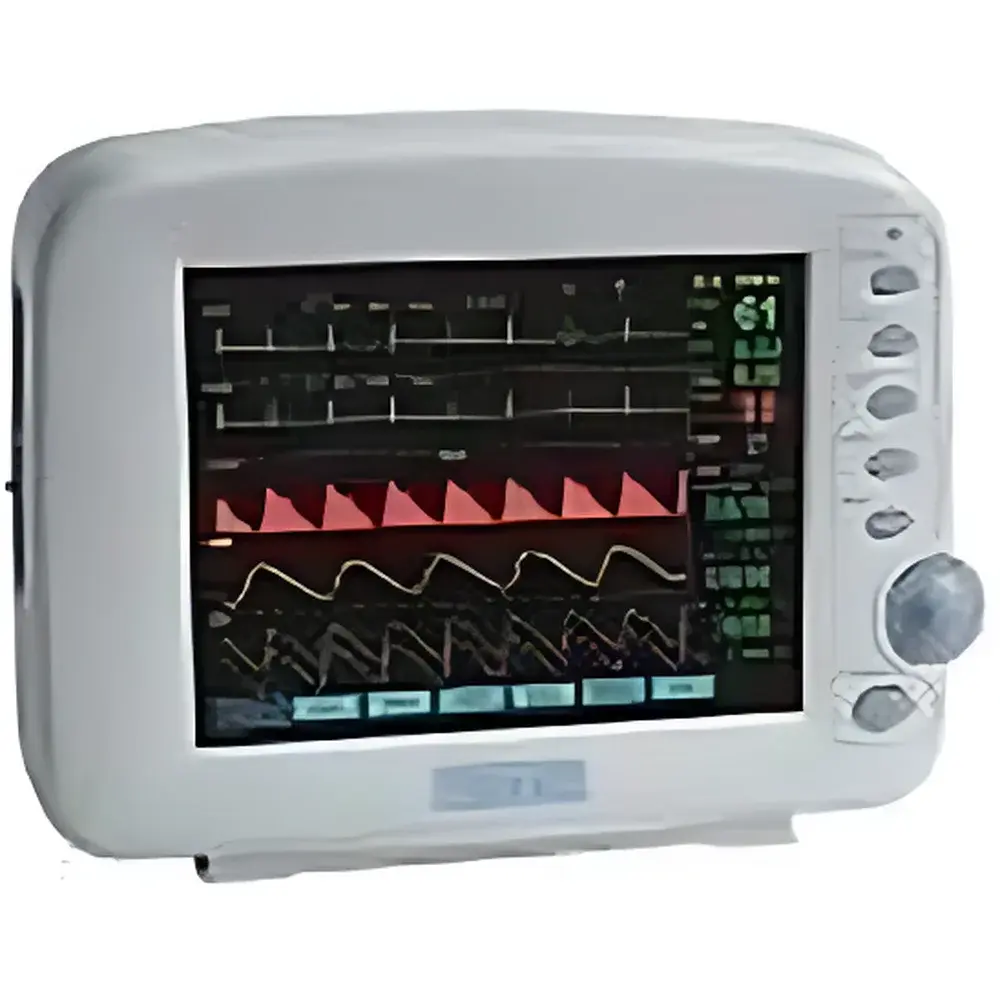
RWD Animal Multi-Parameter Patient Monitor
| Brand | RWD |
|---|---|
| Origin | Shenzhen, China |
| Manufacturer Type | Direct Manufacturer |
| Country of Origin | China |
| Model | Not Specified |
| Pricing | Upon Request |
| ECG Range | 30–350 bpm |
| NIBP Range | 40–270 mmHg |
| IBP Range | −10–300 mmHg |
| RR Range | 0–120 bpm |
| TEMP Range | 25.0–45.0 °C |
| SpO₂ Range | 0–100 % |
| PR Range | 30–250 bpm |
| CO₂ Range (optional) | 0–10.0 % |
| Data Retrospective | 360 hours |
| Display | 10.4″ TFT color LCD, 7-waveform simultaneous display |
| Power | Rechargeable high-capacity battery with standby mode |
| Connectivity | Wired/Wireless LAN, central station integration support |
| Compliance | Designed for GLP-compliant preclinical research environments |
Overview
The RWD Animal Multi-Parameter Patient Monitor is an engineered solution for real-time, non-invasive and invasive physiological monitoring during preclinical surgical and pharmacological studies in small to medium-sized laboratory animals. Built on a robust embedded platform, the system employs clinically validated signal acquisition architectures—including differential ECG amplification with adaptive noise suppression, photoplethysmographic SpO₂ sensing with low-perfusion compensation, oscillometric NIBP measurement, thermistor-based temperature detection, impedance and nasal cannula dual-mode respiration sensing, and optional mainstream or sidestream capnography—to deliver high-fidelity, reproducible parameter acquisition under demanding experimental conditions. Its design prioritizes stability in electromagnetic-intensive environments—such as those involving electrosurgical units—ensuring uninterrupted ECG morphology and accurate heart rate derivation during both cut and coagulation modes. The monitor serves as a core component in ISO 17025-aligned animal research facilities and supports longitudinal assessment across species including rats, rabbits, cats, dogs, sheep, pigs, and non-human primates—excluding mice due to physiological scaling limitations.
Key Features
- Simultaneous real-time monitoring of six core parameters: ECG/HR, SpO₂, NIBP, temperature, respiration rate, and pulse rate—with optional expansion to invasive blood pressure (IBP) and end-tidal CO₂ (EtCO₂)
- Electromagnetic interference resilience: Verified performance in proximity to high-frequency electrosurgical generators; rapid post-defibrillation signal recovery
- Dual-respiration detection: Configurable selection between impedance pneumography and nasal airflow cannula input for species-specific optimization
- 10.4″ high-brightness TFT display supporting 7-channel waveform overlay, large-character numeric readouts, dynamic oxygenation-respiration trend mapping, and customizable screen layouts (5 user-defined presets)
- Multi-language UI (English, Chinese, Spanish, Portuguese, French, Russian, Arabic) with rotary encoder + pop-up menu navigation for intuitive operation under sterile or gloved conditions
- Integrated rechargeable lithium-ion battery with intelligent power management and extended standby capability for mobile or field-deployed use
- Advanced clinical analytics: ST-segment analysis, arrhythmia classification (including PVC, bigeminy, and bradycardia/tachycardia detection), pacing spike recognition, and pharmacokinetic concentration estimation tools
Sample Compatibility & Compliance
The monitor is validated for use in conscious, sedated, and surgically instrumented subjects across standard preclinical models. It accommodates anatomical variations via adjustable electrode placement guides, reusable or single-use SpO₂ probes (clip, wrap, or adhesive), and cuff-sizing kits covering rat (1.5–2.5 cm), rabbit/cat (2.5–4.5 cm), dog/sheep (4.5–9.0 cm), and pig/NHP (9.0–15.0 cm) limb or tail dimensions. All measurement algorithms comply with ANSI/AAMI EC13:2002 (ECG), ISO 80601-2-61:2017 (pulse oximetry), and ISO 81060-2:2018 (non-invasive sphygmomanometers). When deployed with validated firmware and secure network configuration, the system meets data integrity requirements for GLP studies and supports traceable audit logs aligned with FDA 21 CFR Part 11 Annex 11 principles.
Software & Data Management
Data acquisition, visualization, and export are managed through the embedded RWD MonitorOS v3.x platform. Trend data—including waveform snippets, numeric parameters, and annotation timestamps—are stored locally on encrypted internal flash memory (360-hour continuous buffer) and synchronizable via Ethernet or Wi-Fi to centralized databases. Export formats include CSV (for statistical analysis in MATLAB, GraphPad Prism, or Python pandas), PDF (for regulatory documentation), and HL7-compatible XML (for integration into institutional LIMS or electronic lab notebooks). Remote firmware updates and diagnostic telemetry are supported over secure TLS-encrypted channels. Optional PC-based RWD CentralStation software enables multi-device dashboarding, alarm correlation, and retrospective cohort analysis with configurable alert escalation rules.
Applications
- Intraoperative hemodynamic surveillance during cardiovascular, neurosurgical, or oncology xenograft procedures
- Pharmacodynamic evaluation of cardioactive, respiratory, or CNS-modulating compounds
- Toxicology studies requiring continuous vital sign tracking across 24–72 h observation windows
- Device biocompatibility testing (e.g., implantable sensors, vascular grafts, or neuromodulation electrodes)
- Behavioral physiology experiments integrating autonomic response metrics with video tracking or EEG
- Training platforms for veterinary anesthesiology and comparative medicine curricula
FAQ
Is this monitor suitable for mouse studies?
No. Due to physiological scaling constraints—including minimal signal amplitude, high baseline heart rates (>500 bpm), and limited surface area for reliable probe attachment—the system is explicitly validated for rats and larger species only.
Can the device store and export raw ECG waveforms?
Yes. Full-resolution digitized ECG waveforms (1 kHz sampling, 16-bit resolution) are retained in the 360-hour buffer and exportable in CSV or EDF+ format upon request.
Does the system support DICOM or HL7 integration?
HL7 v2.5.1 message transmission is natively supported. DICOM integration requires third-party middleware and is available under custom configuration agreements.
What is the calibration interval recommendation?
NIBP and temperature modules require annual verification against NIST-traceable standards; SpO₂ and ECG subsystems undergo functional verification prior to each study session per institutional SOPs.
Is the battery replaceable by the end user?
The sealed Li-ion pack is field-replaceable using standard Torx tools and RWD-certified spare units; replacement must be performed by authorized service personnel to maintain IP rating and electrical safety certification.



