
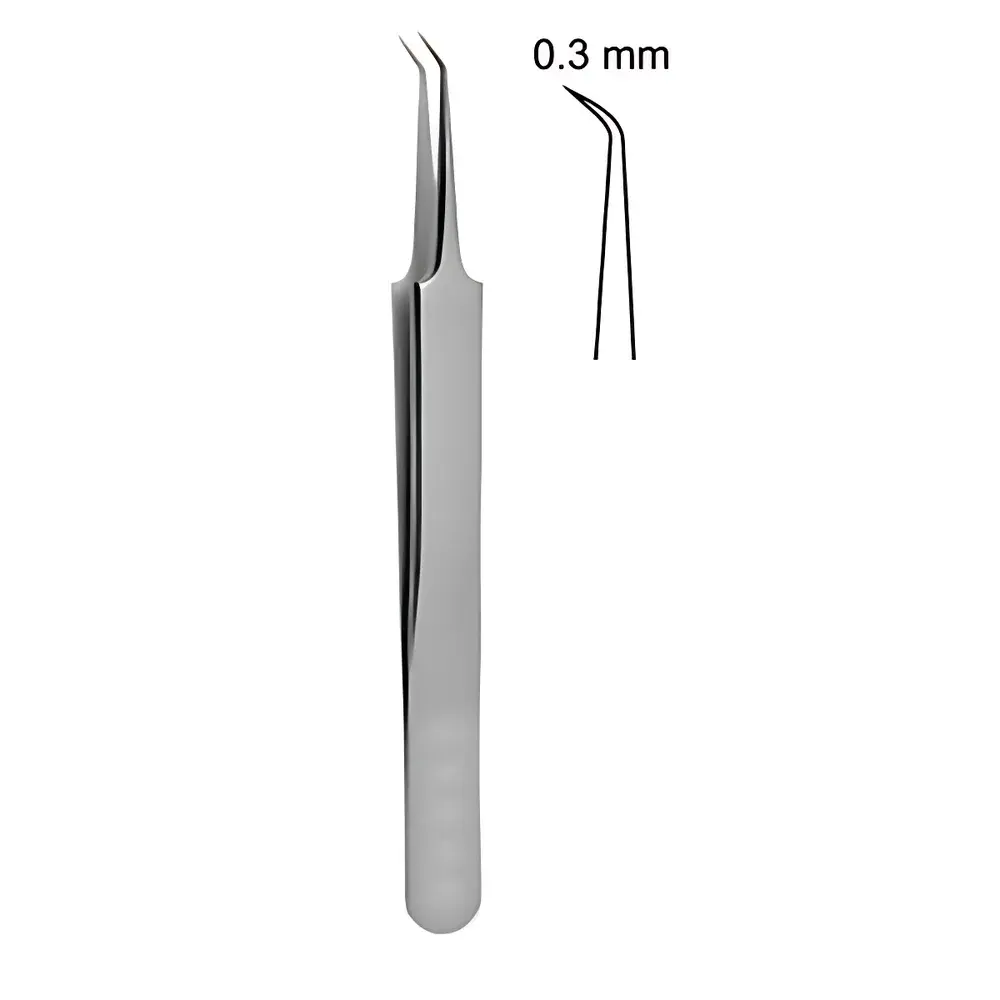
RWD F11003-11 45° Angled Fine-Tip Microforceps
| Brand | RWD |
|---|---|
| Origin | Shenzhen, China |
| Manufacturer Type | Direct Manufacturer |
| Origin Category | Domestic (China) |
| Model | F11003-11 |
| Pricing | Upon Request |
Overview
The RWD F11003-11 45° Angled Fine-Tip Microforceps is a precision-handling instrument engineered for high-resolution manipulation in life science research, microsurgery, and advanced cell culture workflows. Designed with a controlled 45° beveled tip geometry and a nominal tip width of 0.3 mm, this microforceps enables precise grasping, repositioning, and gentle handling of delicate biological structures—including single cells, embryonic tissues, neural explants, and microvascular grafts—without inducing mechanical trauma or lateral slippage. Its 11 cm overall length provides optimal ergonomic reach and tactile feedback while maintaining fine motor control under stereo or inverted microscope observation. Constructed from medical-grade stainless steel (AISI 420 or equivalent), the instrument undergoes electropolishing and passivation to ensure corrosion resistance, biocompatibility, and compatibility with standard sterilization protocols including autoclaving (121°C, 20 min), ethylene oxide (EtO), and low-temperature hydrogen peroxide plasma.
Key Features
- 45° angled tip configuration optimized for oblique access in confined anatomical or culture dish environments
- Consistently ground and polished tip width of 0.3 mm—verified via optical metrology during final quality inspection
- 11 cm total length balances maneuverability with control leverage; distal 35 mm features micro-textured finger-grip zones for enhanced slip resistance
- Fully autoclavable design compliant with ISO 17664-1 for reprocessing of reusable surgical instruments
- Non-magnetic, non-pyrogenic, and free of cadmium, lead, and nickel above EU REACH SVHC thresholds
- Tip alignment tolerance ≤ ±2.5°, ensuring repeatable orientation during repeated use cycles
Sample Compatibility & Compliance
The F11003-11 is routinely employed in applications requiring non-invasive mechanical interaction with fragile specimens: dissociated primary neurons, zebrafish embryos (stages 1–24 hpf), organoid fragments (<200 µm diameter), and electrospun nanofiber scaffolds. It is compatible with laminar flow hoods, CO₂ incubators, and cryogenic handling stages down to −80°C. From a regulatory standpoint, the device meets ISO 7153-1:2016 (Surgical Instruments — Metallic Materials — Part 1: Stainless Steels) and conforms to GB/T 20054-2022 (Chinese National Standard for Reusable Microsurgical Instruments). While not classified as an IVD or Class II/III medical device under FDA 21 CFR Part 807, it supports GLP-compliant experimental procedures when used within validated laboratory workflows.
Software & Data Management
As a manual, non-electronic instrument, the F11003-11 does not incorporate embedded sensors, firmware, or digital interfaces. However, its dimensional consistency and traceable manufacturing origin support integration into digitally documented SOPs. Users may log usage history, sterilization cycles, and calibration verification (via tip-width measurement using calibrated optical micrometers) within LIMS or ELN platforms such as LabArchives, Benchling, or Veeva Vault RIM. Batch-specific certificates of conformance—including material test reports (MTRs) and surface roughness data (Ra ≤ 0.2 µm)—are supplied with each packaged unit for audit readiness.
Applications
- Micromanipulation of murine oocytes and blastocysts during intracytoplasmic sperm injection (ICSI) preparation
- Positioning of retinal pigment epithelium (RPE) monolayers on transwell inserts for barrier function assays
- Handling of Drosophila larval CNS explants during live imaging setup
- Assembly of multi-layer hydrogel constructs in bioprinting post-processing workflows
- Retrieval and transfer of cryopreserved corneal endothelial sheets in regenerative ophthalmology labs
- Microdissection of plant meristematic tissue under stereomicroscopy
FAQ
Is the F11003-11 suitable for sterile tissue culture work?
Yes—it is fully autoclavable and certified for repeated sterilization without degradation of tip geometry or surface integrity.
Can this forceps be used under high-magnification DIC or phase contrast microscopy?
Absolutely—the 0.3 mm tip width and minimal reflectivity after electropolishing reduce optical interference and shadow artifacts.
What is the recommended maintenance protocol between uses?
Rinse with deionized water, dry thoroughly, and store in a designated instrument tray; avoid ultrasonic cleaning unless followed by full visual inspection of tip alignment.
Does RWD provide batch-level traceability documentation?
Yes—each shipment includes a Certificate of Conformance referencing heat lot numbers, material certifications, and dimensional inspection records.
Is there a version with tungsten carbide tips for extended wear resistance?
Not currently available in the F11003 series; however, RWD offers alternative models (e.g., F12005 series) with WC-reinforced tips upon custom request.




