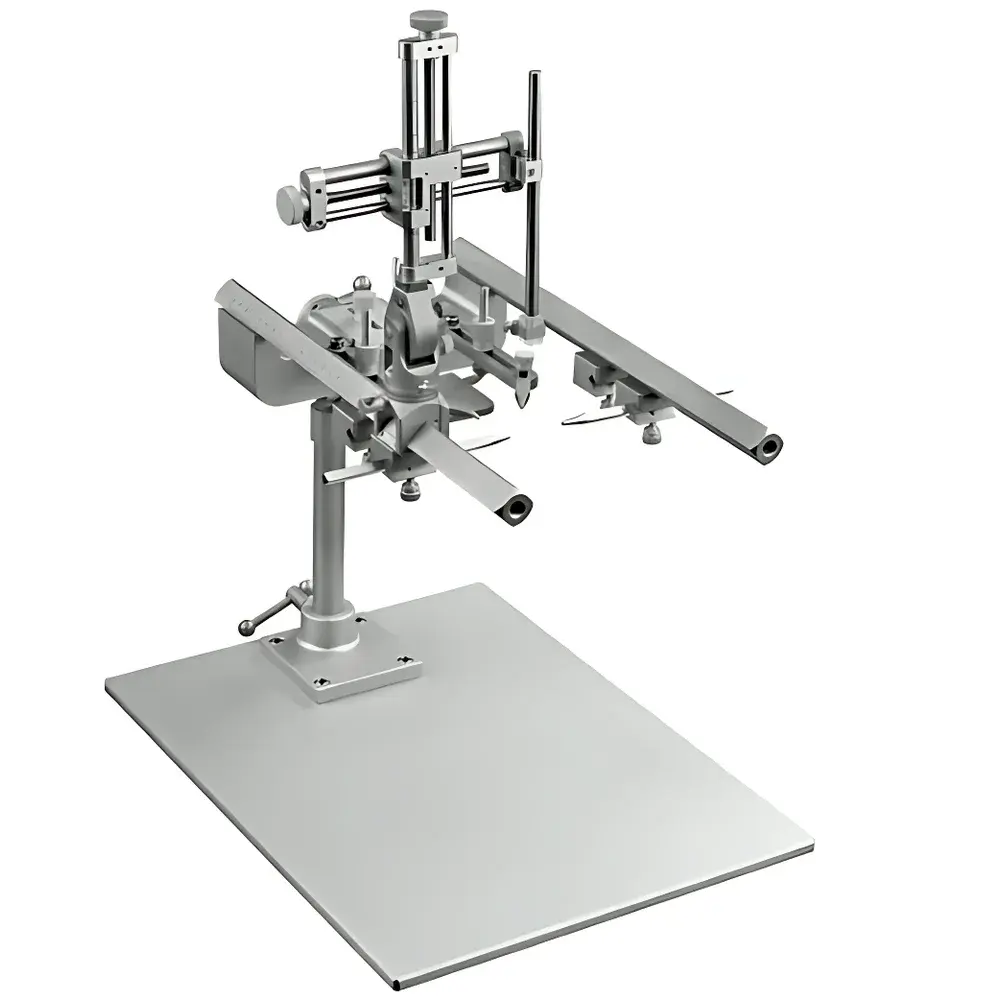
RWD 68901 Large-Animal Stereotaxic Instrument
| Brand | RWD |
|---|---|
| Origin | Shenzhen, China |
| Manufacturer Type | Original Equipment Manufacturer (OEM) |
| Product Category | Domestic |
| Model | 68901 |
| Pricing | Available Upon Request |
| Track Travel Range | ±100 mm (200 mm total) |
| Positioning Resolution | 0.1 mm (100 µm) |
| Microdrive Compatibility | AP Microdrive 45007 (optional, 25 mm stroke, 10 µm step resolution) |
| Arm Rotation | Vertical ±90°, Horizontal 360° |
| Max Simultaneous Arms | 6 |
| Frame Mounting | Benchtop or Baseplate |
| Animal Compatibility | Canine, Porcine, Non-Human Primate (NHP), Feline |
Overview
The RWD 68901 Large-Animal Stereotaxic Instrument is an engineered precision platform for neurosurgical intervention and chronic neural recording in medium-to-large animal models. Designed around a parallel-rail structural architecture, it implements classical stereotaxic principles—based on standardized bregma-lambda coordinate systems—to deliver reproducible three-dimensional (X-Y-Z) targeting accuracy across species with substantial cranial dimensions and anatomical variability. Unlike rodent-scale instruments, the 68901 accommodates head fixation under physiological loading conditions without mechanical compromise, supporting longitudinal studies requiring repeated access to deep brain structures (e.g., thalamus, basal ganglia, hippocampus) in dogs, pigs, non-human primates, and cats. Its rigid aluminum alloy frame, calibrated linear motion system, and modular adapter interface ensure mechanical stability during microelectrode insertion, optogenetic fiber placement, or intracranial cannula implantation—critical for minimizing tissue displacement and maintaining coordinate fidelity across sessions.
Key Features
- Parallel-rail structural design enabling high rigidity, minimal deflection under load, and unobstructed workspace access from multiple angles
- 360° rotatable rail assembly permitting full circumferential approach to the surgical field without repositioning the animal
- Interchangeable species-specific adapters—including reinforced maxillary plates optimized for variable skull morphology and weight distribution in canines (10–30 kg), porcine (20–60 kg), and NHP (3–12 kg)
- Calibrated vernier scale readout across all axes (X/Y/Z), delivering consistent 100 µm manual positioning resolution
- Modular arm mounting system supporting up to six independently adjustable manipulators on a single frame—enabling simultaneous multi-site injections, electrophysiology, or optical fiber placements
- Standardized compatibility with third-party microdrives (e.g., RWD AP Microdrive 45007) for sub-10 µm incremental advancement along the anterior-posterior axis
- Benchtop-mountable configuration with optional baseplate integration for vibration-dampened environments or shared surgical tables
Sample Compatibility & Compliance
The RWD 68901 is validated for use with common large-animal neuroscience models under institutional animal care and use committee (IACUC)-approved protocols. Adapter sets conform to anatomical landmarks defined in widely adopted atlases—including the Paxinos & Huang primate brain atlas and the Swanson pig brain atlas—ensuring alignment with published coordinate frameworks. All structural components comply with ISO 13485:2016 requirements for medical device manufacturing processes. While not classified as a medical device under FDA 21 CFR Part 820, the instrument supports GLP-compliant experimental workflows through traceable mechanical calibration records and documented setup repeatability (±0.1 mm inter-session deviation under controlled environmental conditions). It integrates seamlessly into AAALAC-accredited facilities where documentation of equipment qualification, maintenance logs, and user training records are required for audit readiness.
Software & Data Management
The 68901 operates as a hardware platform without embedded firmware or proprietary software; however, it is fully compatible with industry-standard digital stereotaxic planning tools such as Stereotaxic Atlas Viewer (SAV), Brain Explorer 2, and custom MATLAB/Python-based coordinate transformation pipelines. When paired with optional digital microdrives or motorized manipulators (e.g., RWD 68102), positional data can be logged via RS-232 or USB interfaces into LabChart, Spike2, or custom acquisition platforms supporting timestamped metadata export (CSV/JSON). All mechanical adjustments remain manually indexed and visually verified—supporting FDA 21 CFR Part 11–aligned workflows when combined with electronic lab notebook (ELN) systems that capture operator ID, date/time stamps, and coordinate entries with audit trail functionality.
Applications
- Chronic intracranial electrode array implantation in non-human primates for behavioral electrophysiology
- Multi-target viral vector delivery (AAV, lentivirus) in porcine models of neurodegenerative disease
- Deep brain stimulation (DBS) lead placement validation in canine epilepsy models
- Optogenetic fiber optic cannula implantation with concurrent fMRI-compatible craniotomy planning
- Post-mortem histological verification using coordinate-matched sectioning protocols aligned to digital atlas overlays
- Training platform for stereotactic surgery certification programs in veterinary and translational neuroscience curricula
FAQ
Is the RWD 68901 compatible with MRI-guided stereotaxy workflows?
Yes—the non-ferromagnetic aluminum construction and absence of embedded electronics permit safe use in low-field (≤3T) MRI environments when configured with MR-compatible adapters and non-metallic manipulator components.
Can the 68901 be calibrated in-house, and what documentation is provided?
Each unit ships with a factory-verified calibration certificate referencing NIST-traceable gauge blocks. End users may perform routine verification using certified depth gauges and angular protractors; calibration procedures are detailed in the ISO/IEC 17025–aligned technical manual.
What level of technical support is available for international customers?
RWD provides remote application engineering support, CAD-based mounting guidance, and IACUC protocol review assistance. On-site installation and operator training are available upon request through authorized regional distributors.
Does the system support integration with automated microinjection systems?
Yes—standardized 1/4″-20 threaded mounting interfaces and open mechanical specifications enable third-party integration with Nanoject III, UMP3, or WPI Micro4 controllers via custom bracketing solutions.
Are replacement adapters and spare parts available separately?
All adapters (canine, porcine, NHP, feline), rail components, and vernier scales are stocked globally and supplied with serial-number-matched calibration records.