
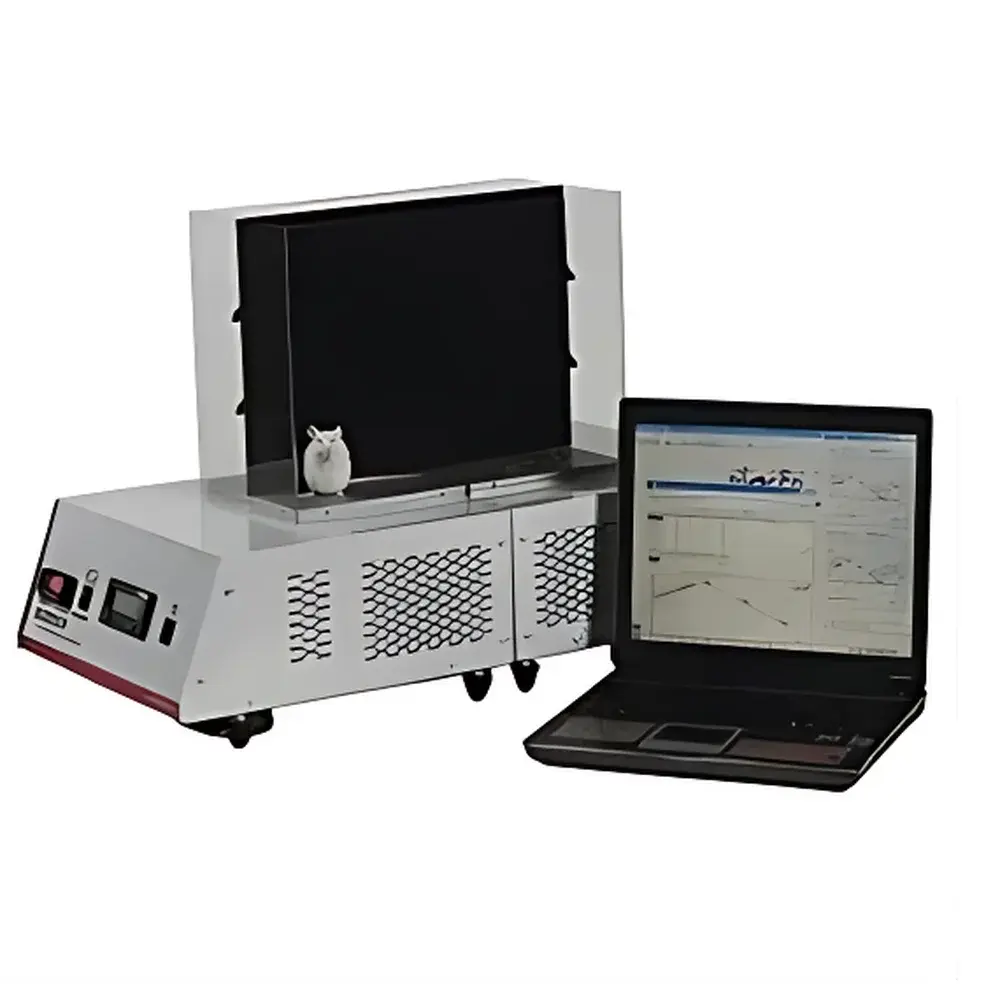
Bioseb BIO-T2CT Thermal Place Preference Test System
| Origin | France |
|---|---|
| Manufacturer Type | Distributor |
| Origin Category | Imported |
| Model | BIO-T2CT (supports 1 rat or 2 mice |
| Pricing | Upon Request |
Overview
The Bioseb BIO-T2CT Thermal Place Preference Test System is a precisely engineered behavioral phenotyping instrument designed for objective, quantitative assessment of thermal nociception and analgesia in rodent models. Based on the validated two-temperature choice paradigm, the system leverages thermotaxis-driven behavior to evaluate an animal’s voluntary preference—or avoidance—of specific thermal zones, thereby reflecting underlying changes in thermal sensitivity, central pain processing, and drug-induced antinociceptive effects. Unlike reflex-based assays (e.g., tail-flick or hot-plate), the BIO-T2CT measures motivated behavior under non-aversive conditions, minimizing stress confounds and enhancing translational relevance to clinical pain states involving affective and cognitive dimensions. The device operates via dual independently controlled Peltier modules embedded within a custom-designed acrylic arena, enabling stable, gradient-free temperature zones across a broad operational range.
Key Features
- Independent dual-zone thermal control: Two adjacent compartments maintain discrete, user-defined temperatures from –3 °C to +65 °C with ±0.5 °C accuracy at ambient conditions (20–25 °C), ensuring high thermal stability and reproducibility across repeated trials.
- Standardized arena geometry: Overall footprint 32 L × 57 W × 45.5 H cm; internal activity chamber dimensions 33 L × 16.5 W × 30 H cm—optimized for natural locomotion and unambiguous zone discrimination by rats (1 subject) or mice (up to 2 subjects).
- GLP-compliant experimental design: Built-in hardware synchronization interface supports time-stamped integration with external high-resolution video acquisition systems (e.g., USB3 cameras), enabling concurrent behavioral annotation and thermal zone occupancy mapping.
- Modular architecture: Core hardware unit does not include proprietary analysis software or camera; this separation ensures flexibility in data acquisition workflows and compatibility with institutional imaging pipelines and third-party tracking platforms (e.g., EthoVision XT, Noldus; DeepLabCut).
- Rugged, chemically resistant construction: Acrylic enclosure with stainless-steel thermal plates and sealed electronics—designed for repeated disinfection cycles and long-term use in vivarium environments adhering to AAALAC-accredited housing standards.
Sample Compatibility & Compliance
The BIO-T2CT is validated for use with adult Sprague-Dawley or Wistar rats (200–300 g) and C57BL/6 or CD-1 mice (20–30 g). Its open-platform design permits adaptation for transgenic lines, neuropathic pain models (e.g., SNI, CCI), and inflammatory paradigms (e.g., CFA injection). All thermal calibration procedures follow ISO/IEC 17025 traceable protocols using NIST-traceable PT100 probes. Experimental protocols generated with the BIO-T2CT align with NIH Guide for the Care and Use of Laboratory Animals, EMA/CHMP/SWP/580892/2013 guidelines for preclinical analgesic evaluation, and support regulatory submissions requiring GLP audit readiness—including full metadata logging, operator ID tagging, and timestamped zone-transition event records.
Software & Data Management
While the BIO-T2CT hardware provides real-time temperature regulation and digital I/O triggers for external devices, data acquisition and behavioral quantification require compatible third-party software. Bioseb recommends integration with video-tracking suites supporting ROI-based zone definition and dwell-time analytics. Raw thermal setpoint logs and TTL-synchronized frame markers are exported in CSV or HDF5 format for downstream statistical analysis (e.g., R, Python/Pandas, GraphPad Prism). When deployed in regulated environments, the system supports 21 CFR Part 11 compliance when paired with validated electronic lab notebook (ELN) or LIMS platforms that enforce audit trails, electronic signatures, and role-based access control for raw data files and processed outputs.
Applications
- Pharmacological characterization of centrally acting analgesics (e.g., µ-opioid agonists, TRPV1 antagonists, Nav1.7 inhibitors) via dose–response analysis of thermal preference shift.
- Longitudinal monitoring of thermal hypersensitivity in chronic pain models, including chemotherapy-induced peripheral neuropathy (CIPN) and diabetic neuropathy.
- Genetic screening of nociceptive phenotypes in knockout/knockin strains, particularly those affecting thermosensory ion channels (e.g., TRPM8, TRPA1, ANO1).
- Validation of novel neuromodulation interventions (e.g., spinal cord stimulation, tDCS) on affective components of pain perception.
- Behavioral pharmacokinetic–pharmacodynamic (PK–PD) correlation studies integrating plasma drug concentration time-courses with dynamic thermal preference metrics.
FAQ
Is the BIO-T2CT compatible with automated video tracking software?
Yes—the system provides TTL output signals synchronized to thermal zone transitions and accepts external trigger inputs for frame-accurate alignment with commercial or open-source tracking tools.
Does the device meet ISO 13485 or FDA QSR requirements?
As a research-use-only (RUO) instrument, the BIO-T2CT is not certified under ISO 13485 or FDA 21 CFR Part 820; however, its design, calibration documentation, and operational logs support GLP-aligned validation per OECD Principles of Good Laboratory Practice.
Can temperature gradients be programmed between zones?
No—the BIO-T2CT maintains two discrete, uniform temperature zones; it does not generate continuous thermal gradients. This design ensures unambiguous interpretation of place preference decisions.
What maintenance is required for long-term thermal accuracy?
Annual recalibration using traceable reference probes is recommended; Peltier modules are rated for >50,000 operational cycles under standard laboratory conditions.
Is cage cleaning compatible with standard vivarium disinfectants?
Yes—acrylic surfaces and stainless-steel thermal plates resist ethanol, Virkon™, and 1% sodium hypochlorite; avoid abrasive cleaners or prolonged exposure to acetone or chlorinated solvents.





