Bioseb FST-DSR / FST-DSM Dual-Sensor Forced Swim Test System
| Origin | France |
|---|---|
| Manufacturer Type | Authorized Distributor |
| Origin Category | Imported |
| Model | Bioseb FST-DSR (Rat) / FST-DSM (Mouse) |
| Detection Principle | Synchronized Vibration + High-Resolution Video Tracking |
| Behavioral Classification | Immobility, Swimming, Climbing (Struggling) |
| Accuracy | <4% inter-trial deviation |
| Reproducibility | 100% intra-system repeatability |
| Output Format | CSV/Excel-compatible data files |
| Throughput | Up to 4 rodents simultaneously |
| Compliance | Designed for GLP-compliant preclinical behavioral phenotyping |
Overview
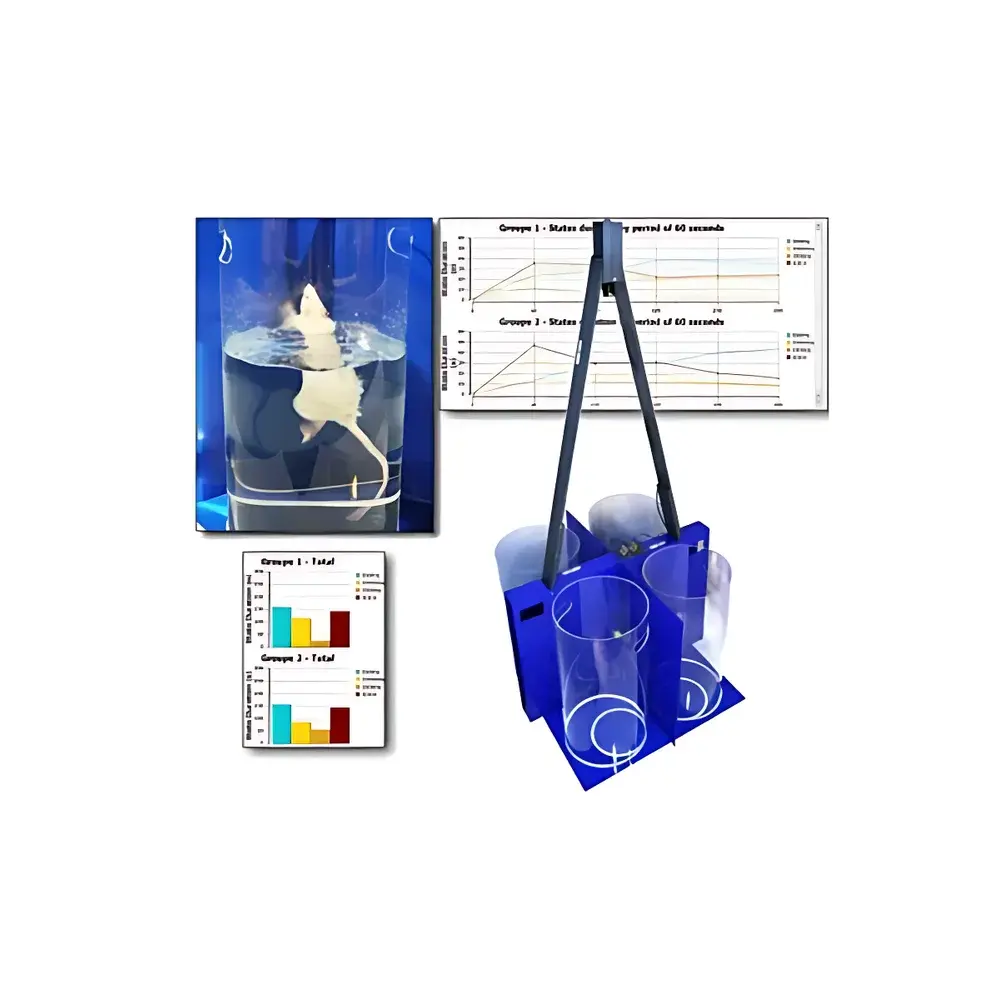
The Bioseb FST-DSR (for rats) and FST-DSM (for mice) Dual-Sensor Forced Swim Test System is a rigorously engineered platform for objective, quantitative assessment of behavioral despair in rodent models—a cornerstone assay in preclinical antidepressant drug discovery and neuropharmacological research. Unlike conventional single-modality systems relying solely on video analysis or motion-sensitive platforms, this system integrates synchronized vibration transduction and high-frame-rate video tracking to capture both gross locomotor displacement and subtle postural shifts with temporal precision. The underlying measurement principle follows the standard forced swim paradigm defined by Porsolt et al. (1977), where immobility duration—interpreted as passive floating without directed movement—is quantified as a validated endophenotype of depressive-like states. By fusing mechanical signal acquisition (via piezoelectric load cells embedded in individual cylinders) with pixel-level motion vector analysis, the system mitigates common confounds such as water surface reflection artifacts, low-contrast fur tracking failure, and operator-dependent scoring bias.
Key Features
- Dual-sensor architecture: Independent, time-synchronized acquisition of vibration signatures (mechanical energy transfer from limb movement) and video-derived motion trajectories ensures cross-validated behavioral classification.
- TYC (Train-Your-Computer) adaptive algorithm: A supervised machine learning module trained on manually annotated behavioral datasets enables real-time discrimination among three ethologically distinct states—immobility (passive floating), swimming (horizontal paddling), and climbing (vertical forelimb movement against cylinder walls)—without manual threshold tuning.
- Zero-intervention experimental workflow: Fully automated session initiation, behavior classification, and data export eliminate observer presence during testing, reducing stress-induced behavioral modulation and enhancing ecological validity.
- Multi-animal parallel operation: Four independent test units (each with calibrated water temperature control, standardized cylinder geometry per OECD TG 425 guidelines, and individual lighting uniformity) support concurrent assessment while maintaining strict inter-subject isolation.
- GLP-ready audit trail: All raw sensor streams, processed event logs, timestamped video clips, and user-initiated actions are archived with immutable metadata (date/time, operator ID, protocol version, calibration status) to satisfy regulatory traceability requirements.
Sample Compatibility & Compliance
The system supports standard Sprague-Dawley, Wistar, and C57BL/6 rodent strains within weight ranges of 18–35 g (mice) and 180–300 g (rats). Cylinder dimensions comply with NIH-recommended specifications (20 cm height × 10 cm diameter for mice; 45 cm height × 18 cm diameter for rats) and are constructed from optically neutral, autoclavable acrylic to ensure consistent light transmission and thermal stability. Water depth is programmatically maintained at 15 ± 0.5 cm (mice) or 30 ± 0.5 cm (rats), with integrated PT100 sensors monitoring temperature at 25.0 ± 0.2 °C throughout the 6-min test session. The platform adheres to institutional animal care protocols aligned with AAALAC International standards and facilitates documentation required for IACUC submissions. Data structure conforms to MIAME-compliant metadata schemas for behavioral assays.
Software & Data Management
Control and analysis are executed via Bioseb’s proprietary FST-Analyzer v4.x software suite, compatible with Windows 10/11 (64-bit) and validated under FDA 21 CFR Part 11 Annex 11 conditions. The software features role-based access control, electronic signature capability, and full audit trail logging—including all parameter modifications, session start/stop events, and manual override interventions. Behavioral output includes total immobility time (s), latency to first immobility episode, frequency and duration of swimming/climbing bouts, and motion entropy metrics derived from trajectory complexity analysis. Export options include ANSI-standard CSV, Excel (.xlsx), and HDF5 formats suitable for downstream integration with MATLAB, Python (SciPy/Pandas), or commercial statistical platforms (e.g., GraphPad Prism, SAS). Raw video is stored in H.264-encoded AVI containers with embedded timecode and synchronized vibration waveform overlays.
Applications
- Preclinical evaluation of novel monoaminergic, glutamatergic, and neurotrophic antidepressants.
- Genetic screening of depression-related behavioral endophenotypes in transgenic/knockout mouse lines.
- Chronic stress model validation (e.g., CMS, CSDS) and longitudinal behavioral phenotyping.
- Pharmacokinetic–pharmacodynamic correlation studies linking plasma drug concentrations to acute behavioral effects.
- Neuroinflammatory intervention trials assessing cytokine-mediated behavioral alterations.
- Academic and contract research organization (CRO) workflows requiring ISO/IEC 17025-aligned method validation reports.
FAQ
Is the system compliant with OECD Test Guideline 425?
Yes—the cylinder geometry, water temperature regulation, session duration, and behavioral endpoint definitions align with OECD TG 425 for acute oral toxicity studies incorporating behavioral observation components.
Can the TYC algorithm be retrained with custom behavioral annotations?
Yes—FST-Analyzer provides a dedicated annotation module supporting manual frame-by-frame labeling and supervised retraining of the classifier using user-defined ethograms.
What calibration procedures are required prior to use?
Daily verification of water temperature uniformity and vibration sensor zero-point drift is recommended; full system calibration (including video lens distortion correction and load cell linearity verification) is performed annually by Bioseb-certified service engineers.
Does the software support batch processing of multiple sessions?
Yes—automated queue-based analysis allows unattended processing of up to 999 sessions with customizable reporting templates and summary statistics aggregation.
Are replacement parts and service contracts available globally?
Bioseb maintains an international network of authorized service centers; all critical components—including load cells, LED illumination arrays, and camera modules—carry a 24-month warranty and are stocked in regional distribution hubs.