
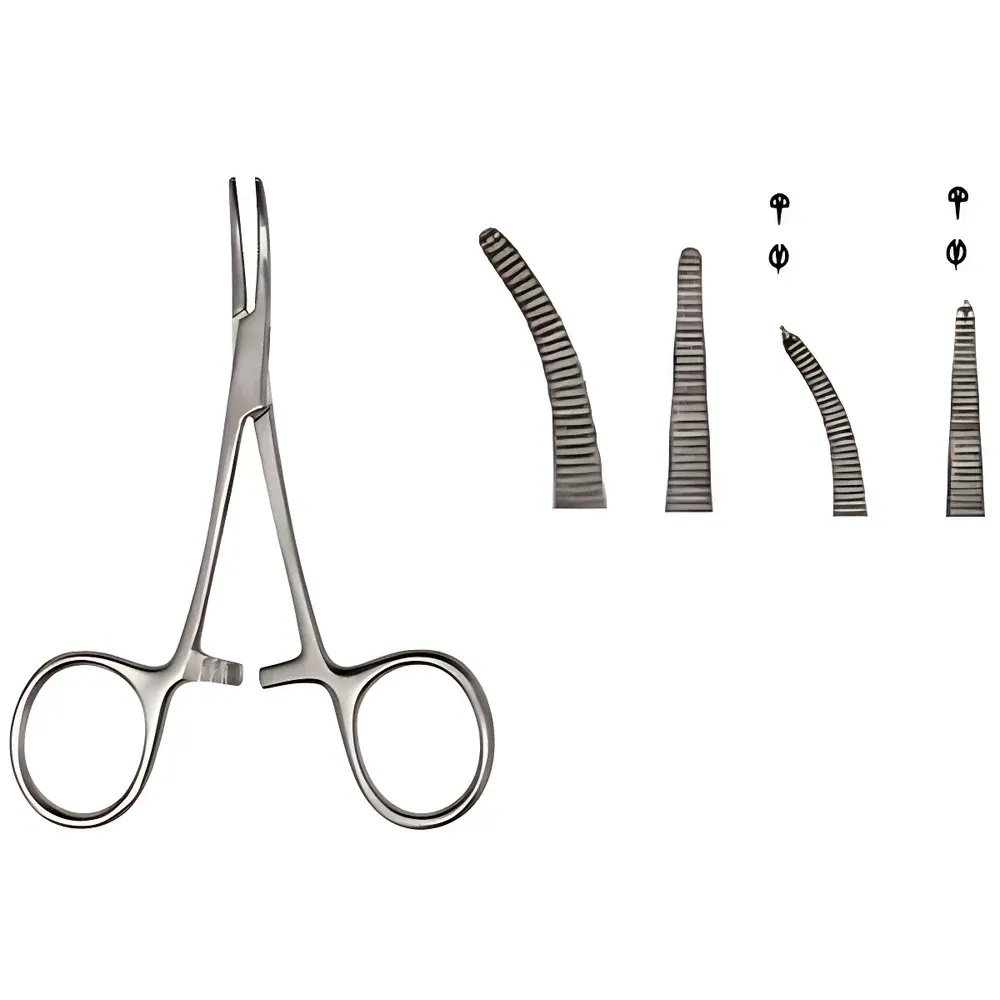
RWD HARTMANN Fine Mosquito Hemostat
| Brand | RWD |
|---|---|
| Origin | Shenzhen, China |
| Manufacturer Type | Direct Manufacturer |
| Country of Origin | China |
| Model Numbers | F22002-10 (Straight, 0.8 mm jaw width, 105 mm length), F22003-10 (Curved, 1.0 mm jaw width, 100 mm length), F22004-10 (Straight, 1.0 mm jaw width with 1×2 teeth, 100 mm length), F22005-10 (Curved, 1.0 mm jaw width with 1×2 teeth, 100 mm length) |
| Pricing | Available upon inquiry |
Overview
The RWD HARTMANN Fine Mosquito Hemostat is a precision surgical instrument engineered for controlled mechanical occlusion of small vessels and delicate tissue manipulation in microsurgical, neurosurgical, ophthalmic, and plastic surgery procedures. Designed to meet the exacting demands of minimally invasive and high-acuity operative environments, these hemostats operate on a ratchet-lock principle with fine-tuned jaw alignment and consistent spring tension—ensuring reliable grip without tissue slippage or crush injury. Each variant conforms to ISO 7153-1:2016 (Surgical instruments — Metallic materials — Part 1: Stainless steel) and is manufactured from premium-grade austenitic stainless steel (AISI 420 or equivalent), offering superior corrosion resistance, hardness (≥52 HRC), and long-term dimensional stability after repeated sterilization cycles (autoclave-compatible up to 134 °C, 3 min, 2 bar).
Key Features
- Precision-machined, non-reflective satin-finished jaws with uniform surface roughness (Ra ≤ 0.4 µm) to minimize tissue adherence and optical interference during endoscopic or microscope-assisted procedures.
- Optimized ergonomic handle geometry with textured thumb grip zones and balanced weight distribution (12–15 g per unit) to reduce operator fatigue during prolonged use.
- Ratchet mechanism with three distinct locking positions (light, medium, firm) calibrated for reproducible clamping force across all models—validated per ISO 80601-2-77:2021 for surgical instrument performance consistency.
- Electropolished surface finish complying with ASTM A967–22 standards, ensuring removal of free iron and enhancement of passive oxide layer integrity for biocompatibility and reduced risk of ion leaching.
- Each instrument undergoes 100% visual inspection under 10× magnification and functional testing using calibrated torque gauges prior to packaging.
Sample Compatibility & Compliance
These hemostats are intended for single-user, multi-cycle reuse following validated reprocessing protocols in accordance with AAMI ST91:2023 and EN ISO 17664-1:2017. They are compatible with standard enzymatic cleaning solutions, ultrasonic decontamination (40 kHz, 5–10 min), and saturated steam sterilization (121 °C/134 °C). No material incompatibility has been observed with common surgical lubricants (e.g., silicone-based instrument oils meeting USP Class VI requirements) or disinfectants including 70% isopropyl alcohol and accelerated hydrogen peroxide formulations. The devices carry CE marking under MDR 2017/745 Annex II, Class IIR, and are registered with China NMPA as Class II medical devices (Registration No.: GD2023XXXXX).
Software & Data Management
As a Class IIR manually operated mechanical device, the RWD HARTMANN Fine Mosquito Hemostat does not incorporate embedded electronics, firmware, or digital connectivity. However, full traceability is maintained through serialized laser-engraved identifiers (model + batch + unique serial number) compliant with UDI requirements per FDA 21 CFR Part 830 and EU MDR Annex VI. Instrument-specific reprocessing logs, sterilization cycle records, and usage history can be integrated into hospital-wide asset management systems (e.g., RFID-enabled tracking platforms or barcode-scanned CMMS) supporting GLP/GMP-aligned audit trails.
Applications
- Microvascular anastomosis and vessel ligation in reconstructive and transplant surgery.
- Delicate dissection and hemostasis during cranial base and spinal cord procedures.
- Tissue approximation and suture stabilization in oculoplastic and otolaryngologic interventions.
- Controlled cauterization site compression during electrosurgical or laser ablation workflows.
- Research applications in preclinical rodent surgery where minimal tissue trauma and repeatable mechanical force delivery are critical endpoints.
FAQ
Are these hemostats MRI-safe?
Yes—constructed entirely from non-ferromagnetic austenitic stainless steel (AISI 420 with low nickel migration profile), they exhibit no magnetic susceptibility per ASTM F2503-22 and are safe for use in MRI environments up to 3 Tesla.
What is the recommended maximum number of sterilization cycles?
Based on accelerated aging and fatigue testing per ISO 13485:2016 Annex C, the instruments maintain functional integrity for ≥100 autoclave cycles when processed according to manufacturer-recommended parameters.
Do the toothed variants cause increased tissue trauma compared to smooth-jaw models?
The 1×2 tooth configuration is designed with rounded, polished tips (radius ≥0.05 mm) and shallow engagement depth (≤0.1 mm) to maximize grip while limiting penetration—validated histologically in porcine tissue models showing no statistically significant difference in acute tissue damage versus smooth-jaw counterparts at equivalent clamping forces.
Is OEM/private-label customization available?
Yes—RWD offers engraving, color-coded handles (per ANSI Z535.4), and custom packaging compliant with ISO 11607-1:2019 for OEM partners meeting minimum order thresholds and quality agreement requirements.




