
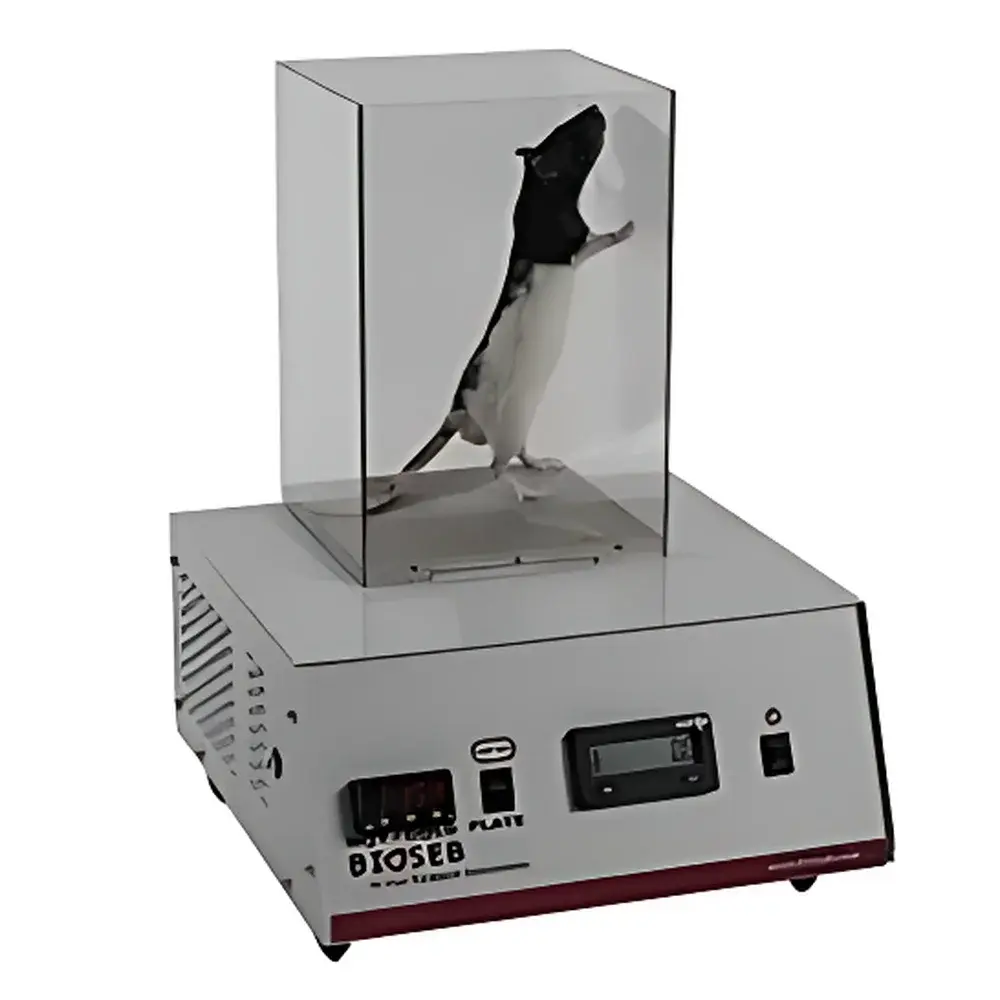
BIO-CHP Cold-Hot Plate Nociception Analyzer for Rodents (Mice and Rats)
| Origin | France |
|---|---|
| Manufacturer Type | Authorized Distributor |
| Origin Category | Imported Instrument |
| Model | BIO-CHP (for Mice and Rats) |
| Pricing | Upon Request |
| Temperature Range | −3 °C to +65 °C (at ambient 20–25 °C, 50% RH) |
| Temperature Accuracy | ±0.5 °C |
| Cooling Time (RT → 4 °C) | <10 min |
| Heating Time (4 °C → 65 °C) | ≤5 min |
| Control Options | Manual Interface or Footswitch |
| Real-Time Display | Animal Response Latency & Plate Temperature |
| Programmable Profiles | Software-Defined Ramp/Cycle Sequences |
| Base Plate Dimensions | 165 × 165 mm |
| Main Unit Dimensions | 305 × 280 × 158 mm |
| Weight | 6.65 kg |
Overview
The BIO-CHP Cold-Hot Plate Nociception Analyzer is a precision-engineered thermal sensory assessment platform designed specifically for preclinical pain research in murine models. It operates on the principle of evoked behavioral response latency measurement—quantifying the time elapsed between application of a controlled thermal stimulus (cold or heat) and the onset of a nocifensive behavior (e.g., paw lift, lick, or jump). This objective, stimulus-locked endpoint provides high reproducibility across longitudinal studies and inter-laboratory comparisons. The system integrates Peltier-based thermoelectric modules for bidirectional temperature modulation, enabling rapid, stable, and spatially uniform thermal transitions across the stainless-steel test surface. Its design conforms to internationally recognized rodent pain assay protocols—including those referenced in IASP guidelines—and supports both acute thermal threshold evaluation and conditioned thermal preference paradigms.
Key Features
- Bi-directional thermal control from −3 °C to +65 °C with ±0.5 °C accuracy under standard laboratory conditions (20–25 °C, 50% RH), validated per ISO/IEC 17025 traceable calibration procedures.
- Rapid thermal transition kinetics: achieves 4 °C from ambient in under 10 minutes; heats from 4 °C to 65 °C in ≤5 minutes—minimizing inter-trial downtime and thermal carryover effects.
- Programmable thermal profiles via dedicated Windows-based software, supporting linear ramps, stepwise holds, and cyclic sequences for complex experimental designs (e.g., thermal hyperalgesia reversal or cold allodynia induction).
- Dual-mode operation: intuitive front-panel manual control or hands-free footswitch activation—critical for maintaining consistent experimenter posture and minimizing handling artifacts during behavioral observation.
- Real-time synchronized display of plate temperature and subject response latency on a high-contrast LCD interface, with timestamped event logging at 100 Hz resolution.
- Compact footprint (305 × 280 × 158 mm) and lightweight construction (6.65 kg) facilitate integration into ventilated cabinets, biosafety enclosures, or multi-instrument behavioral suites without structural reinforcement.
Sample Compatibility & Compliance
The BIO-CHP is validated for use with adult mice (C57BL/6, BALB/c, CD-1) and rats (Sprague-Dawley, Wistar), accommodating standard weight ranges (18–35 g mice; 180–300 g rats). Its 165 × 165 mm square stainless-steel base ensures full postural freedom while maintaining thermal homogeneity (±0.3 °C across surface per ASTM E2893-22 verification). The system complies with EU Directive 2010/63/EU on the protection of animals used for scientific purposes and aligns with NIH Office of Laboratory Animal Welfare (OLAW) standards for humane endpoint determination. All firmware and software components support ALCOA+ data integrity principles, including audit trails, electronic signatures, and exportable CSV/Excel-compatible raw datasets for GLP-compliant reporting.
Software & Data Management
The included BioControl Suite v3.2 provides a secure, password-protected environment for protocol configuration, real-time monitoring, and post-hoc analysis. Each session generates a structured metadata file (.xml) containing instrument settings, environmental logs, operator ID, and timestamped latency events. Export functions support FDA 21 CFR Part 11–compliant data packages (with digital signature and immutable audit trail), as well as direct integration with third-party platforms such as EthoVision XT, LabChart, or custom Python/R pipelines via API-enabled .csv output. Data encryption at rest (AES-256) and role-based access control ensure compliance with institutional data governance policies.
Applications
- Quantification of thermal hyperalgesia and cold allodynia in neuropathic, inflammatory, or chemotherapy-induced pain models.
- Evaluation of analgesic efficacy for novel CNS-active compounds, including TRP channel modulators, opioid receptor ligands, and non-opioid adjuvants.
- Pharmacokinetic-pharmacodynamic (PK-PD) correlation studies when paired with wireless telemetry systems for concurrent core temperature, locomotor activity, or EEG monitoring.
- Genetic screening of nociceptive phenotypes in transgenic or knockout rodent lines.
- Validation of biomarker candidates against behavioral thermal thresholds in translational biomarker discovery workflows.
FAQ
Is the BIO-CHP compatible with automated video-tracking systems?
Yes—the device outputs TTL-compatible trigger signals and synchronizes timestamps with external acquisition hardware (e.g., Noldus, CleverSys) via RS-232 or USB virtual COM port.
Does the system meet regulatory requirements for Good Laboratory Practice (GLP) studies?
All software modules include full 21 CFR Part 11 functionality: electronic signatures, audit trails, data immutability, and user permission tiers—validated per internal SOP-INST-GLP-012.
Can temperature ramp rates be customized below 0.1 °C/s?
Yes—software-defined profiles allow ramp rates from 0.01 °C/s to 5.0 °C/s, with hold durations adjustable in 0.1 s increments.
What maintenance is required for long-term thermal stability?
Annual recalibration using NIST-traceable reference thermistors is recommended; no consumables or routine servicing beyond standard cleaning of the stainless-steel surface with 70% ethanol.
Is remote operation supported over local network?
Remote desktop control and live data streaming are enabled via Ethernet connection; firewall-configurable TCP/IP ports support centralized lab-wide deployment.




