
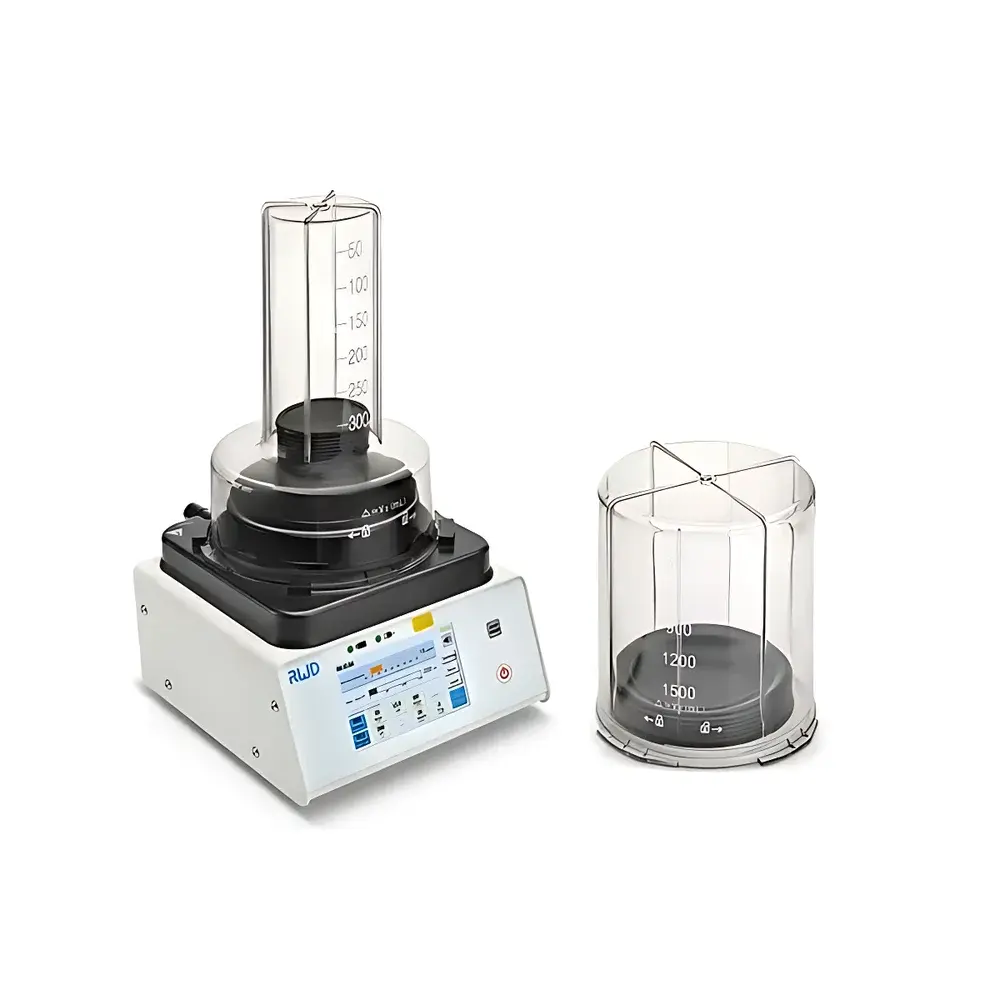
RWD R419 Intelligent Large-Animal Ventilator
| Brand | RWD |
|---|---|
| Origin | Shenzhen, China |
| Manufacturer Type | Original Equipment Manufacturer (OEM) |
| Country of Origin | China |
| Model | R419 |
| Price Range | USD 1,400 – 7,000 |
Overview
The RWD R419 Intelligent Large-Animal Ventilator is a microprocessor-controlled, pneumatically actuated ventilator engineered for precise, adaptive mechanical ventilation in preclinical research and veterinary clinical settings. Designed in accordance with ISO 80601-2-80:2018 (Medical electrical equipment — Part 2-80: Particular requirements for basic safety and essential performance of ventilatory support equipment for ventilatory support of patients in critical care applications), the R419 delivers reliable breath-by-breath control for animals weighing 2–100 kg—including dogs, cats, pigs, and non-human primates. Its dual-chamber bellows system enables seamless transition between low-tidal-volume (e.g., neonatal or small canine) and high-flow (e.g., adult porcine or large canine) ventilation profiles without hardware modification. Unlike fixed-parameter ventilators, the R419 implements real-time algorithmic adaptation: upon user input of animal weight and species-specific respiratory physiology defaults (e.g., tidal volume = 10 mL/kg, I:E ratio = 1:2), the device auto-calculates and initializes clinically appropriate inspiratory pressure, flow rate, and respiratory rate—minimizing setup time while maintaining physiological fidelity.
Key Features
- Three primary ventilation modes: Volume-Controlled (VCV), Pressure-Controlled (PCV), and Apnea (standby/manual-triggered) mode—each configurable with independent upper/lower limits for safety-critical parameters.
- Embedded weight-based parameter auto-matching: Input animal mass (2–100 kg); the system dynamically adjusts tidal volume, peak inspiratory pressure (PIP), positive end-expiratory pressure (PEEP), and respiratory rate per established veterinary respiratory guidelines.
- 20 programmable protocol slots: Store and recall complete ventilation configurations—including gas blend ratios (if interfaced with an anesthesia machine), trigger sensitivity, and alarm thresholds—with one-touch activation.
- Comprehensive alarm architecture: 13 distinct alarm conditions—including high/low airway pressure, apnea, disconnection, low O₂ supply, and bellows malfunction—each generating simultaneous audible tone (85 dB @ 30 cm), on-screen text alert, and visual LED indicator for rapid triage.
- Dual-bellows pneumatic design: Independent small- and large-volume chambers reduce dead space and improve flow linearity across wide tidal volume ranges (20–1500 mL), enhancing CO₂ rebreathing control and reducing work of breathing during spontaneous breathing trials.
Sample Compatibility & Compliance
The R419 supports intubated and mask-based ventilation across common large-animal models used in cardiovascular, pulmonary, and neurophysiological research. It is compatible with standard 15/22 mm conical connectors and integrates seamlessly with RWD’s integrated large-animal anesthesia and monitoring platforms (e.g., R600 Anesthesia Machine, R800 Multi-Parameter Monitor). Device firmware and calibration records comply with GLP documentation requirements; audit trails for parameter changes, alarm events, and user logins are timestamped and exportable via USB for regulatory review. The ventilator meets electromagnetic compatibility (EMC) per IEC 60601-1-2:2014 and carries CE marking under the EU MDR 2017/745 framework.
Software & Data Management
No proprietary software installation is required for basic operation; all configuration occurs via the front-panel touchscreen interface with tactile feedback. For longitudinal studies, optional data logging (via internal SD card or USB export) captures time-stamped waveforms (pressure, flow, volume), setpoints, and alarm logs at 100 Hz sampling resolution. Exported CSV files are compatible with MATLAB, LabChart, and GraphPad Prism for post-hoc respiratory mechanics analysis (e.g., dynamic compliance, resistance calculation). Firmware updates are performed offline via signed .bin files to ensure integrity and traceability—supporting FDA 21 CFR Part 11-aligned validation protocols when deployed in GCP-compliant animal facilities.
Applications
- Large-animal disease modeling: Precise induction of controlled hyperventilation or hypoventilation for ischemia-reperfusion injury models (e.g., myocardial infarction, acute lung injury).
- Thoracic surgery support: Stable intraoperative ventilation during open-chest procedures, enabling consistent arterial blood gas (ABG) parameters and minimizing hemodynamic instability.
- Physiological signal acquisition: Synchronized ventilation ensures stable end-tidal CO₂, SpO₂, and hemodynamic baselines during electrophysiology, fMRI, or PET imaging sessions.
- Emergency resuscitation: Rapid deployment in acute respiratory failure scenarios (e.g., anesthetic overdose, aspiration pneumonia), with immediate access to rescue ventilation presets.
- Respiratory pharmacology studies: Evaluation of bronchodilator or neuromuscular blocker efficacy via serial measurement of airway resistance and compliance under standardized ventilatory conditions.
FAQ
Is the R419 compatible with non-RWD anesthesia machines?
Yes—the R419 accepts standard medical-grade compressed air and oxygen inputs (40–55 psi), and its analog/digital I/O ports support third-party trigger synchronization and gas concentration feedback.
Does the device support spontaneous breathing modes such as PSV or SIMV?
No—the R419 implements VCV, PCV, and apnea modes only; it does not offer pressure-support or synchronized intermittent mandatory ventilation due to its dedicated focus on controlled ventilation in acute experimental and surgical contexts.
Can ventilation data be exported in real time to a central lab network?
Real-time streaming is not supported; however, high-fidelity waveform and event logs can be exported post-acquisition in CSV format for integration into institutional data lakes or LIMS environments.
What maintenance intervals are recommended?
Bellows and bacterial/viral filters require replacement after every 500 hours of cumulative operation or per animal-use cycle in sterile procedures; full functional verification must be performed quarterly using NIST-traceable pressure and flow calibrators.
Is the R419 validated for use in GLP-regulated toxicology studies?
Yes—documentation packages including IQ/OQ/PQ protocols, calibration certificates, and alarm response verification reports are available upon request to support GLP audit readiness.




