
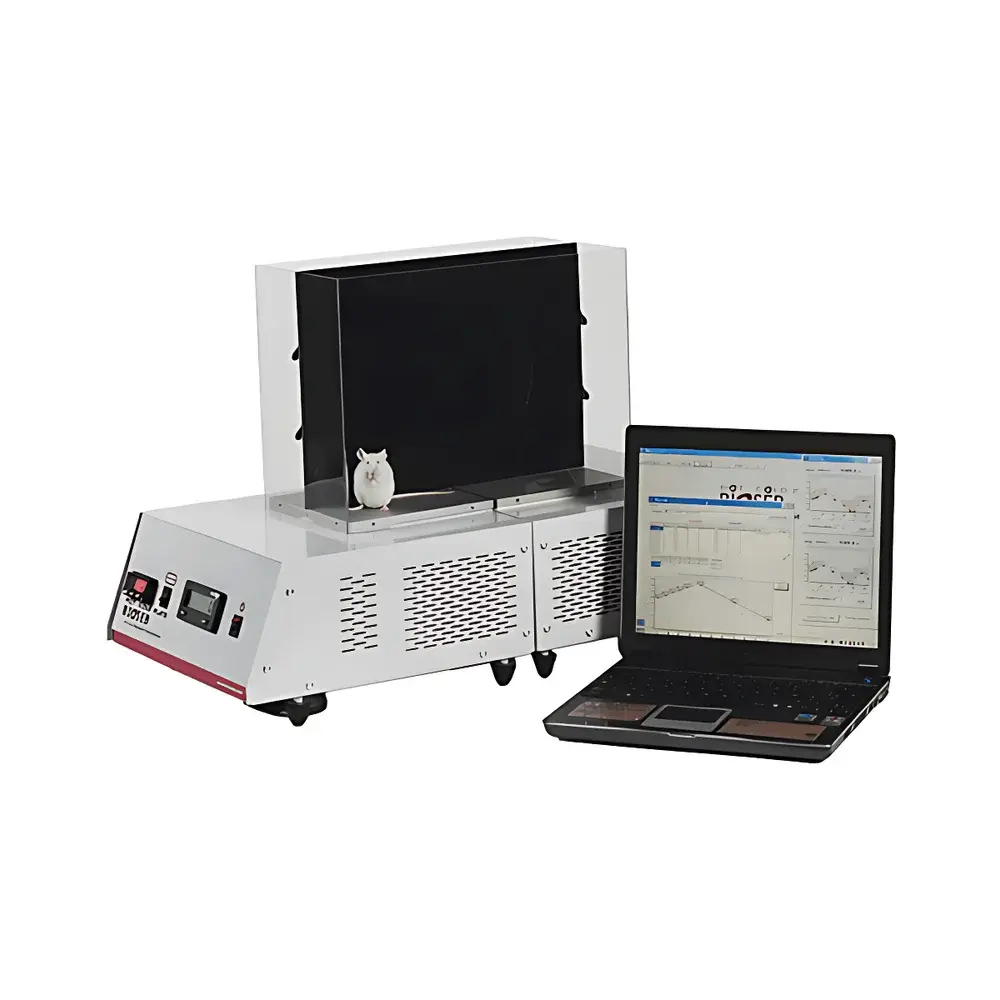
Bioseb BIO-T2CT Temperature Preference Test System
| Origin | France |
|---|---|
| Manufacturer Type | Authorized Distributor |
| Origin Category | Imported Instrument |
| Model | BIO-T2CT |
| Price Range | USD 6,800 – 13,600 (FOB Europe) |
Overview
The Bioseb BIO-T2CT Temperature Preference Test System is a validated, automated behavioral assay platform engineered for quantitative assessment of thermal nociception and thermosensory preference in rodents. Based on the principle of operant two-choice thermal discrimination, the system enables animals to freely select between two adjacent temperature-controlled zones—each independently regulated and precisely maintained—to express innate thermal preference behavior. This paradigm provides an ethologically relevant, non-invasive, and stimulus-free alternative to traditional evoked-pain assays (e.g., hot-plate, tail-flick), as it measures spontaneous thermoregulatory decisions rather than reflexive withdrawal responses. The system integrates Peltier-based thermal control, high-resolution video tracking, and timestamp-synchronized environmental logging to deliver continuous, objective, and observer-independent data on spatial occupancy, dwell time, zone transitions, and real-time thermal exposure history per subject.
Key Features
- Independent dual-zone thermal regulation: Each compartment maintains stable, programmable temperatures from 10 °C to 45 °C with ±0.3 °C accuracy and <0.1 °C drift over 60 min.
- High-fidelity video tracking: 60 fps monochrome camera with IR illumination ensures robust detection of rodent position, orientation, and movement velocity under low-light conditions.
- Automated behavioral annotation: Software identifies entry/exit events, calculates cumulative dwell time per zone, latency to first entry, and frequency of zone transitions—all aligned to precise temperature values at each frame.
- GLP-compliant data acquisition: Raw tracking logs and thermal metadata are saved in a proprietary binary format (.btp) with embedded audit trail, including operator ID, session timestamp, calibration log, and system health status.
- Export-ready analysis output: Automated generation of comma-separated (.csv) and tab-delimited (.txt) files compatible with Excel, GraphPad Prism, R, and Python-based statistical pipelines.
- Playback & verification module: Full synchronized replay of video + thermal timeline allows manual validation of automated event detection and correction of misclassified frames if required.
Sample Compatibility & Compliance
The BIO-T2CT is optimized for adult Sprague-Dawley rats (200–300 g) and C57BL/6 or BALB/c mice (20–30 g). Chamber dimensions (L×W×H: 60 × 30 × 30 cm) accommodate standard housing protocols and minimize stress-induced locomotor bias. All hardware components comply with IEC 61000-6-3 (EMC emission standards) and IEC 61010-1 (safety requirements for laboratory equipment). The software architecture supports 21 CFR Part 11 compliance when deployed with institutional electronic signature and audit trail configurations; raw data files include cryptographic hash verification to ensure integrity during GLP/GCP audits. The system meets ISO/IEC 17025 traceability requirements when used with NIST-traceable temperature calibrators.
Software & Data Management
Bioseb’s T2CT Control & Analysis Suite (v4.2+) runs on Windows 10/11 (64-bit) and features role-based user access control, session scheduling, and batch processing for multi-animal studies. Calibration routines validate thermal uniformity across each zone using embedded PT100 sensors and external reference probes. Data export includes per-subject summary metrics (e.g., % time in warm zone, preference index = [Twarm − Tcool] / [Twarm + Tcool]) and granular frame-level logs (X/Y coordinates, zone ID, ambient temperature, timestamp). All files are stored with ISO 8601-formatted filenames (e.g., “BIO-T2CT_20240522_143022_Subj07.btp”) and support DICOM-like metadata embedding for LIMS integration.
Applications
- Preclinical evaluation of analgesic efficacy in neuropathic, inflammatory, and chemotherapy-induced peripheral neuropathy models.
- Characterization of TRP channel function (e.g., TRPV1, TRPM8) via genetic knockout or pharmacological modulation.
- Thermoregulatory phenotyping in metabolic disease models (e.g., diet-induced obesity, diabetes).
- Assessment of opioid-induced hyperalgesia and tolerance development kinetics.
- Validation of CNS-penetrant thermosensory modulators in translational pain research programs.
- Supporting OECD TG 428 (skin absorption) and ICH S5(R3) reproductive toxicity studies where thermal aversion may confound endpoints.
FAQ
What temperature ranges can be set independently in each zone?
Each zone is programmable from 10 °C to 45 °C in 0.1 °C increments, with simultaneous stability maintained across both compartments.
Is the system compatible with existing lab animal monitoring infrastructure?
Yes—RS-232 and Ethernet interfaces enable synchronization with third-party systems (e.g., telemetry receivers, environmental monitors) via TTL triggers or Modbus TCP.
How is calibration traceability documented?
A quarterly calibration certificate is generated by the software, referencing NIST-traceable PT100 probes and including uncertainty budgets per ISO/IEC 17025 Annex A.3.
Can multiple animals be tested sequentially without recalibration?
Yes—the thermal stabilization time between sessions is ≤90 seconds; full recalibration is recommended every 72 hours or after ambient temperature shifts >5 °C.
Does the software support automated outlier detection during analysis?
Yes—statistical filters flag sessions with 15% frame dropout, prompting manual review before inclusion in group statistics.





