
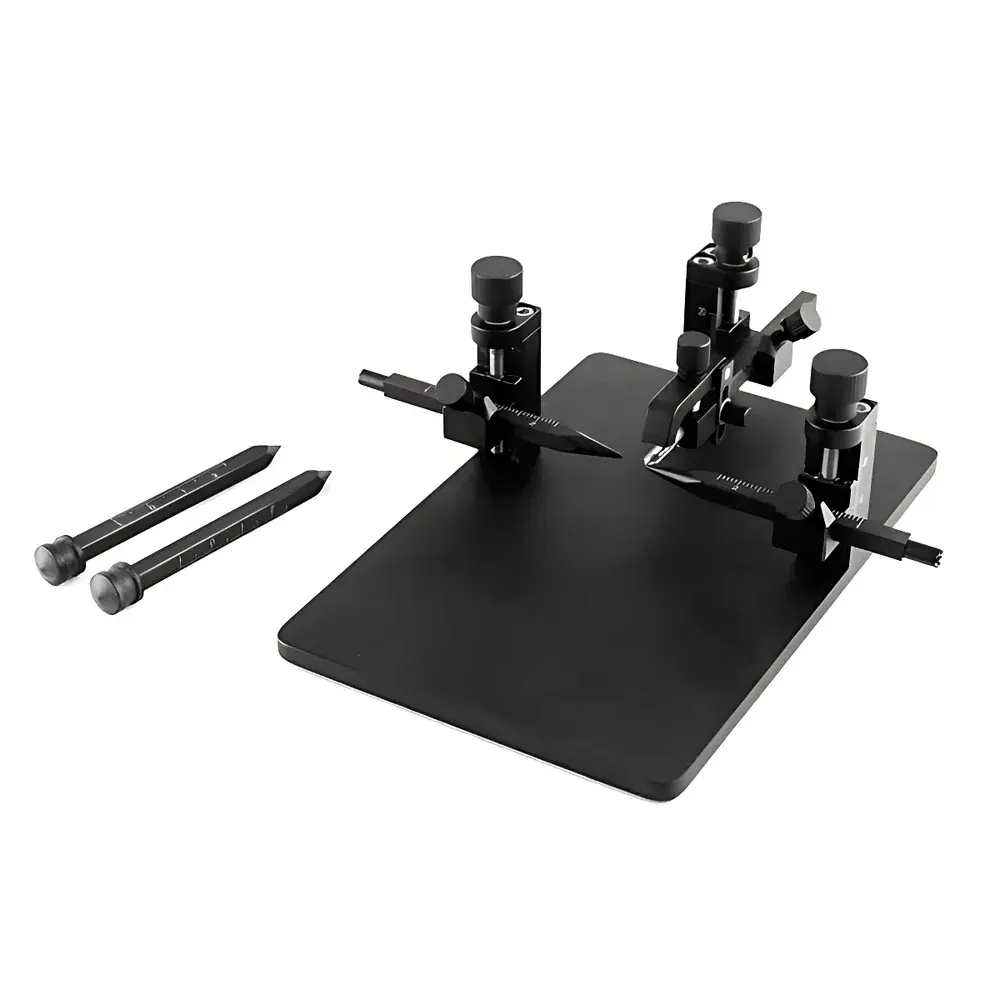
RWD 68014 Juvenile and Neonatal Mouse Adapter Kit with 18° and 45° Ear Bars
| Brand | RWD |
|---|---|
| Origin | Shenzhen, China |
| Manufacturer Type | OEM Manufacturer |
| Country of Origin | China |
| Model | 68014 |
| Pricing | Available Upon Request |
Overview
The RWD 68014 Juvenile and Neonatal Mouse Adapter Kit is an engineered stereotaxic accessory designed specifically for precise head fixation of postnatal day (PND) 0–PND 14 mice during neuroscientific procedures. Unlike standard adult rodent adapters, this system accommodates the anatomically distinct craniofacial morphology of developing pups—characterized by reduced skull thickness, elevated cranial vault height relative to the external auditory meatus, and diminished interaural distance. The adapter integrates dual-angle ear bar configurations (18° and 45°) to align the stereotaxic zero plane (bregma–lambda line) with the horizontal plane of the brain surface under physiological positioning, minimizing angular distortion during intracranial injections, electrophysiological recordings, or optical fiber implantation. Its 150 × 100 mm base plate provides stable mounting compatibility with all major stereotaxic frames—including RWD, Stoelting, and David Kopf systems—while optimizing workspace clearance for micro-manipulator access and surgical instrumentation.
Key Features
- Modular dual-angle ear bar system: Includes RWD 68315 (18° angled ear bars) and RWD 68316 (45° angled ear bars), enabling calibrated adjustment of pitch orientation to match developmental stage-specific skull geometry.
- Adjustable rostral fixation: Integrated incisor and nasal clamp with 20 mm vertical travel range ensures reproducible leveling of the skull’s dorsal surface without compressive force on the nasofrontal suture or mandibular joint.
- Low-profile base design: 150 × 100 mm footprint maintains full compatibility with standard stereotaxic floor plates while maximizing lateral access for bilateral electrode placement or multi-port cannula insertion.
- Biocompatible construction: Machined from medical-grade anodized aluminum alloy (6061-T6), resistant to autoclaving (up to 134°C, 21 psi), ethanol immersion, and repeated exposure to chlorhexidine or iodine-based antiseptics.
- Tool-free interchangeability: Ear bar cartridges feature standardized M4 threaded inserts and quick-release retention pins, allowing rapid reconfiguration between age-matched cohorts without recalibration.
Sample Compatibility & Compliance
The RWD 68014 adapter supports consistent stereotaxic alignment across C57BL/6, BALB/c, CD-1, and FVB/N juvenile strains weighing 1.2–6.8 g. Validation data confirm ≤ ±0.15 mm targeting deviation (n = 42, bregma coordinates in PND7 mice) when used with RWD 68000 series stereotaxic frames and calibrated digital vernier scales. The device conforms to ISO 13485:2016 manufacturing standards for Class I medical devices and meets ASTM F2100 Level 3 barrier performance requirements when sterilized via steam autoclave. All components are traceable to batch-specific QC reports, including dimensional inspection certificates and surface roughness verification (Ra < 0.8 µm).
Software & Data Management
While the RWD 68014 is a mechanical adapter and does not incorporate embedded electronics or firmware, it is fully interoperable with RWD Stereotaxic Suite v3.2+ software (Windows 10/11, 64-bit). This platform enables digital protocol archiving—including animal age, weight, ear bar angle selection, and clamp position settings—for GLP-compliant experiment documentation. Audit trails log user ID, timestamp, and configuration parameters per session, satisfying FDA 21 CFR Part 11 requirements for electronic records in preclinical research environments.
Applications
- Intracerebroventricular (ICV) and intraparenchymal microinjections in neonatal mouse models of neurodevelopmental disorders (e.g., Rett syndrome, Fragile X).
- Chronic cortical EEG electrode implantation with minimal dural trauma in PND5–PND10 pups.
- Two-photon imaging-guided thalamocortical axon tracing using cranial window preparations.
- Optogenetic fiber optic cannula implantation in deep midbrain structures (e.g., superior colliculus, periaqueductal gray).
- Longitudinal stereotaxic surgery across multiple postnatal timepoints within the same litter cohort.
FAQ
What age range of mice is the RWD 68014 adapter validated for?
The adapter is optimized for mice aged postnatal day 0 (PND0) through PND14, with empirical validation performed on PND3, PND7, and PND10 cohorts.
Can the 18° and 45° ear bars be used interchangeably across different strains?
Yes—strain-specific optimization is achieved via angle selection: 18° is recommended for C57BL/6 pups (flatter cranial profile), while 45° improves stability in BALB/c and CD-1 neonates with steeper occipital slopes.
Is the adapter compatible with non-RWD stereotaxic frames?
Yes—the base plate uses industry-standard ¼”-20 threaded mounting holes spaced at 75 mm center-to-center, ensuring mechanical interoperability with Stoelting 51600, David Kopf 1900, and Leica Angle Two systems.
Does the incisor/nasal clamp accommodate weight-based adjustment protocols?
No—vertical adjustment is manually calibrated via micrometer collar; however, the 20 mm travel range allows direct correlation with pup weight (e.g., 4 mm clamp height ≈ 2.3 g, 12 mm ≈ 4.7 g) using RWD’s published calibration chart.
Are replacement ear bars available as standalone components?
Yes—RWD 68315 (18°) and RWD 68316 (45°) ear bars are sold individually with serialized lot tracking for replacement or expansion of multi-angle kits.





